
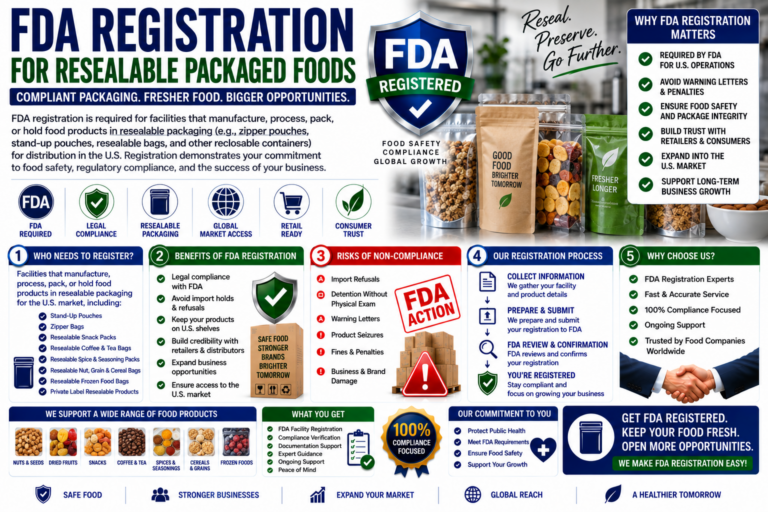
FDA Registration for Resealable Packaged Foods
The dual-column trigger, the closure as a food-contact component, and why a reseal isn't a hermetic seal.
Key Takeaways
- Dual-column often applies — packs at 200–300% of the reference amount need both columns.
- Per serving + per container — the two columns dual-column requires.
- The closure is a food-contact component — the zipper or cap must be a cleared FCS.
- Resealable ≠ hermetically sealed — a reseal isn't an airtight, shelf-stable seal.
- It can't anchor canned-food safety — LACF still needs a hermetic seal + scheduled process.
- "After opening" statements — refrigerate or use-within, where safety depends on it.
Dual-Column Nutrition Facts
Resealable packs are the classic case for dual-column labeling, because they're so often sized to be eaten in one sitting or resealed for later. The trigger is the package size relative to the reference amount (RACC) for the product:
| Package size vs reference amount | Nutrition Facts format |
|---|---|
| Under 200% of the RACC, sold individually | Single serving — the whole package is one serving |
| 200% to 300% of the RACC (could be one sitting or resealed for later) | Dual-column — per serving and per container |
| Over 300% of the RACC | Standard multi-serving — per serving, with servings per container |
The Closure Is a Food-Contact Component
It's tempting to think of the reseal as "just the zipper," but the zipper track, press-to-close seal, screw cap, or snap lid contacts the food — so it's a food-contact component, and its materials must be a cleared food contact substance for the conditions of use, exactly like the rest of the package.
Resealable Is Not Hermetically Sealed
This is the point that carries real safety weight. A resealable closure lets a consumer reopen and reclose the package for convenience — it does not create or restore a hermetic (airtight, tamper-evident) seal.
And once a package is opened, its original protection — sterility, modified atmosphere, or barrier — is broken. Reclosing slows air and moisture, but it doesn't turn an opened perishable food back into a sealed, protected one.
Storage Statements & Freshness Claims
Because a reseal changes what happens after opening, the label often has to address it:
- "Refrigerate after opening" — when a product is shelf-stable sealed but perishable once opened
- "Use within X days of opening" — when quality or safety declines after the seal is broken
- "Reseal to maintain freshness" — a truthful description of the reseal's actual benefit
- Keep freshness claims honest — a reseal slows air and moisture; it doesn't make an opened perishable product shelf-stable
Get Your Resealable Product Compliant
FDA Registration Assistance handles facility registration and U.S. Agent, and reviews the resealable-specific points — whether dual-column Nutrition Facts apply for your package size and reference amount, the closure as a food-contact component, after-opening storage statements, and freshness claims — plus process filing if your product is a low-acid canned or acidified food.
Contact us at info@fdaregistrationassistance.com or call +1 (928) 275-8333. Food Facility Registration is available starting at $858. Trusted by companies across 135+ countries, with 15+ years of experience.
Frequently Asked Questions
1. Do resealable packaged foods need FDA registration?
The facility that manufactures, processes, packs, or holds the food registers with FDA, and foreign facilities need a U.S. Agent — that's the same as any packaged food. The reseal feature doesn't change registration. What it does change are some specific labeling and packaging points: how the Nutrition Facts are formatted, the closure as a food-contact component, and what has to be said about storage after opening.
2. Why do resealable packages often need dual-column Nutrition Facts?
Because resealable packs are frequently sized so they could be eaten in one sitting or resealed for later. Under FDA's rules, a package (or unit) that contains at least 200% and up to and including 300% of the reference amount — one that could reasonably be consumed in one sitting or multiple sittings — must use dual-column labeling: one column per serving and one column per container. Resealable snack bags and pouches land in this range constantly, which is why the format comes up so often.
3. What is dual-column labeling?
It's a Nutrition Facts format with two columns: the left shows the values for a single serving, and the right shows the values for the entire container. It's required (with limited exceptions) for packages containing 200% to 300% of the reference amount, under 21 CFR 101.9(b)(12). The idea is that if someone might eat the whole thing at once, they can see both what a serving contains and what the full package contains.
4. When is a resealable package a single serving instead?
If the package is sold individually and contains less than 200% of the reference amount, it's treated as a single-serving container and the entire contents are labeled as one serving — even if it's resealable. Above 300% of the reference amount, it's a standard multi-serving package labeled per serving with servings per container. It's the 200–300% middle band that triggers dual columns, and resealable packs frequently fall there.
5. Is the reseal closure itself regulated?
Yes — the zipper, press-to-close track, screw cap, or snap lid contacts the food, so it's a food-contact component and must be a cleared food contact substance, just like the rest of the package. A closure added to an otherwise-compliant package still has to be made of materials cleared for food contact under the conditions of use. It's easy to overlook the closure as "just the zipper," but it touches the food.
6. Is a resealable package the same as hermetically sealed?
No, and this is important. A resealable closure lets a consumer reopen and reclose the package — it does not create or restore a hermetic (airtight, tamper-evident) seal. So a resealable feature can't be the basis for the shelf stability of a low-acid canned food, which depends on a true hermetic seal plus a scheduled process. Resealable is about convenience after opening, not about the sterility or shelf-stable safety of the sealed product.
7. Does resealable packaging change shelf-stable or canned-food rules?
It doesn't relax them. If your product is a low-acid canned or acidified food, it still needs a hermetically sealed container and a scheduled process (FCE/SID) for its shelf stability — a reseal feature doesn't substitute for that. Often the reseal is a secondary outer feature, or the product isn't shelf-stable in the first place. The safety basis of the sealed product and the convenience of reclosing are two separate things.
8. What storage information does a resealable package need?
If the food's safety or quality depends on how it's handled after opening, the label should say so — for example, "Refrigerate after opening," "Use within X days of opening," or "Reseal to maintain freshness." Once opened, the original protection is broken, so any instruction needed to keep the product safe or of acceptable quality after opening has to be clear and truthful. Misleading freshness claims are a risk here.
9. Can I claim the reseal "keeps food fresh"?
You can describe a reseal's benefit, but the claim has to be truthful and not misleading. A reseal can slow moisture or air exposure after opening, but it doesn't restore the original barrier or sterility, and it doesn't extend the safe life of a perishable food indefinitely. Overstating what the reseal does — implying it makes an opened perishable product shelf-stable, for instance — is the kind of claim that draws scrutiny.
10. Do imported resealable products follow the same rules?
Yes. Imported resealable packaged foods must meet the same FDA labeling and packaging rules, and the importer holds FSVP. That includes the dual-column format where it applies, a closure made of cleared food-contact materials, and any needed after-opening storage statements — all in U.S. format. A resealable pack designed for another market often needs its label rebuilt before import.
11. What if the package has multiple discrete units and is resealable?
Then you combine the rules: how the units and container relate to the reference amount drives the serving-size and column format (single serving, dual column, or multi-serving), and the resealable closure is still a food-contact component. A resealable bag of individually wrapped pieces, for example, may raise both discrete-unit serving questions and the reseal points. Mapping the product to the right serving-size rule comes first.
12. Does registration mean FDA approved my resealable product?
No. FDA doesn't pre-approve food, packaging, or facilities — registration just puts the facility on record. It doesn't certify your Nutrition Facts format, your closure materials, or your storage claims; those remain your responsibility. The resealable product still has to meet all applicable labeling, food-contact, and (if canned or acidified) process-filing requirements.
13. What are the common mistakes with resealable packages?
Using a single-serving or standard label when dual-column is required (or vice versa); overlooking the closure as a food-contact component; assuming a reseal makes a product shelf-stable or hermetically sealed; missing "refrigerate after opening" or similar statements; and overstating freshness claims. Most trace back to treating the reseal as purely a marketing feature rather than something with labeling and packaging consequences.
14. How does FDA Registration Assistance help with resealable products?
We handle facility registration and U.S. Agent, and review the resealable-specific points: whether dual-column Nutrition Facts apply based on your package size and reference amount, the closure as a food-contact component, after-opening storage statements, and any freshness claims — plus process filing if the product is a low-acid canned or acidified food. Starting at $858 for registration, for companies across 135+ countries. Contact info@fdaregistrationassistance.com or +1 (928) 275-8333.