
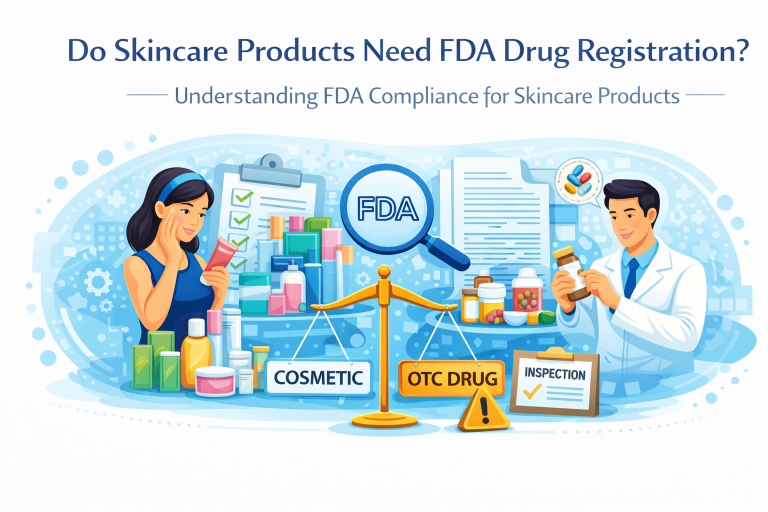
Do Skincare Products Need FDA Drug Registration?
When skincare stays a cosmetic, when a claim turns it into a drug, the anti-aging gray zone, and where skin lighteners now stand.
Key Takeaways
- Most skincare is a cosmetic — no drug registration (but MoCRA applies).
- A drug claim or drug active flips it — then it's an OTC drug.
- Anti-aging is the gray zone — appearance = cosmetic; structure/function = drug.
- No anti-aging monograph — a real anti-aging drug claim needs an NDA.
- Acne, SPF & skin protectants have monographs — drugs, but no NDA needed.
- OTC hydroquinone lighteners are out — unapproved new drugs since 2020.
It Comes Down to the Claim
FDA classifies skincare by intended use, and for skincare that's almost always established by the claims. A cosmetic claim is about appearance and cleansing; a drug claim is about treating a condition or affecting the skin's structure or function. The same serum can be either — the words decide.
Appearance (Cosmetic) vs Structure/Function (Drug)
Anti-aging is where skincare most often crosses into drug territory. A product intended to affect the skin's structure or function is a drug — even though the point is appearance:
| Cosmetic-safe claim (appearance) | Drug-triggering claim (structure/function) |
|---|---|
| Reduces the appearance of wrinkles | Removes / diminishes wrinkles |
| Skin looks firmer / plumper | Stimulates / boosts collagen production |
| Improves the look of skin texture | Repairs / restores the skin barrier |
| Smooths & moisturizes | Regenerates skin / boosts cell renewal |
| Brightens the look of dull skin | Treats / lightens hyperpigmentation |
The Common OTC-Drug Skincare Categories
| Skincare product | Why it's a drug | Pathway |
|---|---|---|
| Acne treatment | Salicylic acid, benzoyl peroxide, sulfur | OTC monograph |
| Sunscreen / SPF | Sun-protection claim | OTC monograph |
| Skin protectant (chapped/irritated skin) | Allantoin, dimethicone, petrolatum, zinc oxide | OTC monograph |
| Antiperspirant | Reduces sweating (structure/function) | OTC monograph |
| Anti-aging with structure/function claims | Affects collagen / skin structure | Needs an NDA (no monograph) |
| Skin lightener (hydroquinone) | Affects pigmentation | Needs an NDA — not OTC |
Skin Lighteners: OTC Hydroquinone Is No Longer Allowed
Skin-lightening/brightening is a big skincare segment — and a specific compliance trap. OTC skin-lightening products containing hydroquinone are now unapproved new drugs. The CARES Act finalized their status, and effective September 23, 2020, unapproved OTC skin lighteners had to come off the U.S. market.
- All OTC skin lighteners now require an approved NDA — there are no FDA-approved or legally marketed OTC skin-lightening drugs
- Only a prescription product (Tri-Luma) is approved — for short-term melasma, under a doctor's supervision
- FDA has issued warning letters — to companies still selling OTC hydroquinone lighteners
- Mercury is a separate hazard — FDA has warned that some skin lighteners contain illegal mercury
Cosmetic (MoCRA) or OTC Drug
- If it's a cosmetic — MoCRA facility registration, product listing, safety substantiation, and labeling; no drug registration; renews every two years
- If it's an OTC drug — drug establishment registration (21 CFR 207), NDC listing (SPL), monograph or NDA, Drug Facts labeling, cGMP, OMUFA, U.S. Agent (foreign), annual renewal
- If it's both (e.g., SPF moisturizer) — you carry both sets of requirements
Get Your Skincare Classified & Compliant
FDA Registration Assistance reviews your skincare product's claims and ingredients to classify it as a cosmetic, an OTC drug, or both, and then handles the resulting pathway — MoCRA cosmetic obligations, or OTC drug registration, NDC listing, Drug Facts label review, and U.S. Agent for foreign firms. We also flag high-risk claims (anti-aging structure/function, skin lightening) before they become a problem.
Contact us at info@fdaregistrationassistance.com or call +1 (928) 275-8333 for a quote. An independent compliance firm serving 1,000+ companies across 135+ countries, with 15+ years of experience.
Frequently Asked Questions — Skincare & FDA
1. Do skincare products need FDA drug registration?
Only if they're drugs. Most skincare is a cosmetic - moisturizers, cleansers, serums, toners that cleanse or improve appearance - and cosmetics don't need drug registration (though they do have MoCRA obligations). A skincare product becomes an OTC drug the moment it makes a drug claim (treats a condition or affects the skin's structure/function) or uses a drug active ingredient - and then it needs the full OTC drug apparatus.
2. What makes a skincare product a drug instead of a cosmetic?
The claims. Cosmetic claims are about appearance and cleansing ("moisturizes," "reduces the appearance of fine lines," "improves the look of skin"). Drug claims are about treating a condition or affecting the skin's structure or function ("treats acne," "stimulates collagen," "repairs the skin barrier," "protects from sunburn"). FDA reads the claim, not your intent - and the same base cream can be either, depending on how you describe it.
3. Are anti-aging and anti-wrinkle products drugs?
It depends on the claim, and this is skincare's biggest gray zone. A product that says it "reduces the appearance of wrinkles" or "moisturizes to smooth skin" is a cosmetic. But a product intended to "remove wrinkles" or "increase the skin's production of collagen" - anything affecting the skin's structure or function - is a drug, even though the effect is on appearance. FDA has specifically flagged anti-aging skincare with structure/function claims.
4. Is there an OTC monograph for anti-aging products?
No - and that's the trap. Acne, sunscreen, and skin-protectant skincare have OTC monographs, so a compliant product can be marketed without a new-drug application. There is no monograph for anti-aging/anti-wrinkle, so a skincare product that makes a genuine anti-aging drug claim (like boosting collagen) would need an approved NDA/ANDA - a costly, lengthy route. That's why anti-aging is usually kept to cosmetic (appearance) claims.
5. Which skincare products are OTC drugs?
The common ones: acne treatments (salicylic acid, benzoyl peroxide, sulfur), sunscreens and SPF products, skin protectants (allantoin, dimethicone, petrolatum, zinc oxide - for chapped/irritated skin), antiperspirants, and dandruff/scalp treatments. Each is a drug because it treats a condition or affects the body, and each has an OTC monograph. A moisturizer or serum with SPF becomes a drug/cosmetic combination.
6. Can I sell a skin-lightening (hydroquinone) product OTC?
No. OTC skin-lightening products containing hydroquinone are now unapproved new drugs. The CARES Act finalized their status, and effective September 23, 2020, unapproved OTC skin lighteners had to come off the market - all OTC skin lighteners now require an approved NDA to be legally marketed, and FDA has issued warning letters to companies still selling them. The only FDA-approved hydroquinone product is a prescription drug (Tri-Luma) for short-term melasma. FDA has also warned about mercury in some skin-lightening products.
7. What are "structure or function" claims?
Claims that a product changes how the body (here, the skin) works or is built - not just how it looks. In skincare: "stimulates collagen production," "repairs the skin barrier," "boosts cell renewal," "restores elasticity," "regenerates skin." These are drug claims. The cosmetic-safe versions describe appearance instead: "improves the look of skin texture," "skin looks firmer," "reduces the appearance of lines." The wording is the whole difference.
8. If my skincare is a cosmetic, what do I have to do?
Cosmetics don't need FDA premarket approval or drug registration, but under MoCRA they need facility registration, product listing, safety substantiation, a responsible person, and adverse-event reporting, plus truthful labeling. So "cosmetic" isn't "no rules" - it's a different (lighter) set of rules than the drug pathway. Cosmetic facility registration renews every two years.
9. If my skincare is a drug, what do I have to do?
The OTC drug apparatus: drug establishment registration (21 CFR Part 207), an NDC drug listing (SPL), compliance with the applicable OTC monograph (or an approved NDA), a Drug Facts label, cGMP, OMUFA facility fees, a U.S. Agent for foreign facilities, and an annual renewal. It's a substantially heavier load than the cosmetic path - which is why classifying the product correctly up front matters so much.
10. Can a moisturizer be a drug?
Yes - if it makes a drug claim or adds a drug active. A plain moisturizer that hydrates is a cosmetic. Add an SPF/sun-protection claim and it's a drug (or a drug/cosmetic combination); claim it "treats eczema" or "repairs the skin barrier" and it's a drug. Same jar, different category, decided by the words and the actives.
11. Do "natural," "clean," or "cosmeceutical" labels change the rules?
No. "Cosmeceutical" has no legal status, and "natural"/"clean" don't affect classification. If your claims or ingredients give the product a drug intended use, it's a drug regardless of the marketing language. These terms describe positioning, not regulatory category.
12. Do foreign skincare brands need a U.S. Agent?
For the drug side, yes - a foreign OTC drug (e.g., an SPF or acne product) establishment must designate a U.S. Agent (21 CFR 207.69). MoCRA also has a U.S.-based responsible-person role for cosmetics. If your skincare is "both" (say, an SPF moisturizer), you'll handle the drug U.S. Agent requirement as part of the OTC registration.
13. What happens if I misclassify my skincare product?
A skincare product with drug claims but no drug registration/listing/Drug Facts is misbranded - and if it's a "new drug" (like an anti-aging structure/function claim or an OTC hydroquinone lightener) without an approved application, it's also an unapproved new drug. That exposes you to warning letters, import refusal and detention, and marketplace removal. Skincare draws a lot of FDA claim scrutiny.
14. Are AHAs, retinol, or peptides drugs?
It depends on the claims made, not the ingredient name alone. Cosmetic exfoliation/appearance claims can keep an AHA or retinol product a cosmetic; but claims that the ingredient changes the skin's structure or function (rebuilds collagen, repairs cells) push it toward drug status - and there's no anti-aging monograph to fall back on. FDA has scrutinized AHA products specifically. The safe path is appearance-based wording, reviewed before launch.
15. How do I get my skincare product classified?
Review the intended-use claims and ingredients before the label and marketing are finalized. Map each claim as cosmetic (appearance) or drug (treat/structure-function), check for drug actives (SPF filters, salicylic acid, hydroquinone), and confirm whether any drug element fits a monograph or would need an NDA. Then follow the right pathway - MoCRA for cosmetics, the OTC apparatus for drugs. Doing this first prevents relabels and enforcement.
16. How does FDA Registration Assistance help with skincare?
We review your skincare product's claims and ingredients to classify it as a cosmetic, an OTC drug, or both, and then handle the resulting pathway: MoCRA cosmetic obligations, or OTC drug establishment registration, NDC listing, Drug Facts label review, and U.S. Agent for foreign firms. We also flag high-risk claims (anti-aging structure/function, skin lightening) before they become a problem. We're an independent compliance firm serving 1,000+ companies across 135+ countries with 15+ years of experience. Contact info@fdaregistrationassistance.com or +1 (928) 275-8333.
