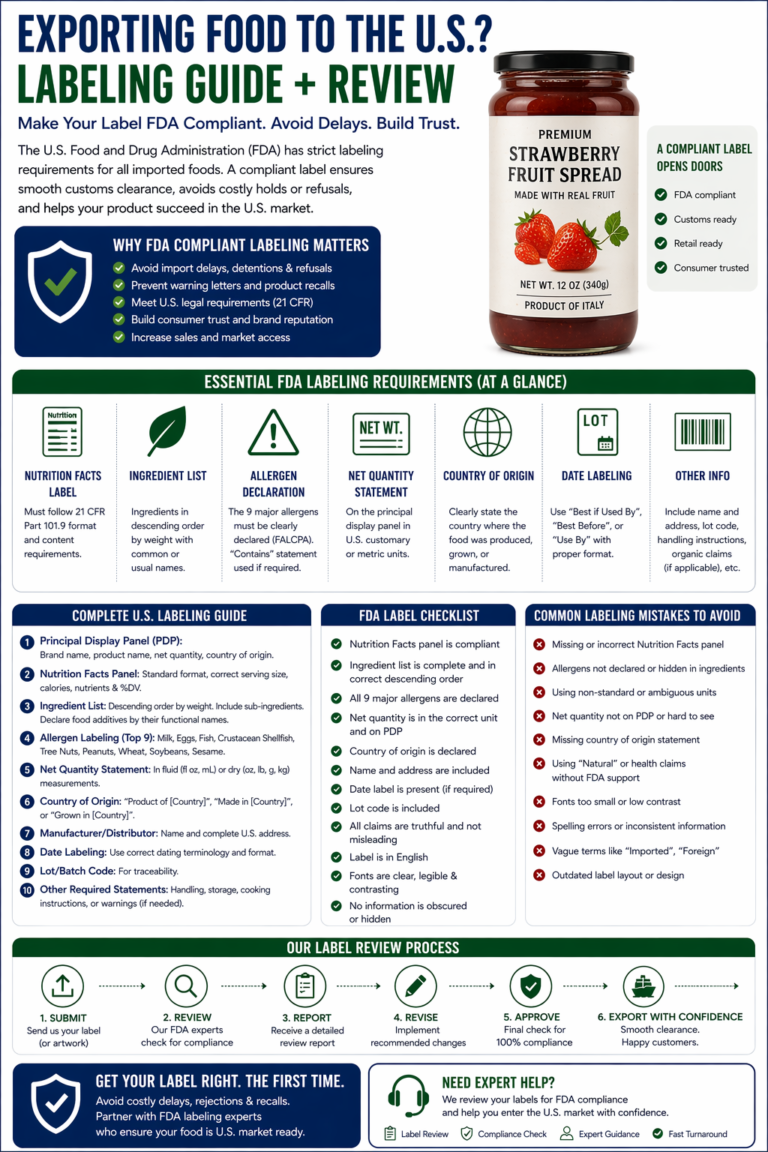
Exporting Food to the U.S.: Labeling Guide
If you built your label for another market, it almost certainly needs rebuilding for the U.S. Here's what changes, the exporter-specific pitfalls, and how labeling connects to the rest of the import process.
Key Takeaways
- Same rules as domestic: imported food meets the full requirements of 21 CFR Part 101 — no reduced standard for imports.
- English required: all mandatory information in English; if another language appears, all required info must appear in it too.
- U.S. responsible firm: the label must name a U.S. importer/distributor (qualified, e.g. "Imported by"), not just a foreign address.
- Country of origin: required by U.S. Customs — accurate, in English, clearly visible.
- Labeling is one gate: you also need facility registration, a U.S. Agent, an importer FSVP, and Prior Notice per shipment.
- Rebuild, don't adapt: foreign Nutrition formats, serving sizes, ingredient names, and metric-only weights all fail U.S. rules.
Where Labeling Fits in the Import Process
Labeling is one requirement in a sequence. Here's the full path a food shipment travels — with labeling as the gate this guide focuses on:
Facility registration + U.S. Agent
The foreign facility must hold an active FDA Food Facility Registration and designate a U.S. Agent. Renewed biennially (Oct 1–Dec 31, even years).
Importer's FSVP
The U.S. importer generally must maintain a Foreign Supplier Verification Program — their legal obligation, but it needs your facility documentation.
Prior Notice (every shipment)
Electronic notice to FDA before the shipment arrives, referencing the facility's registration number — filed with the CBP entry.
Label compliance (21 CFR Part 101)
Statement of identity, net quantity (U.S. + metric), ingredient list, allergen declaration, current Nutrition Facts, U.S. responsible firm — all in English.
Country-of-origin marking
Required by U.S. Customs — accurate, in English, clearly visible on the label.
Entry & FDA review
CBP entry + FDA risk targeting. FDA may do a document review, physical exam, or lab analysis. Problems → detention, refusal, or Import Alert.
The Required Elements — and Where to Go Deep
Every imported label needs these elements. Rather than repeat the full rules here, this table summarizes each and links to the deep guide:
| Element | What exporters miss | Deep guide |
|---|---|---|
| Statement of identity | Marketing name instead of the common food name | Labeling requirements |
| Net quantity | Metric-only — U.S. needs both U.S. + metric units | Labeling requirements |
| Ingredient list | Missing sub-ingredients; non-FDA ingredient names | Ingredient list |
| Allergens | No specific source names; sesame omitted | Allergen labeling |
| Nutrition Facts | Foreign format; serving size not a U.S. reference amount | Labeling requirements |
| Responsible firm | Foreign address only; no U.S. importer named | See below |
The Three Requirements Unique to Imported Labels
English language
All mandatory information must be in English. If your label also carries another language, all required information must appear in that language too. A home-market-language-only label is a frequent detention trigger.
U.S. responsible firm
The label must name the manufacturer, packer, or distributor — and for imports, the U.S. importer or distributor is identified, qualified with "Imported by" or "Distributed by." A foreign address alone is not enough.
Country of origin
A U.S. Customs requirement (not an FDA label rule, but still mandatory): the product's country of origin must be marked accurately, in English, and clearly visible.
What Happens at the U.S. Port
Detention
The shipment is held for review while storage fees accrue and your supply chain slips.
Relabel under supervision
Sometimes permitted — but slow, costly, and done under FDA supervision.
Refusal
If the issue is significant, the shipment is refused and must be re-exported or destroyed.
Import Alert (DWPE)
Repeated problems can place your product on an Import Alert — future shipments detained without physical exam until you prove compliance.
How to Prepare Your Label for Export
Rebuild to U.S. rules — don't adapt
Start from FDA requirements. Nutrition Facts format, serving size, ingredient naming, and net-quantity units all differ from other markets.
Put everything mandatory in English
And if another language appears, mirror all required information in it.
Name a U.S. responsible firm + country of origin
Identify the U.S. importer/distributor ("Imported by"), and mark country of origin per U.S. Customs.
Verify ingredients, allergens, Nutrition Facts
Confirm each against 21 CFR Part 101 — including sub-ingredients, allergen sources, and a U.S. serving size.
Line up the rest of the import file
Active registration + U.S. Agent, the importer's FSVP where required, and Prior Notice per shipment.
Review before printing
Confirm the label with a professional review before the print run — relabeling at the port is the expensive path.
Get Export-Ready Before You Ship
FDA Registration Assistance rebuilds and reviews export labels against 21 CFR Part 101 — and can handle everything around it: Food Facility Registration, U.S. Agent designation, biennial renewal, and guidance on FSVP and Prior Notice — so the label and the import file are both right the first time.
Contact us at info@fdaregistrationassistance.com or call +1 (928) 275-8333. Trusted by 1,000+ clients across 135+ countries, with 15+ years of FDA experience.
Frequently Asked Questions — Exporting Food to the U.S.
1. Do imported food products follow the same FDA labeling rules as U.S. products?
Yes — exactly the same, with no reduced standard for imports. Imported food must meet the full 21 CFR Part 101 requirements: statement of identity, net quantity (U.S. + metric), ingredient list, allergen declaration, a current-format Nutrition Facts panel, and the responsible firm — all in English.
2. Do I need to change my label to export to the U.S.?
In most cases, yes. Labels built for other markets usually fail because the Nutrition Facts format, serving size, ingredient naming, allergen rules, and units differ. Rebuilding to FDA rules is more reliable than adapting a foreign label.
3. Does my label have to be in English?
Yes. All mandatory information must be in English, and if another language also appears, all required information must appear in it too. A home-language-only label is a common detention trigger.
4. Who is the "responsible firm" on an imported label?
The manufacturer, packer, or distributor — and for imports, the U.S. importer or distributor is named, qualified with "Imported by" or "Distributed by." A foreign address alone is a frequent gap.
5. Is country-of-origin marking required?
Yes — by U.S. Customs (not FDA's label rules), and it must be accurate, in English, and clearly visible. Missing origin marking is a common cause of delay and relabeling.
6. How does labeling fit with the other import requirements?
It's one gate among several. You also need facility registration + a U.S. Agent, an importer FSVP, and Prior Notice per shipment. A perfect label won't clear a shipment missing registration or Prior Notice, and perfect paperwork won't save a bad label.
7. What is Prior Notice, and do I need it?
An electronic notice filed with FDA before an imported food shipment arrives, referencing the facility's registration number. It's required for essentially every FDA food import and is usually filed with the CBP entry. It's separate from label compliance.
8. What is FSVP, and is it my responsibility as the exporter?
The Foreign Supplier Verification Program requires the U.S. importer to verify suppliers meet U.S. safety standards. It's the importer's obligation, not the exporter's — but they need documentation about your facility. Seafood and juice under HACCP have modified FSVP.
9. Does my facility need to be registered to export food to the U.S.?
Yes. A foreign facility making, processing, packing, or holding food for U.S. consumption must have an FDA Food Facility Registration and a U.S. Agent, renewed biennially (Oct 1–Dec 31, even years). A lapsed registration blocks shipments.
10. What's the most common reason export labels are rejected?
Usually several small errors at once: a foreign-format Nutrition Facts panel, a non-U.S. serving size, metric-only net weight, missing sub-ingredients or allergen sources, no English text, no U.S. responsible firm, or missing country of origin.
11. Is a Nutrition Facts panel required on exported food?
Most packaged foods require a current-format panel. Small-business exemptions exist but are strict and often impractical, and many U.S. retailers require a panel anyway. The serving size must match the FDA reference amount, not a foreign serving.
12. How detailed does my ingredient list need to be?
Every ingredient by common name in descending order by weight, including sub-ingredients. Foreign labels commonly fail on missing sub-ingredients and non-FDA names. See our ingredient list guide.
13. How must allergens be declared for U.S. import?
The source of each of the 9 major allergens must be declared, in the ingredient list or a "Contains" statement, with specific source names. Sesame has been required since Jan 1, 2023 and is often missing. See our allergen guide.
14. Do I need both U.S. and metric units for net weight?
Yes — both, on the front panel. Metric-only, common on foreign labels, is a frequent error.
15. Are claims like "natural," "organic," or "healthy" allowed?
Yes, if truthful, not misleading, and meeting FDA criteria. "Healthy" has a defined meaning, nutrient claims have thresholds, and "organic" requires USDA certification. Claims accepted in your home market may not meet U.S. rules.
16. What happens if my label isn't compliant on arrival?
The shipment can be detained (with storage fees), you may relabel under supervision, or it can be refused and re-exported or destroyed. Repeated issues can lead to an Import Alert.
17. What is an Import Alert?
It lets FDA detain shipments of a product — from a firm or country — without examining each one (Detention Without Physical Examination). Removal requires demonstrating sustained compliance.
18. Can I fix my label after the product has shipped?
Sometimes, but it's expensive and slow — held at the port with fees, relabeling under supervision, or refusal. Fixing before printing and shipping is always better.
19. How long does an FDA label review take?
Typically 2–3 business days, depending on product complexity and the number of ingredients and claims.
20. What's the risk of exporting without a label review?
Significant — delay, detention, or refusal, plus financial loss, supply-chain disruption, and brand damage, with repeated violations risking an Import Alert. A pre-export review is cheap by comparison.
21. Should I fix labeling before or after arranging shipping?
Before. Confirm the label plus registration, U.S. Agent, importer FSVP, and Prior Notice before printing labels and booking cargo.
22. Do imported labels get more scrutiny than domestic ones?
FDA and CBP use risk-based targeting on the importer's and country's history, the commodity, prior exams, and Import Alerts. A clean record means smoother entry; past violations increase scrutiny — a reason to get everything right from the first shipment.
23. How does FDA Registration Assistance help exporters?
FDA Registration Assistance rebuilds and reviews export labels against 21 CFR Part 101 and can handle the surrounding requirements — Food Facility Registration, U.S. Agent, biennial renewal, and FSVP/Prior Notice guidance — for exporters in 135+ countries.
24. How do I get my export label reviewed?
Contact FDA Registration Assistance at info@fdaregistrationassistance.com or call +1 (928) 275-8333. Provide your label artwork, full formulation, and product details for review before you print and ship.