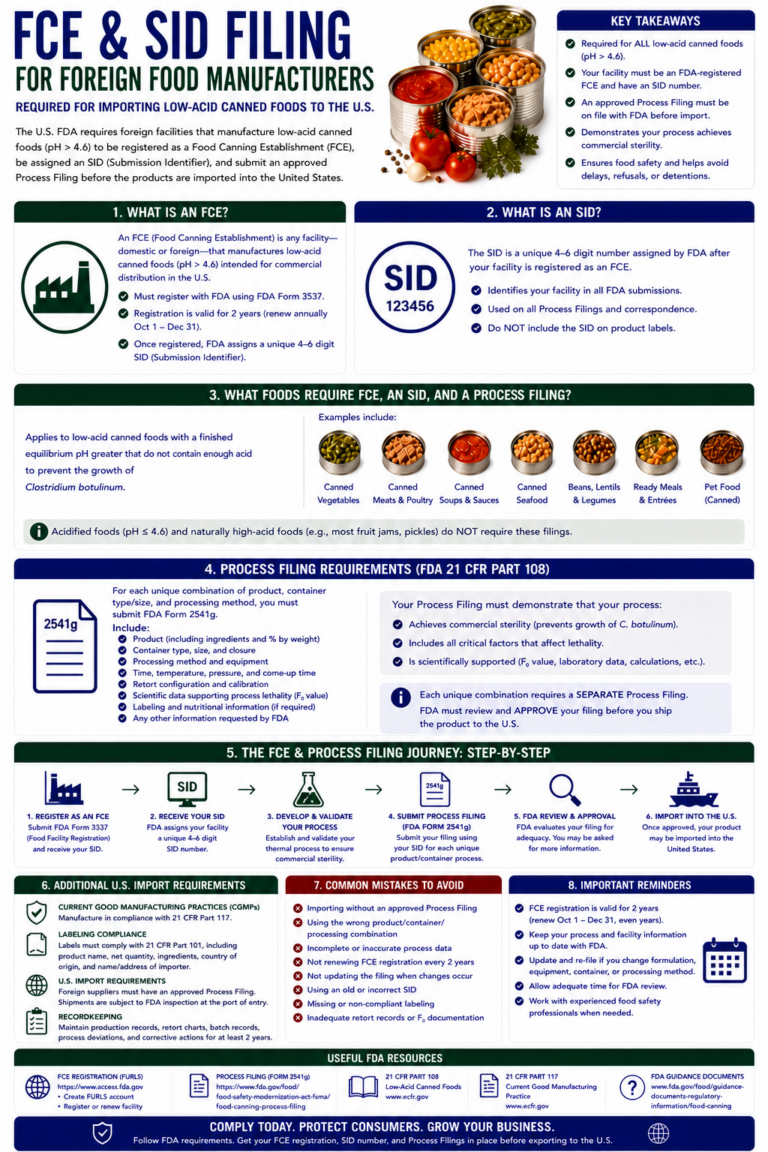
FCE & SID Filing for Foreign Food Manufacturers
Who files what, which form applies to your product, and what you need to file from outside the U.S.
Key Takeaways
- You file, not your importer — FCE and SID are the manufacturer's responsibility.
- FCE is Form 2541 — filed first, one per plant.
- The SID form depends on your process — 2541d, 2541e, 2541f, or 2541g.
- Each product needs its own SID — often each container and formula too.
- Filing from abroad needs a U.S. Agent — plus a process authority.
- The importer relies on your filings — for their FSVP.
Who Files, Who Relies On It
A common and costly assumption is that the U.S. importer handles the process filings. They don't — they can't. Here's how the responsibilities actually split:
| Party | Responsible for |
|---|---|
| You — the foreign manufacturer (or your FDA agent) | Files FCE and the scheduled process (SID) for each product; engages a process authority; appoints a U.S. Agent |
| Your U.S. importer | Relies on your FCE and SID for their FSVP; is the owner or consignee at entry |
| Customs broker | Files prior notice and the customs entry before arrival |
Which Form Do You File?
FCE registration uses one form; the scheduled process uses the form that matches how your product achieves safety. You file the SID form that fits each product:
| Filing | Form | Use it for |
|---|---|---|
| FCE registration | 2541 | Registering the canning establishment — filed first, one per plant |
| Scheduled process — low-acid retorted | 2541d | Low-acid canned foods processed by retort (heat sterilization) |
| Scheduled process — acidified method | 2541e | Acidified foods (added acid to pH ≤ 4.6) — pickles, hot sauces, salsas |
| Scheduled process — water activity / formulation | 2541f | Products controlled by water activity or formulation rather than heat |
| Scheduled process — low-acid aseptic | 2541g | Low-acid foods processed and packaged aseptically |
What You Need in Place
Before you can file as a foreign manufacturer, four things have to be ready:
- Active Food Facility Registration — your facility on record with FDA
- A U.S. Agent — required for every foreign facility as FDA's U.S. point of contact 21 CFR 1.225
- A process authority — to validate each product's process and supply the documentation your SID rests on
- Consistent product information — formulation, pH, container, and process details that match across your filings and label
Get Your FCE & SID Filed Right
FDA Registration Assistance acts as your U.S. Agent and handles the filings as your authorized agent: Food Facility Registration, FCE registration, and the correct scheduled process (SID) for each product, with process-authority coordination — and we support your U.S. importer's FSVP so the whole chain lines up.
Contact us at info@fdaregistrationassistance.com or call +1 (928) 275-8333. Food Facility Registration is available starting at $858. Trusted by companies across 135+ countries, with 15+ years of experience.
Frequently Asked Questions
1. Who files FCE and SID — the foreign manufacturer or the U.S. importer?
The foreign manufacturer, or an authorized FDA agent acting for it. FCE and SID relate to your facility and your process, so they're your responsibility to file — the U.S. importer, distributor, and broker can't file them on your behalf. What the importer does is rely on your FCE and SID as part of their own FSVP; they verify, you file.
2. What form do I use to register my FCE?
FCE (Food Canning Establishment) registration is done using Form FDA 2541, which registers your facility and issues your FCE number. There's one FCE per physical plant, and it has to be in place before any scheduled process can be filed against it. It's the first filing in the sequence.
3. Which scheduled process form applies to my product?
It depends on your process. The scheduled process forms are: Form 2541d for low-acid retorted foods, 2541e for the acidified method, 2541f for products controlled by water activity or formulation, and 2541g for low-acid aseptic processing. You file the one that matches how your product achieves safety, for each product and container.
4. Do I need an FCE before I can file a SID?
Yes. The FCE registers your establishment and issues the number that every scheduled process is filed against. You can't submit a SID without an FCE in place, so the order is fixed: Food Facility Registration, then FCE, then a scheduled process for each product.
5. What do I need to file from outside the U.S.?
Three things beyond your own product information: a U.S. Agent (required for every foreign facility as FDA's point of contact), a process authority to validate each product's process, and active Food Facility Registration. With those in place, you file the FCE and then each scheduled process electronically through FDA's system.
6. Does each product need its own SID?
Yes — and often each container size and formulation too. A scheduled process is specific to the product and how it's processed and packaged, so a different formula, container type, or size can require its own filing. Using one SID across products that actually behave differently is a common filing error.
7. Is a process authority required for my SID?
Yes. A process authority validates your process — determining the safe parameters and providing the documentation your scheduled process depends on. Without that validation, a SID isn't properly supported and can be questioned during an FDA review. As the manufacturer, you engage the process authority.
8. Who is my U.S. Agent, and do they file for me?
A U.S. Agent is a U.S.-based point of contact FDA can reach about your facility — required for every foreign facility. The agent role is a contact function; the FCE and SID are filed by you or an authorized FDA agent. In practice one provider often serves as both your U.S. Agent and the party handling your filings, but they're distinct roles.
9. What happens if my filings are missing or wrong?
Your shipment can be held while FDA requests documentation, delayed while it's resolved, or refused — and a missing or incorrect filing can't be fixed once goods are at the port. Repeated or serious failures can lead to detention without physical examination on future shipments, so accurate filing before export matters.
10. Does my label have to match my SID?
Yes. Your label's ingredients, identity, and description have to be consistent with the formulation and process in your SID. A label that doesn't match the filed process can hold a shipment even when the FCE and SID are valid, so keep labeling and filings aligned.
11. Can I file after my product has shipped?
No. FCE, SID, and prior notice must be complete before export, and they can't be back-dated to rescue a shipment in transit or at the port. Because process-authority validation takes time, start it early rather than treating filing as a last step before shipping.
12. Does filing FCE and SID mean FDA approved my product?
No. FCE registration and scheduled process filings are compliance steps, not an FDA approval or endorsement. FDA doesn't pre-approve foods; the filings put your facility and validated process on record. Your product still has to meet all applicable U.S. requirements, including labeling, at import.
13. How long does the filing take?
There's no single fixed number — it depends on your product and how ready your information is. The FCE registration and the SID submission themselves are relatively quick; the process-authority validation behind each scheduled process is the part that takes longest. The practical advice is to start the validation early.
14. How does FDA Registration Assistance help foreign manufacturers file?
We act as your U.S. Agent and handle the filings as your authorized agent: Food Facility Registration, FCE registration, and the correct scheduled process (SID) for each product, with process-authority coordination for validation — and we support your U.S. importer's FSVP. Starting at $858 for registration, for companies across 135+ countries. Contact info@fdaregistrationassistance.com or +1 (928) 275-8333.