
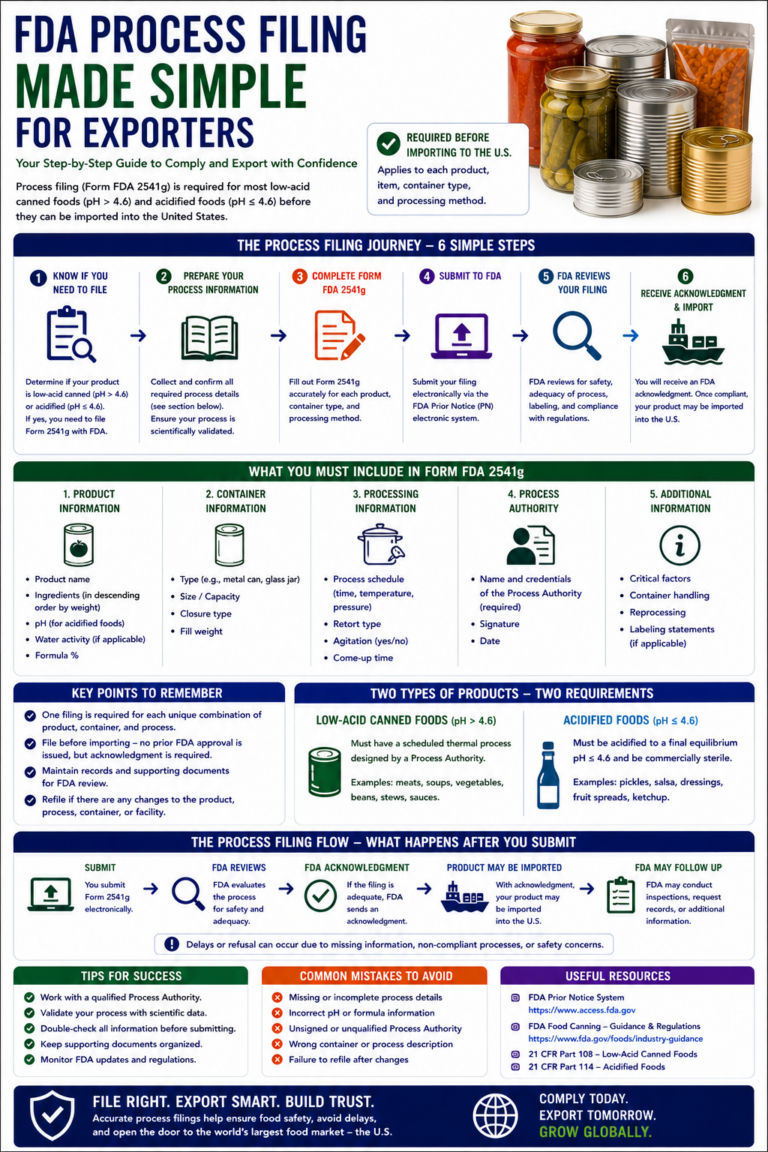
FDA Process Filing, Explained for Exporters
A plain-language guide to what a process filing actually is, what goes into one, and which FDA form you need.
Key Takeaways
- Two parts: FCE registration (Form 2541) + a scheduled process for each product.
- FCE = your factory; scheduled process = the safe recipe — the simplest mental model.
- Required for LACF & acidified foods — not fresh, frozen, or dry.
- The form depends on your method — 2541d, 2541e, 2541f, or 2541g.
- A process authority validates it — the filing records that validation.
- One filing per product & container — and it must match production.
The Two Parts of Process Filing
Almost all the confusion clears up once you separate these two pieces:
- Registers the plant as a Food Canning Establishment
- One per establishment; gives you an FCE number
- Applies to domestic and foreign facilities
- Must be in place before any process filing
- Describes how a product is safely processed
- One for each product, container, and variation
- Records the process a process authority validated
- Must match what actually happens in production
What a Scheduled Process Filing Contains
A scheduled process isn't a formality — it captures the specific factors that make the product safe. Change any of them and the safety math changes:
Product & container
The specific product, plus container type, size, and dimensions.
Processing method
Retort, aseptic, water-activity/formulation control, or acidified.
pH
The finished equilibrium pH — the line between low-acid and acidified.
Time & temperature
The thermal process — how long, how hot — that achieves safety.
F value
The measure of thermal lethality the process delivers.
Overpressure
Where relevant — e.g. for glass containers — the pressure held during processing.
Which FDA Form Do You Need?
One form registers the establishment; the process-filing form depends on your processing method:
| Form | Purpose | When |
|---|---|---|
| FDA 2541 | Food Canning Establishment (FCE) registration | Once per plant, before any process filing |
| FDA 2541d | Process filing — low-acid retorted method | Conventionally retorted low-acid canned foods |
| FDA 2541e | Process filing — acidified method | Acidified foods (finished pH ≤ 4.6 with added acid) |
| FDA 2541f | Process filing — water activity / formulation control | Safety controlled by water activity or formulation |
| FDA 2541g | Process filing — low-acid aseptic systems | Low-acid foods in aseptic systems |
Where Filings Go Wrong
One filing for many products
A different recipe, can size, or method changes the thermal behavior — each combination needs its own validated scheduled process.
Filing ≠ production
If what's filed doesn't match what actually happens on the line, it's a discrepancy that can trigger a hold.
No process-authority validation
A filing without an established, validated process behind it isn't supportable — validation comes first.
Not updating after a change
Reformulate, switch containers, or change the process, and the filing (and often the validation) must be updated.
Process Filing, Start to Finish
Confirm whether you need it
Required for LACF and acidified foods — classification first.
Register the food facility
And identify it as an acidified/low-acid processor; foreign adds a U.S. Agent.
Register the FCE (Form 2541)
Get your FCE number — required before any process filing.
Get the process validated
A process authority establishes pH, time, temperature, container, F value.
File the scheduled process
Use the form for your method (2541d–g), per product and container.
Align everything before shipping
FCE active, filings validated, label matches, FSVP importer set.
Process Filing, Done Right
FDA Registration Assistance handles the FDA filings end to end: Food Facility Registration and U.S. Agent, FCE registration (Form 2541), and the scheduled process filings — and we coordinate with a process authority for the validation those filings rest on. We also review labels and documentation so everything aligns before you ship. For the full canned-food picture, see the canned food market entry guide.
Contact us at info@fdaregistrationassistance.com or call +1 (928) 275-8333. Food Facility Registration is available starting at $858. Trusted by companies across 135+ countries, with 15+ years of experience.
Frequently Asked Questions
1. What is FDA process filing?
It's two things: registering your plant as a Food Canning Establishment (FCE) using Form FDA 2541, and filing a scheduled process for each product that describes exactly how it's made safe. A simple way to think about it: the FCE identifies your factory, and the scheduled process is the validated recipe for safety. It's required for low-acid canned and acidified foods.
2. What's the difference between FCE and the scheduled process (SID)?
The FCE registration (Form 2541) identifies the establishment — one per plant. The scheduled process filing describes how a specific product is safely processed — one for each product, container, and process variation. You register the FCE once, then file scheduled processes for each product you make.
3. Which products need process filing?
Low-acid canned foods (finished pH above 4.6 with water activity above 0.85) and acidified foods (low-acid foods acidified to a finished pH of 4.6 or below). Fresh, frozen, and dry foods generally don't need it. That's why the first step is confirming your product's classification.
4. Which form do I file?
Form FDA 2541 registers the Food Canning Establishment. For the scheduled process, the form depends on your method: 2541d for the low-acid retorted method, 2541e for the acidified method, 2541f for water activity/formulation control, and 2541g for low-acid aseptic systems. These are filed under 21 CFR 108.25 (acidified) and 108.35 (low-acid).
5. What goes into a scheduled process filing?
The details that make the product safe: the product and its container type and size, the processing method, and the critical factors — pH, time, temperature, the F value (thermal lethality), and container overpressure where relevant. Everything filed must match what actually happens in production.
6. Do I need a process authority?
Yes. A competent process authority establishes and validates the scheduled process — confirming the parameters actually achieve safety. Your filing relies on that validation; without it, the process filing generally isn't supportable. The process authority does the technical validation, and the filing records it with FDA.
7. Why does each product need its own filing?
Because safety depends on the specific product, container, and process. A different recipe, a different can size, or a different processing method changes the thermal behavior, so each combination needs its own validated scheduled process on file. One filing can't cover products that behave differently.
8. How is process filing submitted?
Through FDA's electronic acidified food/low-acid canned food system, part of FDA Industry Systems, after you've registered the food facility and identified it as an AF/LACF processor. Paper forms remain available, but most processors file electronically.
9. Can I export without process filing?
Not if your product requires it. Missing FCE registration or scheduled process filings can lead to your shipment being held, detained, or refused at import. For LACF and acidified foods, the filings must be complete before you ship.
10. Can I file after shipping?
No. Process filing has to be completed before export — it can't be resolved at the border. Because validation and filing take time, the safe approach is to start well ahead of your intended ship date.
11. What are the most common filing mistakes?
Skipping the FCE or a scheduled process, misclassifying the product, filing a process that doesn't match actual production, using one filing for products that behave differently, and not updating a filing after a formulation, container, or process change. Each can trigger an FDA hold.
12. How long does process filing take?
FCE registration can be quick, but the process-authority validation and the scheduled process filings take longer because they involve technical review of each product and container. Timelines depend on how ready your process documentation is, so it's worth starting early.
13. What happens if I change my recipe or container later?
A change to formulation, container, or process can change the thermal behavior, so the scheduled process — and often the process-authority validation — needs to be updated and re-filed. Shipping under an outdated filing that no longer matches production is a compliance risk.
14. How does FDA Registration Assistance help?
We handle the FDA filings end to end: Food Facility Registration and U.S. Agent, FCE registration (Form 2541), and the scheduled process filings, and we coordinate with a process authority for the validation those filings rest on. We also review labels and documentation so everything aligns before you ship. Starting at $858 for registration, for companies across 135+ countries. Contact info@fdaregistrationassistance.com or +1 (928) 275-8333.