
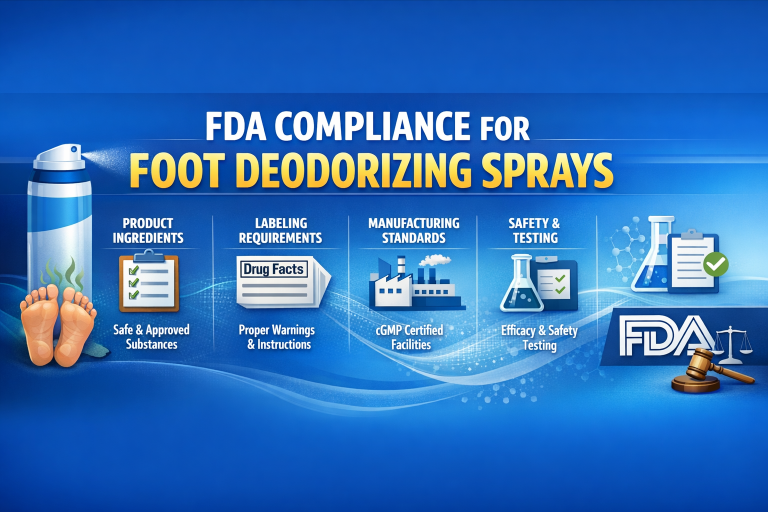
FDA Compliance for Foot Deodorizing Sprays
The three-way fork for foot sprays — deodorizer, antiperspirant, antifungal — plus the athlete's-foot-vs-nail-fungus distinction and the aerosol warning.
Key Takeaways
- Odor control = cosmetic — a true foot deodorizer follows MoCRA.
- Reduces sweat = antiperspirant drug — 21 CFR Part 350, aluminum actives.
- Treats athlete's foot = antifungal drug — OTC antifungal monograph.
- Athlete's foot is OTC-treatable; toenail fungus isn't — the latter needs Rx.
- Aerosol sprays need a flammability warning — 21 CFR Part 740.
- Classify by claims; registration ≠ approval.
How a Foot Spray Is Classified
| If the spray… | It's… | Basis |
|---|---|---|
| Freshens / controls odor only | A cosmetic (deodorizer) | MoCRA |
| Reduces foot sweat / perspiration (aluminum active) | An OTC drug (antiperspirant) | Antiperspirant monograph (21 CFR 350) |
| Treats/prevents athlete's foot; "antifungal" | An OTC drug (antifungal) | Topical antifungal monograph |
| "Antibacterial" / "kills germs" | An OTC drug | Antiseptic drug claim |
| Claims to cure toenail fungus | Not OTC-treatable | Prescription (not the OTC monograph) |
Athlete's Foot Is OTC-Treatable — Nail Fungus Isn't
This distinction matters for foot products. Both are fungal, but they're regulated differently:
- Athlete's foot (tinea pedis) — OTC drug — squarely covered by the OTC topical antifungal monograph, with actives like clotrimazole, miconazole, terbinafine, and tolnaftate (tolnaftate can also claim prevention). So a foot antifungal spray is a legitimate OTC drug.
- Toenail fungus (onychomycosis) — not OTC — the same monograph says those OTC topical antifungals are "not effective on nails," so nail fungus requires prescription therapy. A product can't claim to cure toenail fungus over the counter.
Aerosol Foot Sprays
Many foot sprays are aerosols, and the format adds labeling on top of the category. Self-pressurized (aerosol) products require specific flammability and use warnings under 21 CFR Part 740.
Registering Each
Cosmetic deodorizer — the MoCRA path:
- Facility registration + product listing + Responsible Person — via Cosmetics Direct; biennial renewal; U.S. Agent if foreign
- Safety substantiation, adverse-event reporting, labeling — with aerosol warnings if applicable
Antiperspirant or antifungal foot spray — the OTC drug path:
- Drug establishment registration + NDC listing — annual renewal; U.S. Agent if foreign
- Drug Facts + monograph-compliant actives/claims (antiperspirant 21 CFR 350, or the topical antifungal monograph) + cGMP + OMUFA
Common Foot-Spray Mistakes
- Treating a sweat-reducing spray as a cosmetic — it's an antiperspirant drug
- An "athlete's foot" or "antibacterial" claim on a cosmetic deodorizer — makes it a drug
- Claiming to cure toenail fungus over the counter — not OTC-treatable
- Skipping the aerosol flammability warning
- Missing the U.S. Agent (foreign); "FDA approved" claims
Get Your Foot Spray Compliant
FDA Registration Assistance classifies the product first — deodorizer (cosmetic), antiperspirant (drug), or antifungal (drug) — then handles the right registration: MoCRA facility registration and product listing (with Responsible Person, U.S. Agent, safety, and labeling) for a cosmetic foot deodorizer, or drug establishment registration, NDC listing, Drug Facts, and monograph compliance for an antiperspirant or antifungal foot spray.
Contact us at info@fdaregistrationassistance.com or call +1 (928) 275-8333 for a quote. An independent compliance firm serving 1,000+ companies across 135+ countries, with 15+ years of experience.
Frequently Asked Questions — Foot Deodorizing Sprays
1. Are foot deodorizing sprays regulated by the FDA?
Yes, and the classification depends on what the spray claims to do. A foot spray that only freshens or controls odor is a cosmetic (MoCRA). A spray that reduces foot sweat is an antiperspirant - an OTC drug. And a spray that treats athlete's foot or claims to be antifungal/antibacterial is also an OTC drug. So a single "foot spray" can be a cosmetic or a drug depending on its claims and actives - classification comes first.
2. When is a foot spray a cosmetic?
When it's intended only to freshen the feet or control odor, with cosmetic claims: "deodorizes," "freshens," "controls foot odor," "for daily foot hygiene." A true foot deodorizer works on odor without reducing sweat or treating a condition, so it's a cosmetic under MoCRA - facility registration, product listing, a Responsible Person, safety substantiation, adverse-event reporting, and labeling. The moment it claims to reduce sweat or treat athlete's foot, it becomes a drug.
3. When does a foot spray become an antiperspirant drug?
When it claims to reduce foot sweat/perspiration, or uses an aluminum-based antiperspirant active. Reducing perspiration affects a body function, so it's an OTC drug under the antiperspirant monograph (21 CFR Part 350) - the same framework as an underarm antiperspirant. That means the drug pathway: drug establishment registration, NDC listing, Drug Facts, monograph-compliant aluminum actives, cGMP, and a U.S. Agent if foreign. Excessive foot sweating is common, so this is a frequent fork for foot products.
4. When does a foot spray become an antifungal drug?
When it claims to treat or prevent athlete's foot (tinea pedis) or is antifungal. That's an OTC drug under the topical antifungal monograph, with actives like clotrimazole, miconazole, terbinafine, or tolnaftate (tolnaftate can also claim prevention). Athlete's foot is squarely covered by the OTC antifungal monograph, so a foot antifungal spray is a viable OTC drug - which is different from nail fungus (see below).
5. Is athlete's foot OTC-treatable but nail fungus not?
Yes - an important distinction. Athlete's foot (tinea pedis) is covered by the OTC topical antifungal monograph, so an OTC foot antifungal spray is legitimate. But the same monograph states those OTC topical antifungals are "not effective on nails," so nail fungus (onychomycosis) is not OTC-treatable and requires prescription therapy. So a foot spray can claim to treat athlete's foot (OTC drug), but a product can't claim to cure toenail fungus over the counter.
6. Do antibacterial claims make a foot spray a drug?
Yes. "Antibacterial," "antimicrobial," or "kills germs/bacteria" are drug claims (reducing or killing microorganisms), so a foot spray making them is an OTC drug, not a cosmetic. A cosmetic foot deodorizer can control odor - including by using fragrance or odor-absorbing ingredients - but it can't claim to kill bacteria therapeutically. If you don't intend a drug, keep the claims to odor control.
7. Do aerosol foot sprays have extra labeling?
Yes. Self-pressurized (aerosol) products, including many foot sprays, require specific flammability and use warnings under 21 CFR Part 740 - on top of the base labeling for the product's category. So an aerosol cosmetic foot deodorizer needs cosmetic labeling plus the aerosol warnings, and an aerosol antiperspirant or antifungal foot spray needs Drug Facts plus applicable warnings. The format adds requirements regardless of the category.
8. What is the cosmetic (MoCRA) path for a foot deodorizer?
Register the manufacturing facility with FDA (via Cosmetics Direct, with an FEI, and a U.S. Agent if foreign), list each product, designate a Responsible Person, maintain safety substantiation, set up adverse-event reporting, and use compliant labeling (with aerosol warnings if applicable). Facility registration renews every two years and listings update at least annually. This is the path for a true odor-only foot deodorizer.
9. What is the drug path for a sweat or athlete's-foot spray?
For a foot antiperspirant or antifungal spray (a drug): drug establishment registration (21 CFR Part 207), an NDC listing for each product, a Drug Facts label, monograph-compliant actives and claims (the antiperspirant monograph, 21 CFR Part 350, for sweat; the topical antifungal monograph for athlete's foot), cGMP, OMUFA, and a U.S. Agent if foreign. Drug establishment registration renews annually. It's the standard OTC monograph drug framework.
10. Can a foot spray be both a deodorizer and an antifungal?
A product that both controls odor and treats athlete's foot is, for compliance purposes, a drug - the antifungal (or antiperspirant) function is the governing one, so it follows the drug pathway even though it also deodorizes. Combining odor control with a therapeutic claim doesn't average out to "cosmetic"; the treatment claim pulls the whole product into drug regulation. Decide up front whether you want a cosmetic deodorizer or a drug.
11. Do foreign foot-spray brands need to register?
Yes. Any foot spray marketed in the U.S. must comply regardless of where it's made, and foreign facilities need a U.S. Agent on either pathway. A foreign cosmetic foot deodorizer registers under MoCRA with a U.S. Agent; a foreign antiperspirant or antifungal foot spray registers as a drug establishment with a U.S. Agent. Home-country classification doesn't transfer, so confirm the U.S. classification before shipping.
12. Does "natural" foot spray still need to comply?
Yes. "Natural," "herbal," and "clean" are marketing terms that don't change regulatory status. A natural foot deodorizer is still a cosmetic under MoCRA and needs registration, listing, safety substantiation, and labeling - and a "natural" spray that claims to treat athlete's foot or reduce sweat is still a drug. These terms describe positioning, not compliance.
13. What labeling does a foot spray need?
A cosmetic foot deodorizer needs cosmetic labeling: a Principal Display Panel (statement of identity, net quantity) and an information panel (INCI ingredient declaration, responsible-party name/address, any required warnings including aerosol, and the MoCRA adverse-event contact) - with no drug claims. An antiperspirant or antifungal foot spray (a drug) needs a Drug Facts panel. The label - and website - must match the classification.
14. Does registering my foot spray mean it's FDA-approved?
No. FDA doesn't approve cosmetics, and OTC monograph drugs (like a compliant antiperspirant or antifungal foot spray) are "compliance, not approval." So neither a cosmetic foot deodorizer nor a monograph foot drug is "FDA-approved." Calling it that because it's registered is misleading. The accurate statement is that your facility is registered and your products are listed (or, for a monograph drug, that it complies with the monograph).
15. What are common foot-spray mistakes?
Treating a sweat-reducing or antifungal foot spray as a cosmetic (both are drugs); adding an "antibacterial" or "athlete's foot" claim to a cosmetic deodorizer; claiming to treat toenail fungus over the counter (not OTC-treatable); skipping the aerosol flammability warning; missing the U.S. Agent (foreign); and "FDA approved" claims. Most trace back to not settling the deodorizer/antiperspirant/antifungal classification first.
16. How does FDA Registration Assistance help foot-spray brands?
We classify the product first - deodorizer (cosmetic), antiperspirant (drug), or antifungal (drug) - then handle the right registration: MoCRA facility registration and product listing (with Responsible Person, U.S. Agent, safety, and labeling) for a cosmetic foot deodorizer, or drug establishment registration, NDC listing, Drug Facts, and monograph compliance for an antiperspirant or antifungal foot spray. We're an independent compliance firm serving 1,000+ companies across 135+ countries with 15+ years of experience. Contact info@fdaregistrationassistance.com or +1 (928) 275-8333.
