
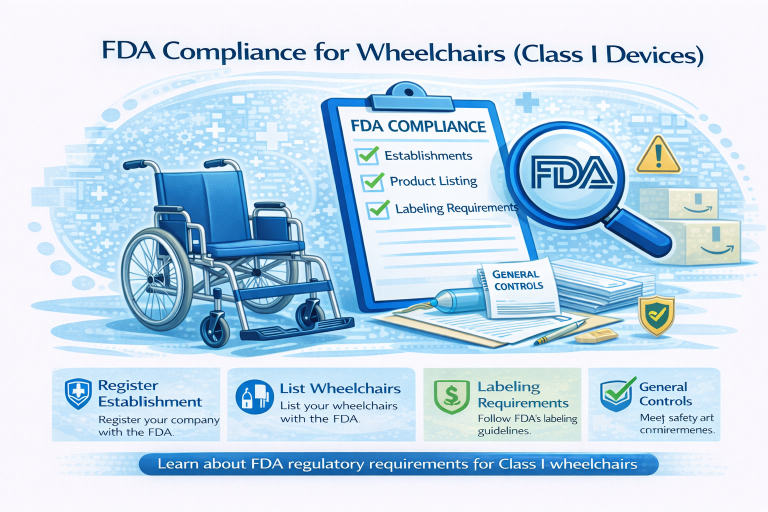
FDA Compliance for Wheelchairs
Manual (Class I) vs powered (Class II), scooters and specialty models, the RESNA/ISO 7176 standards, and how to register.
Key Takeaways
- Manual/mechanical wheelchair = Class I — 21 CFR 890.3850 (IOR); many 510(k)-exempt.
- Powered wheelchair = Class II — 21 CFR 890.3860 (ITI); needs a 510(k).
- Scooters = Class II — motorized three-wheeled vehicles (890.3800).
- Specialty (stair-climbing, standup, special grade) = Class II.
- Tested to ANSI/RESNA WC & ISO 7176 — durability, braking, stability, electronics.
- "Cleared" ≠ "approved" — powered is 510(k)-cleared; manual is registered/listed.
Wheelchair Types & Their FDA Class
| Type | Regulation | Class | Pathway |
|---|---|---|---|
| Manual / mechanical wheelchair | 21 CFR 890.3850 (IOR) | Class I | General controls; often 510(k)-exempt |
| Powered (battery) wheelchair | 21 CFR 890.3860 (ITI) | Class II | 510(k) + performance standards |
| Mobility scooter | 21 CFR 890.3800 / 890.3860 | Class II | 510(k) |
| Special grade wheelchair | 21 CFR 890.3880 | Class II | 510(k) |
| Stair-climbing wheelchair | 21 CFR 890.3890 | Class II | 510(k) |
| Standup wheelchair | 21 CFR 890.3900 | Class II | 510(k) |
Class I (Manual) vs Class II (Powered)
Manual/mechanical wheelchair — Class I. A human-propelled wheelchair (21 CFR 890.3850, product code IOR) is a Class I device under general controls. Many are 510(k)-exempt — but the exemption depends on the product code and whether the device has new technological characteristics or claims, so confirm it for your exact model rather than assuming.
Powered/battery wheelchair — Class II. Adding motors, batteries, and control systems adds risk, so a powered wheelchair (21 CFR 890.3860, product code ITI) is Class II with performance standards and generally requires a 510(k). Mobility scooters and specialty wheelchairs (stair-climbing, standup, special grade) are Class II too.
RESNA & ISO 7176 Testing
Wheelchairs are tested to recognized consensus standards to show they're safe and perform as intended:
- ANSI/RESNA WC standards (e.g., WC-1, WC-2) — the U.S. wheelchair standards
- ISO 7176 series — international wheelchair standards (static/dynamic/fatigue durability, brakes, stability, dimensions, and more)
- For powered devices — electrical systems, controls, and battery-related testing
- In the 510(k) — a powered/Class II wheelchair typically demonstrates conformance to the applicable RESNA/ISO 7176 tests for its type
The Device Pathway for Wheelchairs
- Classify — manual (Class I, 890.3850) vs powered (Class II, 890.3860) vs scooter/specialty; confirm the product code and 510(k) status
- 510(k) — for powered/Class II wheelchairs (and any non-exempt manual ones), with RESNA/ISO 7176 testing
- Establishment registration & device listing — 21 CFR Part 807, via FURLS/DRLM
- Quality system — 21 CFR Part 820, now the QMSR
- Labeling & UDI — 21 CFR Part 801 (weight capacity, warnings, safe operation) and UDI (21 CFR Part 830)
- MDR + U.S. Agent — 21 CFR Part 803; a U.S. Agent for foreign establishments
Common Wheelchair Mistakes
- Treating a powered wheelchair/scooter as exempt — it's Class II and needs a 510(k)
- Assuming every manual wheelchair is exempt without checking the product code
- Skipping RESNA/ISO 7176 testing
- Inadequate safety labeling on powered devices (batteries, controls, weight capacity)
- Calling a wheelchair "FDA approved"; missing UDI
- Missing the U.S. Agent (foreign manufacturers)
Get Your Wheelchair Compliant
FDA Registration Assistance confirms the classification (manual Class I under 890.3850, powered Class II under 890.3860, scooter/specialty as applicable) and 510(k) status, maps the standards strategy (ANSI/RESNA WC and ISO 7176), and handles establishment registration and device listing, labeling/UDI, and U.S. Agent service for foreign makers.
Contact us at info@fdaregistrationassistance.com or call +1 (928) 275-8333 for a quote. An independent compliance firm serving 1,000+ companies across 135+ countries, with 15+ years of experience.
Frequently Asked Questions — Wheelchairs
1. Are wheelchairs FDA medical devices?
Yes. A wheelchair intended to provide mobility for a medical purpose (for people restricted to a sitting position) is an FDA medical device. The class depends mainly on whether it's manual or powered: a manual/mechanical wheelchair is Class I (21 CFR 890.3850), while a powered (battery) wheelchair is Class II (21 CFR 890.3860). Mobility scooters and specialty wheelchairs are generally Class II as well. All of them are subject to FDA device requirements; the powered ones add a 510(k).
2. Is a manual wheelchair a Class I device?
Yes. A mechanical (manually operated) wheelchair is a Class I device under 21 CFR 890.3850 (product code IOR), subject to general controls - establishment registration, device listing, labeling, quality system, and Medical Device Reporting. Many Class I mechanical wheelchairs are 510(k)-exempt, but not all are - the exemption depends on the specific product code and any new technological characteristics or claims - so confirm the exemption for your exact device rather than assuming it.
3. Does a powered wheelchair need a 510(k)?
Yes. A powered (battery-operated) wheelchair is a Class II device under 21 CFR 890.3860 (product code ITI), classified with performance standards, and it generally requires a 510(k) clearance before marketing - demonstrating substantial equivalence to a predicate and conformance to the applicable performance standards. The added power, controls, and electronics are why powered wheelchairs sit a class above manual ones.
4. How are mobility scooters classified?
Mobility scooters are generally Class II devices, regulated as motorized three-wheeled vehicles (21 CFR 890.3800) or as powered wheelchairs (21 CFR 890.3860), and they require a 510(k) with conformance to the applicable performance standards. Like powered wheelchairs, they're intended for medical mobility, are battery-operated, and carry the electronics/controls that put them in Class II. The exact regulation and product code depend on the design.
5. What about specialty wheelchairs (stair-climbing, standup, special grade)?
Specialty wheelchairs have their own classification regulations and are generally Class II: special grade wheelchair (21 CFR 890.3880), stair-climbing wheelchair (21 CFR 890.3890), and standup wheelchair (21 CFR 890.3900). These typically require a 510(k) with appropriate testing for their added functions and risks. FDA's wheelchair 510(k) guidance covers mechanical, powered, and motorized three-wheeled vehicles, and specialty types follow their specific regulations.
6. What performance standards apply to wheelchairs?
Wheelchairs are tested to recognized consensus standards - principally the ANSI/RESNA WC standards (e.g., WC-1 and WC-2) and the ISO 7176 series - which cover things like static/dynamic/fatigue durability, braking, stability, dimensions, and (for powered devices) electrical systems and controls. A wheelchair 510(k) typically demonstrates conformance to the applicable RESNA/ISO 7176 tests for the device type. These standards are how you show the wheelchair is safe and performs as intended.
7. What is the difference between a manual and a powered wheelchair, for FDA?
It's the power source and the resulting risk. A manual/mechanical wheelchair (human-propelled) is Class I (890.3850) with general controls and is often 510(k)-exempt. A powered/battery wheelchair (890.3860) adds motors, batteries, and control systems - more that can go wrong - so it's Class II with performance standards and generally needs a 510(k). Same basic purpose (seated mobility), different class because of the power and electronics.
8. What registration does a wheelchair company need?
The device pathway: FDA establishment registration and device listing (21 CFR Part 807), a 510(k) for powered/Class II wheelchairs (and any non-exempt manual ones), a compliant quality system (QMSR), device labeling and UDI where applicable, Medical Device Reporting, and a U.S. Agent if the establishment is foreign. For a 510(k)-exempt manual wheelchair, you still register, list, and meet general controls - you just may not need the 510(k).
9. Is a wheelchair "FDA approved"?
No - a powered wheelchair is "FDA cleared" (via 510(k)), not "approved," and a Class I manual wheelchair is registered/listed (and, if exempt, has no premarket submission at all). Only high-risk Class III PMA devices are "FDA approved." So describe a wheelchair accurately: FDA-cleared (powered/Class II) or registered and listed (manual/Class I) - not "FDA approved."
10. Do foreign wheelchair manufacturers need to register?
Yes. A foreign maker of wheelchairs must complete FDA establishment registration and device listing, obtain the 510(k) for powered/Class II models (and non-exempt manual ones), comply with the quality system and labeling/UDI requirements, and appoint a U.S. Agent. Many wheelchairs and scooters are made abroad, so this is common - each foreign establishment registers for its role and needs a valid U.S. Agent before it can complete registration and import.
11. Are wheelchair parts and accessories regulated?
It depends on the component and how it's marketed. Some wheelchair components and accessories are regulated as device accessories (with their own classification), while general replacement parts may be handled under the finished device. Cushions, for example, can be their own device type. If you make or sell wheelchair accessories, each should be assessed on its own intended use and classification rather than assumed to be covered by the wheelchair.
12. What labeling does a wheelchair need?
Device labeling under 21 CFR Part 801: intended use and indications, instructions for use, weight capacity and specifications, required warnings and cautions (especially for powered devices - batteries, controls, safe operation), and UDI where applicable (21 CFR Part 830). Powered wheelchairs and scooters have more safety-critical labeling given the motors, batteries, and speed. Labeling must be truthful and match what the device is cleared/validated to do.
13. Does a wheelchair need a quality system?
Yes. Wheelchair manufacturers must comply with FDA's quality system requirements (21 CFR Part 820, now the QMSR harmonized with ISO 13485; most Class I devices are exempt from the design-control provisions but comply with the rest). A quality system covers design, manufacturing, complaint handling, and corrective actions - important for a load-bearing mobility device where failures can cause injury. It isn't submitted with registration but is expected as a general control.
14. What are the most common wheelchair compliance mistakes?
Treating a powered wheelchair or scooter as if it were exempt (it's Class II and needs a 510(k)); assuming every manual wheelchair is automatically 510(k)-exempt without checking the product code; skipping RESNA/ISO 7176 testing; inadequate safety labeling on powered devices; calling a wheelchair "FDA approved"; missing UDI; and (for foreign makers) missing the U.S. Agent. Most trace back to not matching the specific wheelchair type to its regulation and class.
15. Are transport/companion chairs treated the same as wheelchairs?
A transport chair (a lightweight, attendant-pushed chair for moving a seated person) intended for medical mobility is generally treated as a mechanical wheelchair - Class I under 21 CFR 890.3850 - with the same general controls and, often, 510(k) exemption (confirm the product code). As always, the intended use and any special features drive the classification, so a chair with added functions may fall under a different regulation. Assess each model on its own.
16. How does FDA Registration Assistance help wheelchair companies?
We confirm the classification (manual Class I under 890.3850, powered Class II under 890.3860, scooter/specialty as applicable) and 510(k) status, map the standards strategy (ANSI/RESNA WC and ISO 7176), and handle FDA establishment registration and device listing, labeling/UDI, and U.S. Agent service for foreign makers - so your mobility device is registered and market-ready under the right pathway. We're an independent compliance firm serving 1,000+ companies across 135+ countries with 15+ years of experience. Contact info@fdaregistrationassistance.com or +1 (928) 275-8333.