Medical Device FDA Registration Checklist
The end-to-end steps to register a device — the fee, the systems (DUNS, DFUF, FURLS), the timing, and the traps.
Key Takeaways
- Classify first — class, product code, and pathway before you register.
- DUNS number required — keep name/address consistent to avoid delays.
- FY2026 FDA fee: $11,423 — flat, no proration; paid via DFUF (PIN → PCN).
- Register & list in FURLS/DRLM — 21 CFR Part 807; role-specific.
- Renew annually Oct 1–Dec 31 — miss it and devices are misbranded.
- Registration ≠ approval — "FDA registered" as a selling point is misbranding.
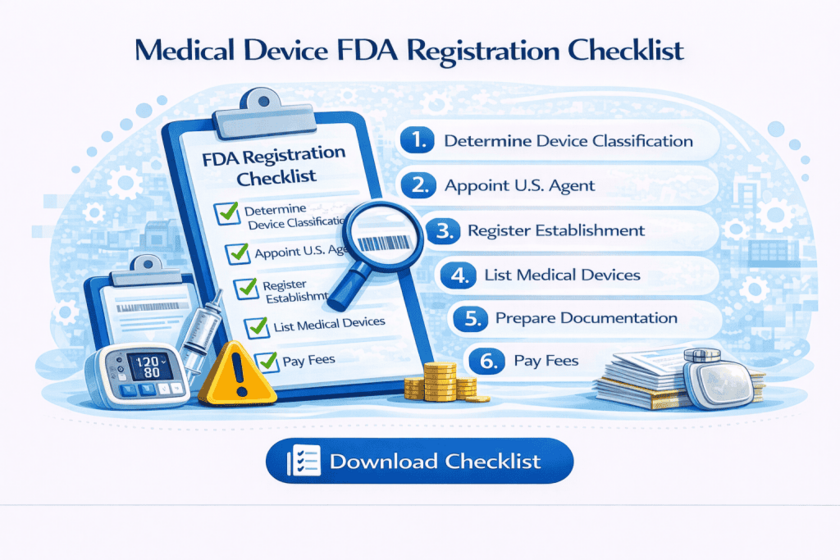
Eight Steps to Register a Device
- Classify the device. Determine the class, product code, and classification regulation — this drives listing and the pathway. See how to determine classification.
- Confirm (and obtain) the premarket pathway. Exempt, 510(k), De Novo, or PMA — and if clearance/approval is required, get it before marketing. Registration doesn't substitute for it.
- Get a DUNS number. FDA verifies establishment details via Dun & Bradstreet; keep legal name and address consistent across records.
- Pay the annual establishment fee. For FY2026 the FDA fee is $11,423 per establishment, via the Device Facility User Fee (DFUF) system — order, get a PIN, pay, receive a PCN.
- Register the establishment. In FURLS/DRLM under 21 CFR Part 807 — role-specific, within 30 days of starting covered operations.
- List each device. Product code, proprietary name, regulatory status, activities, and the premarket submission number if the device required authorization.
- Appoint a U.S. Agent (if foreign). A U.S.-based contact for FDA communications; required for foreign establishments.
- Have quality, labeling & MDR in place. A compliant quality system (QMSR), labeling and UDI where applicable, and Medical Device Reporting.
The Annual Fee, DUNS, DFUF & FURLS
- FY2026 establishment fee: $11,423 — set by MDUFA (Federal Register); a flat annual fee with no proration for partial years
- New for FY2026: a small-business waiver — FDA may waive the annual fee (not an initial registration) for certain SBD-certified small businesses showing financial hardship
- DFUF payment — create the order, get a Payment Identification Number (PIN), pay, receive a Payment Confirmation Number (PCN); pay before completing registration
- DUNS — required; D&B verifies name/address, so mismatches cause delays
- FURLS/DRLM — the Device Registration and Listing Module, where registration and listing are submitted (21 CFR Part 807)
Who Registers, and When
- Role-specific — each establishment registers for its own role: manufacturer, specification developer, sterilizer, repackager/relabeler, or initial importer
- A contract manufacturer's registration doesn't cover the brand owner — and a spec developer registers even without making the device
- Initial registration — generally within 30 days of starting covered operations
- Annual renewal — October 1 to December 31, with the fee paid and listings reviewed
- Foreign establishments — also appoint a U.S. Agent
Registration Is Not Approval
Registration and a registration number identify your establishment to FDA — they do not mean FDA cleared, approved, certified, or endorsed the device or the establishment.
Common Registration Mistakes
- Registering before classifying — wrong product code looks complete but is noncompliant
- Assuming registration replaces a 510(k)/PMA — it doesn't
- Name/address mismatches between DUNS and FDA records
- Relying on a contract manufacturer's registration — each role registers
- Missing the Oct 1–Dec 31 renewal or not listing all devices
- "FDA registered" marketing claims (misbranding); missing the U.S. Agent (foreign)
Device Registration & Classification
Register Your Device the Right Way
FDA Registration Assistance runs the checklist end to end: confirm classification and product code, flag the pathway (exempt/510(k)/De Novo/PMA), help obtain a DUNS number, coordinate the MDUFA fee payment, complete establishment registration and device listing in FURLS/DRLM, and provide U.S. Agent service for foreign establishments — plus point you to the quality, labeling, and MDR obligations that come with being a device establishment.
Contact us at info@fdaregistrationassistance.com or call +1 (928) 275-8333 for a quote. An independent compliance firm serving 1,000+ companies across 135+ countries, with 15+ years of experience.
Frequently Asked Questions — Device Registration
1. What are the steps to register a medical device with FDA?
In order: (1) classify the device (class, product code, regulation); (2) confirm and, if required, obtain the premarket pathway (exempt, 510(k), De Novo, or PMA) before marketing; (3) get a DUNS number; (4) pay the annual establishment registration fee through the DFUF system; (5) register the establishment in FURLS/DRLM (21 CFR Part 807); (6) list each device; (7) appoint a U.S. Agent if the establishment is foreign; and (8) have a quality system, compliant labeling/UDI, and Medical Device Reporting in place. Registration is a sequence, not a single form.
2. How much is the FDA device establishment registration fee?
For FY2026, the FDA annual establishment registration fee is $11,423 per establishment (set by MDUFA and published in the Federal Register). It's a flat annual government fee - there's no proration for registering partway through the fiscal year. New for FY2026, FDA may grant a waiver of this fee (excluding an initial registration) to certain small businesses certified through the Small Business Determination (SBD) Program that demonstrate financial hardship. This is a government fee paid to FDA, separate from any consulting fee.
3. How do I pay the device registration fee?
Through FDA's Device Facility User Fee (DFUF) system, which is separate from the registration system (FURLS/DRLM). You create a DFUF order, receive a Payment Identification Number (PIN), pay, and get a Payment Confirmation Number (PCN). You generally must pay the fee (and have the PCN) before you can complete establishment registration and listing - unless FDA grants a small-business waiver. Keep the PIN and PCN; you'll need them to finish registration.
4. What is a DUNS number and do I need one?
A DUNS number is a unique nine-digit business identifier from Dun & Bradstreet. FDA uses it (via D&B) to verify establishment details like legal name and address, so you need one for device registration. Make sure your legal entity name and facility address are consistent across your records - small spelling or formatting differences between your DUNS record and your FDA registration can trigger verification issues and delays.
5. What is FURLS/DRLM?
FURLS is FDA's Unified Registration and Listing System, and DRLM is the Device Registration and Listing Module within it. You use DRLM to submit your establishment registration and your device listings under 21 CFR Part 807. It's a separate system from the DFUF fee-payment system, with its own account. Registration and listing are both done in DRLM once the fee is paid.
6. Do I have to register if I'm a foreign manufacturer?
Yes. Foreign establishments that manufacture devices for the U.S. market must register and list, pay the annual fee, and appoint a U.S. Agent - a U.S.-based contact for FDA communications. The foreign establishment and its U.S. initial importer generally both have registration obligations based on their roles. A foreign facility can't skip registration by relying on its importer or distributor; each registers based on what it does.
7. Is registration role-specific?
Yes. Under 21 CFR Part 807, each establishment registers independently based on its role - manufacturer, specification developer, sterilizer, repackager/relabeler, or initial importer. A contract manufacturer's registration does not cover the brand owner, and a specification developer registers even if it doesn't physically make the device. So more than one entity in a single product's supply chain may each need to register for the role it performs.
8. When do I register, and when do I renew?
Initial registration is generally required within 30 days of beginning covered operations. After that, registration must be renewed annually during the window of October 1 to December 31, along with payment of the annual establishment fee, and device listings must be reviewed and kept current. Manufacturing or distributing after December 31 without completing the annual registration leaves you not duly registered, and the devices can be considered misbranded.
9. Do I list every device separately?
Yes. Each device must be listed with its product code, proprietary name, regulatory/marketing status, and the activities performed on it; if the device required marketing authorization, the listing includes the premarket submission number (e.g., the 510(k) K-number). Listings are submitted with initial registration and reviewed/updated annually (Oct 1–Dec 31). Registering the establishment but not listing all the devices is a common gap.
10. Does registration have to come after classification?
Classification should come first. You need the device class and product code to list correctly, and you need to know whether a 510(k)/De Novo/PMA is required before marketing - registration and listing don't substitute for that clearance/approval. Registering or listing under the wrong product code can look complete while being noncompliant. So classify (class, product code, regulation) and confirm the pathway, then register, pay, and list to match.
11. Do I need a quality system to register?
You must comply with the applicable quality system requirements as a general control, though the quality system isn't submitted with registration. FDA's quality system framework (21 CFR Part 820) transitioned to the QMSR, harmonized with ISO 13485, with a compliance date of February 2, 2026; most Class I devices are exempt from the design-control provisions. You should have a compliant quality system, labeling (and UDI where applicable), and Medical Device Reporting in place as part of being a lawful device establishment.
12. Is there a small-business discount on the registration fee?
The annual establishment registration fee is a flat rate with no general small-business reduction and no proration. However, new for FY2026, FDA may grant a waiver of the annual registration fee (not an initial registration) to certain small businesses certified through the Small Business Determination (SBD) Program that show paying it is a financial hardship. Small-business reductions also apply separately to submission fees like the 510(k). Check the current MDUFA fees page and SBD criteria.
13. Can I say my device is "FDA registered" in marketing?
Be very careful. Under 21 CFR 807.39, registration and possession of a registration number do not mean FDA approved or cleared the device or establishment, and using registration to imply approval is misbranding. "FDA registered," "FDA certified," or "registration certificate" claims are misleading and should be avoided in marketing. The accurate statement is simply that your establishment is registered and your devices are listed - not that they're FDA-approved.
14. What happens if I miss the annual registration?
If you don't complete the annual registration (and fee) by December 31, you are not duly registered for the new period, and continuing to manufacture or distribute can render your devices misbranded - exposing you to warning letters, import detention, and enforcement. FDA has issued warning letters for failure to complete annual establishment registration and listing. Treat the October–December window as a hard deadline and pay the fee early to avoid last-minute issues.
15. How long does device registration take?
The timeline depends on the pieces: obtaining a DUNS number and resolving any name/address mismatches, paying the fee and receiving the PCN, and completing the DRLM entries. The registration and listing entry itself can be quick once the fee is paid and your information is consistent, but front-end steps (DUNS verification, and especially any required 510(k)/De Novo/PMA before marketing) can take much longer. Because timing varies, we don't quote a fixed duration - plan the pathway steps early.
16. How does FDA Registration Assistance help with device registration?
We run the checklist end to end: confirm classification and product code, flag the pathway (exempt/510(k)/De Novo/PMA), help obtain a DUNS number, coordinate the MDUFA fee payment, complete establishment registration and device listing in FURLS/DRLM, and provide U.S. Agent service for foreign establishments - plus point you to the quality, labeling, and MDR obligations that come with being a device establishment. We're an independent compliance firm serving 1,000+ companies across 135+ countries with 15+ years of experience. Contact info@fdaregistrationassistance.com or +1 (928) 275-8333.