
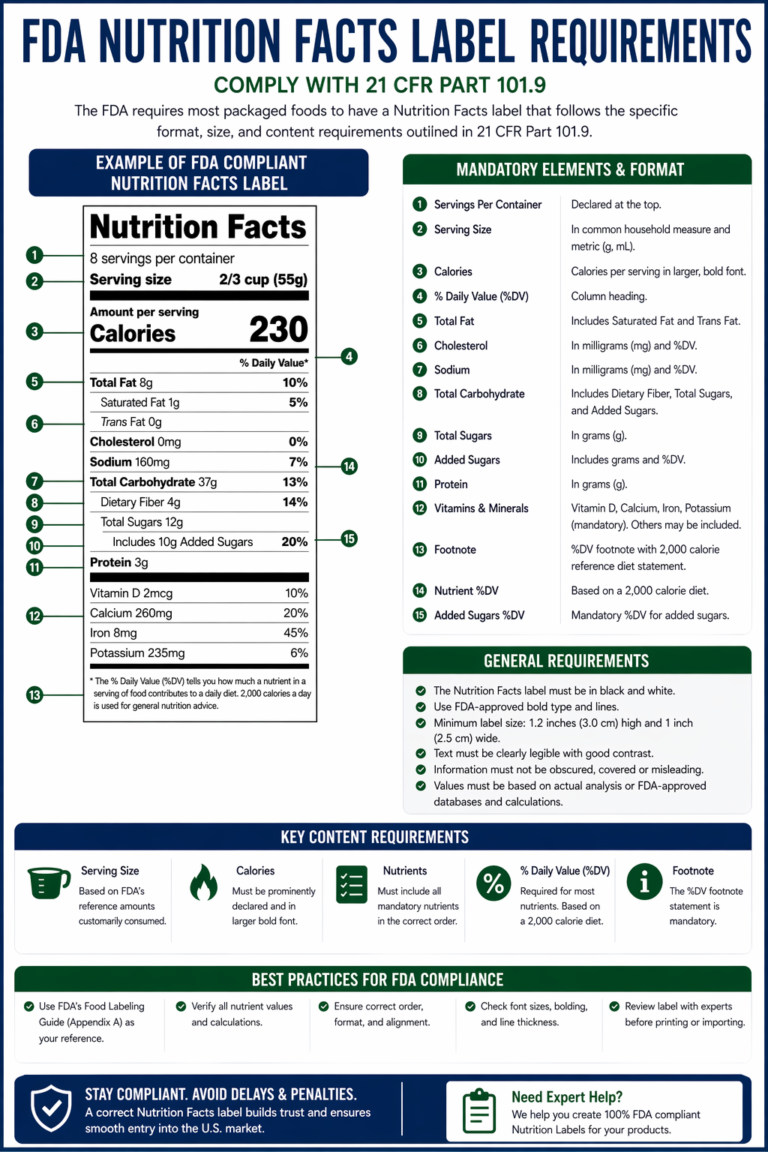
FDA Nutrition Facts Label Requirements
This guide covers what the Nutrition Facts label must contain, how serving size is determined, format and type size requirements, the Dual-Column label, small business exemptions, and the most common compliance errors — with specific references to the governing regulations throughout.
The Governing Regulation: 21 CFR Part 101.9
FDA Nutrition Facts label requirements are codified primarily at 21 CFR Part 101.9. This regulation specifies required nutrients, serving size determination, format layout, type sizes, Daily Value calculations, rounding rules, and exemptions. The current format was significantly updated in May 2016 — the most substantial revision since Nutrition Facts labels were first required in 1994.
The 2016 update became mandatory for manufacturers with $10 million or more in annual food sales on January 1, 2020, and for all other manufacturers on January 1, 2021. As of 2021, the pre-2016 label format is non-compliant for all manufacturers. Products still bearing the old format are misbranded under FDA regulations regardless of when they were produced.
Supporting regulations include: 21 CFR Part 101.12 (Reference Amounts Customarily Consumed — RACCs used to determine serving size); 21 CFR Part 101.36 (Supplement Facts for dietary supplements); and 21 CFR Part 101.9(f) (simplified label format). Nutrient content claims that trigger labeling obligations are governed by 21 CFR Parts 101.13 and 101.54–101.69.
What Must Appear on the Nutrition Facts Label
Under 21 CFR Part 101.9(c), the following nutrients are mandatory on every compliant Nutrition Facts panel. Voluntary nutrients may be added but are not required unless a claim is made about them.
Serving Size: The Most Common Compliance Failure
Serving size is one of the most frequently incorrect elements on Nutrition Facts labels. Under 21 CFR Part 101.9(b), serving size must be based on the FDA Reference Amount Customarily Consumed (RACC) for the product category — the amount typically consumed in one eating occasion by persons 4 years and older. RACCs for specific product categories are listed in 21 CFR Part 101.12.
A manufacturer cannot set the serving size to a nutritionally convenient amount, a smaller-than-typical portion to make the product appear healthier, or an amount based on foreign market conventions. Serving size must be expressed in both a common household measure (e.g., 2 tablespoons, 1 cup) and the metric equivalent weight (e.g., 32g, 240mL).
Single-Serving Packages
If a package contains between 1 and 2 servings based on the RACC and is typically consumed in one sitting, the package is labeled as a single-serving container. The entire contents count as one serving, and all calorie and nutrient values reflect the entire package.
Multi-Serving Packages
Multi-serving packages must declare the number of servings per container rounded to the nearest whole number (except for packages between 2 and 5 servings, which may round to the nearest half-serving). Nutrient values are per serving, not per package.
Format, Type Size & Layout Requirements
FDA regulates not just what appears on the Nutrition Facts label, but exactly how it must look. Specifications are in 21 CFR Part 101.9(d). Key format requirements include:
| Label Element | Minimum Requirement | CFR Reference |
|---|---|---|
| "Nutrition Facts" heading | 13-point type minimum, bold, prominently larger than surrounding text | 101.9(d)(1) |
| Calorie amount | 22-point type minimum, bold | 101.9(d)(1)(ii) |
| All other nutrient text | 8-point type minimum | 101.9(d)(1) |
| Label background | White or neutral background with good contrast | 101.9(d) |
| Hairline rules | Required between major nutrient categories; thick rule above Calories | 101.9(d) |
| %DV footnote | 6-point type minimum; required unless label is too small | 101.9(d)(9) |
| Dual-Column format | Required for packages between 2–3 servings that may be consumed in one sitting | 101.9(d)(13) |
| Linear (tabular) format | Permitted for packages with less than 12 square inches available for labeling | 101.9(d)(11) |
How to Make Your Nutrition Facts Label FDA-Compliant
Determine if a Nutrition Facts label is required
Most packaged food products require a Nutrition Facts label. Determine whether your product qualifies for a small business exemption (fewer than 100 full-time equivalent employees and fewer than 100,000 units sold annually) or a low-volume threshold (fewer than 10 FTE employees and fewer than 10,000 units). Raw produce and single-ingredient raw meat are generally exempt. Dietary supplements use a Supplement Facts panel instead.
Establish accurate serving size from the FDA RACC table
Look up the RACC for your product category in 21 CFR Part 101.12. Serving size must be expressed in both household measure and metric weight. If the product could reasonably be consumed in one sitting (between 2–3 servings per package), evaluate whether the Dual-Column label format is required under 21 CFR Part 101.9(d)(13).
Calculate all required nutrients accurately
Nutrient values must be based on laboratory analysis, USDA database values, or other recognized sources. Apply FDA rounding rules from 21 CFR Part 101.9(c) for each nutrient. Calculate percent Daily Values using the reference values in 21 CFR Part 101.9(c)(9). Ensure added sugars are calculated and declared correctly.
Format the label to FDA specifications
Use the current 2016-update format. Confirm "Nutrition Facts" is at least 13-point, calorie amount is at least 22-point, all other text is at least 8-point. Include the required %DV footnote. Use correct hairline rules between nutrient groupings. Use the standard vertical format unless the package has less than 12 square inches available for labeling.
Review against 21 CFR Part 101.9 before production
Review the final label artwork against the full checklist before packaging is printed. Common pre-production review findings include: incorrect serving size, missing added sugars, missing vitamin D or potassium, wrong %DV calculations, type size below minimums, and missing Dual-Column format. Corrections before printing cost far less than relabeling after production or at the U.S. border.
Most Common Nutrition Facts Label Compliance Errors
Outdated Format
Using the pre-2016 label format — which listed vitamins A and C instead of vitamin D and potassium, used different type sizes for calories, and did not require added sugars. As of January 1, 2021, the pre-2016 format is non-compliant for all manufacturers.
Incorrect Serving Size
Serving size not based on the FDA RACC for the product category, or expressed in non-standard units. A smaller serving size may make per-serving nutrient values look more favorable but is a compliance violation under 21 CFR Part 101.9(b).
Missing Added Sugars
Failing to declare added sugars as a separate indented line with a percent Daily Value. Added sugars must appear under Total Sugars. The distinction between naturally occurring and added sugars is required; omitting the added sugars line is a non-compliance under the 2016 update.
Missing Vitamin D or Potassium
The 2016 update replaced Vitamins A and C with Vitamin D and Potassium as required nutrients. Labels still showing Vitamins A and C instead of Vitamin D and Potassium are using the outdated format. If Vitamin D or Potassium is present at zero, it must still be declared (though it may be expressed as 0 mcg / 0 mg, 0%DV).
Wrong Type Sizes
Type sizes below FDA minimums — especially using less than 22-point for the calorie amount, less than 13-point for the "Nutrition Facts" heading, or less than 8-point for nutrient names. This is a formatting violation that makes the label non-compliant even if the nutrient data is correct.
Incorrect Rounding
Nutrient values must be rounded per FDA's specific rounding increments in 21 CFR Part 101.9(c). For example, total fat between 0.5g and 5g is rounded to the nearest 0.5g increment; fat above 5g rounds to the nearest gram. Incorrect rounding produces technically non-compliant values even when the underlying data is accurate.
Get Your Nutrition Facts Label Reviewed Before Production
FDA Registration Assistance reviews food product labels against the current Nutrition Facts requirements of 21 CFR Part 101.9 before products go into production or are imported into the United States. Corrections before packaging is printed cost far less than relabeling after shipment.
Contact us at info@fdaregistrationassistance.com or call +1 (928) 275-8333. FDA Registration Assistance serves 1,000+ clients in 135+ countries with 15+ years of combined regulatory experience.
Frequently Asked Questions — FDA Nutrition Facts Label Requirements
1. What regulation governs the Nutrition Facts label?
FDA Nutrition Facts label requirements are codified in 21 CFR Part 101.9. The current format was significantly updated in 2016, with compliance required for all manufacturers by January 1, 2021. The regulation governs required nutrients, serving size determination, format specifications, type size, Daily Value calculations, and placement requirements.
2. What products require a Nutrition Facts label?
Most packaged food products sold in the United States require a Nutrition Facts label under 21 CFR Part 101.9. This includes domestic and imported products. Exemptions exist for raw produce, single-ingredient raw meat and poultry (USDA-regulated), restaurant foods, and products from businesses qualifying for small business or low-volume exemptions. Dietary supplements use a Supplement Facts panel instead of a Nutrition Facts label.
3. What nutrients are required on the Nutrition Facts label?
Required nutrients under 21 CFR Part 101.9(c): calories; total fat; saturated fat; trans fat; cholesterol; sodium; total carbohydrate; dietary fiber; total sugars; added sugars; protein; vitamin D; calcium; iron; and potassium. The 2016 update added added sugars, vitamin D, and potassium, and removed vitamins A and C as mandatory nutrients (now voluntary).
4. How is serving size determined for FDA Nutrition Facts labels?
Serving size must be based on the FDA Reference Amount Customarily Consumed (RACC) for the product category, listed in 21 CFR Part 101.12. It must reflect the amount typically consumed at one eating occasion — not a manufacturer-preferred amount. Serving size must be expressed in both a common household measure and metric weight. Incorrect serving size is one of the most common Nutrition Facts label compliance failures.
5. What is the small business exemption for Nutrition Facts labels?
A small business exemption may apply if a company has fewer than 100 full-time equivalent employees and sells fewer than 100,000 units of that product in the United States annually. A low-volume exemption applies to companies with fewer than 10 full-time equivalent employees selling fewer than 10,000 units annually. Both exemptions must be claimed annually by notifying FDA. Products must still comply with other labeling requirements.
6. What is the Dual-Column Nutrition Facts label and when is it required?
The Dual-Column Nutrition Facts label is required for certain packages that contain between 2 and 3 servings per container and are likely to be consumed in one sitting. It shows nutrient information per serving in one column and per package in a second column. The requirement is at 21 CFR Part 101.9(d)(13). This is one of the 2016 update additions that many manufacturers miss.
7. What are the type size requirements for the Nutrition Facts label?
Under 21 CFR Part 101.9(d)(1): "Nutrition Facts" heading must be at least 13-point type. The calorie amount must be at least 22-point type. All other nutrient names and amounts must be at least 8-point type. The %DV footnote must be at least 6-point type. Violations of type size requirements make the label non-compliant even if all nutrient data is accurate.
8. How must added sugars be declared on the Nutrition Facts label?
Added sugars must be declared as a separate indented line under Total Sugars, with a percent Daily Value based on a 50-gram daily reference value. Added sugars include sugars added during processing, honey, syrups, and concentrated fruit or vegetable juice in excess of natural levels. Omitting the added sugars line is a non-compliance under the 2016 update per 21 CFR Part 101.9(c)(6)(iii).
9. What is the percent Daily Value and how is it calculated?
The percent Daily Value (%DV) shows how much a nutrient in one serving contributes to a 2,000-calorie daily diet. Daily Values are set by FDA and listed at 21 CFR Part 101.9(c)(9). %DV is calculated by dividing the amount of a nutrient per serving by the Daily Value for that nutrient and multiplying by 100. %DV is not required for trans fat, total sugars, or protein (unless a protein claim is made).
10. Do imported food products need FDA Nutrition Facts labels?
Yes. Imported food products sold in the United States must meet the same Nutrition Facts labeling requirements as domestically produced products under 21 CFR Part 101.9. Labels must be in English. Nutrient values from EU nutrition labels, Canadian nutrition tables, or Asian food labels do not automatically satisfy FDA requirements because serving sizes, required nutrients, and format specifications differ from FDA standards.
11. Can I use a foreign country's nutrition label format for U.S. import?
No. Foreign nutrition label formats — including EU nutrition declarations, Japanese nutrition labels, Canadian Nutrition Facts tables, and Australian/NZ Nutrition Information Panels — do not satisfy FDA Nutrition Facts requirements. The format, required nutrients, serving size basis, font sizes, and Daily Value system all differ. Products imported into the United States must carry an FDA-compliant Nutrition Facts label, typically requiring relabeling before or at the point of entry.
12. What are the most common Nutrition Facts label errors?
The most common errors include: using the pre-2020/2021 outdated label format; incorrect serving size (not based on RACC); missing added sugars declaration; missing vitamin D or potassium declarations; incorrect %DV calculations; type size below FDA minimums; missing the Dual-Column format when required; and incorrect rounding of nutrient values per 21 CFR Part 101.9(c) rounding rules.
13. When did the current Nutrition Facts label format become mandatory?
Mandatory on January 1, 2020 for manufacturers with $10 million or more in annual food sales. Mandatory on January 1, 2021 for all other manufacturers. As of 2021, the pre-2016 label format is no longer compliant for any manufacturer. Products still using the old format are misbranded under FDA regulations.
14. What is the difference between Nutrition Facts and Supplement Facts?
The Nutrition Facts panel is required for conventional food products under 21 CFR Part 101.9. The Supplement Facts panel is required for dietary supplements under 21 CFR Part 101.36. The panels have different required nutrients, different formatting requirements, and different serving size rules. A product cannot carry both panels, and misclassifying a dietary supplement as a food product results in non-compliant labeling.
15. What happens if a food product has a non-compliant Nutrition Facts label?
A food product with a non-compliant Nutrition Facts label is misbranded under the Federal Food, Drug, and Cosmetic Act. Misbranded imported products may be detained or refused at the U.S. port of entry. For products in distribution, FDA may issue a warning letter, request voluntary recall, or initiate seizure action under 21 U.S.C. § 381.
16. What is the linear (horizontal) Nutrition Facts format?
FDA permits a linear (horizontal) Nutrition Facts format for packages where there is insufficient vertical space for the standard format. The linear format may only be used when the package area available for labeling is less than 12 square inches. Requirements for the linear format are in 21 CFR Part 101.9(d)(11).
17. How are calories rounded on the Nutrition Facts label?
Per 21 CFR Part 101.9(c)(1): fewer than 5 calories may be expressed as zero. 5 to 50 calories are rounded to the nearest 5-calorie increment. More than 50 calories are rounded to the nearest 10-calorie increment. Similar nutrient-specific rounding rules apply to fat, sodium, carbohydrates, and other nutrients throughout 21 CFR Part 101.9(c).
18. Does a very small package need a Nutrition Facts label?
Products with a total surface area available for labeling of less than 12 square inches may use a simplified or tabular format, or may omit the Nutrition Facts panel and instead provide a contact method for consumers to obtain the information — as long as no nutrient content claims or health claims appear on the label. Adding a claim triggers the full labeling requirement. See 21 CFR Part 101.9(j)(13).
19. What is the footnote required on the Nutrition Facts label?
The required footnote states: "The % Daily Value (DV) tells you how much a nutrient in a serving of food contributes to a daily diet. 2,000 calories a day is used for general nutrition advice." It must appear in at least 6-point type and may be omitted if the label is too small to accommodate it (in which case a simplified format applies).
20. Can a company use the simplified Nutrition Facts format?
Yes, under 21 CFR Part 101.9(f), if a food contains insignificant amounts (declarable as zero) of eight or more required nutrients, a simplified format may be used showing only calories, total fat, sodium, total carbohydrate, protein, and any nutrients present in significant amounts. The simplified format requires all the same type size and formatting rules as the standard format.
21. What are the font requirements for the "Nutrition Facts" heading?
The "Nutrition Facts" heading must be bold, at least 13-point type, and must be set in a larger size than the remaining text on the label per 21 CFR Part 101.9(d)(1). The heading must appear within a box or hairline rules that set it off from other label information. Font style must be easy to read.
22. How does FDA label review help with Nutrition Facts compliance?
An FDA label review evaluates your Nutrition Facts panel against the current requirements of 21 CFR Part 101.9 before production or import. It identifies specific compliance issues — incorrect serving size, missing nutrients, outdated format, wrong type sizes, missing added sugars, incorrect %DV percentages — while corrections are still inexpensive. Correcting errors after packaging is printed or after products arrive at U.S. ports is significantly more costly.
23. Is the Nutrition Facts label required on restaurant and food service products?
The standard Nutrition Facts label requirement under 21 CFR Part 101.9 applies to packaged food products. Restaurant foods served directly to consumers are generally exempt. However, chain restaurants with 20 or more locations must provide calorie information under the FDA menu labeling rule at 21 CFR Part 101.11. Packaged foods sold through food service channels are still subject to standard Nutrition Facts requirements.
24. What is the difference between total sugars and added sugars on the label?
Total sugars represents all sugars naturally present plus any added sugars. Added sugars is a subset representing only those sugars added during processing — including table sugar, high fructose corn syrup, honey, maple syrup, agave, and concentrated fruit juice in excess of natural levels. Added sugars must be declared as a separate indented line under Total Sugars, with a %DV based on a 50-gram daily reference. Naturally occurring sugars in dairy or whole fruits are not added sugars.
25. What is the regulatory basis for requiring Nutrition Facts labels on imported food?
Under section 403 of the Federal Food, Drug, and Cosmetic Act, a food is misbranded if it does not bear the required nutrition labeling. This applies equally to imported and domestically produced foods. 21 CFR Part 101.9 implements these requirements. FDA enforces Nutrition Facts label compliance at U.S. ports of entry — imported food products without compliant Nutrition Facts panels may be detained or refused admission under 21 U.S.C. § 381.