FDA Label Requirements for Selling Food on Amazon FBA
Every Required FDA Label Element for Amazon FBA Food Products
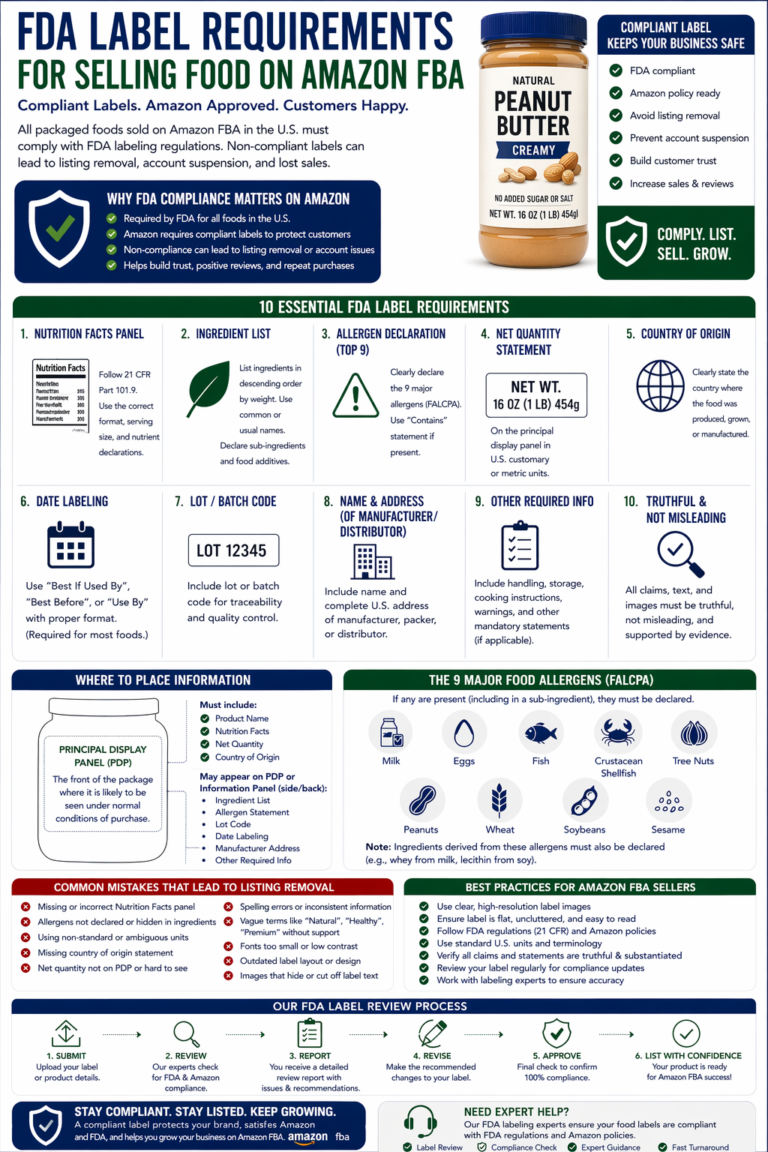
The following elements are required on every packaged food label sold through Amazon FBA. Missing or incorrect elements make the food misbranded under 21 U.S.C. § 343 — a prohibited act under federal law:
| Label Element | CFR Citation | Location on Package | Key Requirements |
|---|---|---|---|
| Statement of Identity | 21 CFR 101.3 | Principal Display Panel (PDP) | Common or usual name of the food in type size reasonably related to the most prominent printed matter on the PDP. |
| Net Quantity of Contents | 21 CFR 101.105 | Bottom 30% of PDP | Both U.S. customary and metric units. Minimum type size based on PDP area. No qualifying words ("about," "approximately"). |
| Nutrition Facts Panel | 21 CFR 101.9 | Information Panel | Current 2020 FDA format. U.S. RACC serving size. Calories in bold/larger type. Added Sugars mandatory. Vitamin D, Calcium, Iron, Potassium mandatory. No Calories from Fat line. |
| Ingredient List | 21 CFR 101.4 | Information Panel | Descending order by weight. Common or usual names. Sub-ingredients for compound ingredients. Color additives by name. Flavors declared as natural or artificial. |
| Allergen Declarations | FALCPA + FASTER Act | Information Panel (adjacent to or after ingredient list) | All 9 major allergens: milk, eggs, fish (species), shellfish (species), tree nuts (specific nut), peanuts, wheat, soybeans, sesame. Either "Contains:" statement or bold parenthetical in ingredient list. |
| Manufacturer / Distributor Name & Address | 21 CFR 101.5 | Information Panel | Full street, city, state, ZIP. If not manufacturer: "Manufactured for," "Distributed by," or "Imported by" qualification required. |
| English Language Requirement | 21 CFR 101.15 | All required label panels | All required label information must appear in English. Bilingual labels permitted. Foreign-language-only labels are non-compliant. |
| Country of Origin | 19 U.S.C. § 1304 (CBP) | Any label panel | Required for imported food under CBP rules, not FDA rules — but Amazon enforces it. Must be clearly and conspicuously marked. |
Nutrition Facts Panel — RACC Serving Size and the 2020 Format
The Nutrition Facts panel is the most frequently non-compliant element on imported food labels sent to Amazon FBA. Two issues dominate:
Wrong Serving Size — Non-U.S. RACC
Under 21 CFR Part 101.12, serving size must be based on the FDA Reference Amount Customarily Consumed (RACC) for the food category — not the manufacturer's preferred portion. Foreign labels routinely use non-U.S. serving sizes. Common RACC examples: cookies = 30g; potato chips = 28g; peanut butter = 2 tbsp (32g); cooking oil = 1 tbsp (15mL); salad dressing = 2 tbsp (30mL); bread = 1 slice (50g). A label using the wrong serving size makes every nutrient declaration on the panel incorrect relative to FDA expectations.
Pre-2020 Format — Outdated Nutrition Facts
The 2020 FDA Nutrition Facts update is mandatory. The updated format: calories displayed in larger, bolder type; Added Sugars now a mandatory separate line; Vitamin D and Potassium now mandatory (replacing Vitamins A and C which are now voluntary); Calories from Fat removed entirely; and updated Daily Values for many nutrients. Labels using the pre-2020 format — still common on labels designed before 2020 or for non-U.S. markets — are non-compliant.
The Nine Major Allergens Required on All Amazon Food Labels
All nine major food allergens must be declared on the label when present. Two permitted declaration formats exist under FALCPA and the FASTER Act:
Format 1 — "Contains:" Statement
A "Contains" statement immediately following the ingredient list, listing each major allergen present by its common name: "Contains: wheat, milk, sesame." If a "Contains" statement is used, it must be complete — all allergens present must be listed. A partial "Contains" statement creates additional compliance risk by suggesting the only allergens are those listed.
Format 2 — Bold Parenthetical in Ingredient List
The allergen's common name is bolded parenthetically within the ingredient list: "enriched wheat flour (wheat)" or "soy lecithin (soy)". Each allergen must be bolded and identified by its FDA common name. This format requires no separate "Contains" statement but requires careful attention to every ingredient in the list.
Milk
Includes all dairy derivatives — whey, casein, lactose, milk powder, butter, cream, cheese. Must be declared as "milk."
Eggs
Egg whites, yolks, albumin, globulin, ovomucin, and egg-derived ingredients must be declared as "egg."
Fish
Species name must be declared: "salmon," "cod," "tuna," "tilapia." "Fish" alone is insufficient — the specific species is required.
Shellfish
Species name required: "shrimp," "lobster," "crab," "clam," "oyster," "scallop," "squid." "Shellfish" alone is insufficient.
Tree Nuts
Specific nut name required: "almonds," "cashews," "walnuts," "pistachios." "Tree nuts" alone is insufficient — each specific nut must be named.
Peanuts
Peanut oil, peanut flour, peanut butter, and all peanut derivatives must be declared as "peanut."
Wheat
Wheat flour, wheat starch, wheat germ, spelt, kamut, and other wheat varieties. Must be declared as "wheat."
Soybeans
Soy lecithin, soy protein, tofu, miso, edamame, and all soy derivatives. Must be declared as "soy" or "soybeans."
⚠ Sesame — New Since January 2023
Sesame seeds, sesame oil, sesame paste, tahini, til, gingelly oil, and benne. Must be declared as "sesame." Effective January 1, 2023 under the FASTER Act. The most common new labeling gap for Amazon food sellers.
Claims on Amazon Food Labels — What FDA Allows and What It Doesn’t
Claims That Require Substantiation or Certification
“Organic” — requires USDA National Organic Program (NOP) certification by an accredited certifier. Cannot be used without certification regardless of how the food was produced.
“Gluten-Free” — under 21 CFR Part 101.91, the food must contain fewer than 20 ppm gluten. Amazon FBA sellers making this claim should have third-party test documentation.
Nutrient content claims (“low fat,” “high fiber,” “good source of calcium”) — specific defined thresholds at 21 CFR Part 101.54. Using these claims without meeting the threshold is a misbranding violation.
Claims With No Federal Standard or Informal FDA Guidance
“Natural” — FDA has not issued a formal definition. FDA’s longstanding informal policy is that “natural” means no artificial or synthetic ingredients have been added. Do not use “natural” on processed foods with artificial colors, artificial flavors, or synthetic preservatives.
“Non-GMO” — no federal mandatory standard. The Non-GMO Project and USDA’s Bioengineered Food Disclosure are the relevant voluntary programs. Amazon sellers making non-GMO claims may need to meet third-party verification for credibility.
Listing claims that don’t match the label — any claim made in the Amazon title, bullets, or A+ content that is not supported by the physical label creates regulatory risk.
7 FDA Labeling Mistakes That Get Amazon FBA Food Listings Blocked
Get Your Amazon Food Label Reviewed Before It Costs You
FDA Registration Assistance reviews Amazon FBA food product labels against all applicable 21 CFR Part 101 requirements — Nutrition Facts RACC compliance, allergen declarations, ingredient list, statement of identity, net quantity, manufacturer name, claims compliance, and Amazon listing consistency. Every compliance gap identified before your inventory ships. 1,000+ clients. 135+ countries. 15+ years of FDA regulatory experience.
Contact us at info@fdaregistrationassistance.com or call +1 (928) 275-8333.
Frequently Asked Questions — FDA Label Requirements for Selling Food on Amazon FBA
1. What FDA labeling requirements apply to food sold on Amazon FBA?
All foods on Amazon FBA must comply with 21 CFR Part 101: statement of identity on the PDP; net quantity in U.S. and metric units; Nutrition Facts panel in the current 2020 FDA format with the correct U.S. RACC serving size; complete ingredient list in descending order by weight; allergen declarations for all nine FALCPA and FASTER Act allergens including sesame (effective January 2023); and manufacturer, packer, or distributor name and U.S. address. All required text must appear in English.
2. What is the Principal Display Panel and what must appear on it?
The PDP is the front of the package — the portion most likely seen at point of purchase. Required PDP elements: the statement of identity (common or usual name of the food) and the net quantity of contents in the bottom 30% of the PDP. Amazon product images must show the PDP clearly and consistently with the physical label.
3. What are the Nutrition Facts panel requirements for Amazon FBA food products?
Under 21 CFR Part 101.9, the 2020 updated format is mandatory: calories in larger bold type; serving size based on the U.S. RACC (not manufacturer’s preferred portion); Added Sugars as a mandatory separate line; Calories from Fat removed; Vitamin D and Potassium mandatory; Vitamins A and C now voluntary. The pre-2020 format is no longer compliant.
4. What is the RACC and why does it matter?
RACC (Reference Amount Customarily Consumed) under 21 CFR Part 101.12 is the FDA-established mandatory serving size for each food category. Foreign labels routinely use non-U.S. serving sizes. Examples: cookies = 30g; potato chips = 28g; peanut butter = 2 tbsp (32g); cooking oil = 1 tbsp (15mL). A wrong serving size makes the entire Nutrition Facts panel non-compliant.
5. What allergen declarations are required on Amazon food labels?
All nine major allergens must be declared when present: milk, eggs, fish (species name), shellfish (species name), tree nuts (specific nut name), peanuts, wheat, soybeans, and sesame (FASTER Act, effective January 2023). Two permitted formats: a "Contains:" statement after the ingredient list, or bold parenthetical within the ingredient list.
6. What ingredient list requirements apply to Amazon food labels?
Under 21 CFR Part 101.4: all ingredients in descending order by weight; common or usual names (not trade names); sub-ingredients for compound ingredients making up more than 2% of the food (e.g., "soy sauce (water, wheat, soybeans, salt)"); color additives by their common name; and flavors declared as "natural flavor" or "artificial flavor."
7. What name and address must appear on an Amazon food label?
Under 21 CFR Part 101.5: business name and full address (street, city, state, ZIP). If not the manufacturer: "Manufactured for [Brand]," "Distributed by [Brand]," or "Imported by [Brand]" with a U.S. address. Amazon private label brands importing from foreign manufacturers typically use "Imported by" or "Distributed by" with their U.S. entity’s address.
8. Does a food label for Amazon need to be in English?
Yes. Under 21 CFR Part 101.15, all required label information must appear in English. Bilingual labels are permitted. Foreign-language-only labels are non-compliant and will be refused import. Amazon also requires English as the primary label language.
9. What claims rules apply to Amazon food labels?
"Organic" requires USDA NOP certification. "Gluten-free" means under 20 ppm gluten under 21 CFR Part 101.91. "Natural" has no formal FDA definition — FDA’s informal policy is no artificial or synthetic additives. Nutrient content claims ("low fat," "high fiber") have specific defined thresholds at 21 CFR Part 101.54. Claims made in Amazon listing content that aren’t on the physical label also create regulatory risk.
10. Why must the Amazon listing match the physical food label?
Amazon requires listing content — title, bullet points, A+ content, images — to accurately reflect the physical product and label. FDA also considers online listing content to be labeling for regulatory purposes. Claims in the listing not on the label, or images showing different packaging than the actual product, create both Amazon policy risk and FDA regulatory risk.
11. What happens if an Amazon FBA food product label is non-compliant?
Consequences: FDA may detain the food shipment at import; FDA may issue a Warning Letter or request a voluntary recall for misbranded food under 21 U.S.C. § 343; Amazon may suppress the listing, block inventory acceptance, or restrict the account. For undeclared allergens specifically, consequences include FDA enforcement and product liability exposure. Note that import detention also occurs when the manufacturing facility’s FDA Food Facility Registration is expired or missing — a separate compliance requirement from labeling.
12. What is a misbranded food?
A misbranded food under 21 U.S.C. § 343 is one with false or misleading labeling, missing required elements, incorrect Nutrition Facts, missing allergen declarations, wrong net quantity, or absent manufacturer information. Distributing a misbranded food in U.S. interstate commerce is a prohibited act under 21 U.S.C. § 331.
13. Do imported food products on Amazon need country of origin labeling?
Yes. Country of origin marking is required for imported food under CBP rules at 19 U.S.C. § 1304 — a CBP requirement, not FDA. Amazon enforces it. The country of origin must be clearly and conspicuously marked on the product or packaging.
14. What is the difference between the PDP and the Information Panel?
The PDP (front of package) must carry the statement of identity and net quantity. The Information Panel (immediately to the right of the PDP) must carry the Nutrition Facts panel, ingredient list, allergen declarations, and manufacturer name and address. Elements in the wrong location technically make the label non-compliant, though FDA focuses enforcement primarily on missing or incorrect content.
15. Do small FBA sellers have any Nutrition Facts exemptions?
Some small businesses qualify for a Nutrition Facts exemption under 21 CFR Part 101.9(j) — annual food sales below $50,000 or fewer than 100 FTEs producing fewer than 100,000 units annually. But the exemption is lost if any nutrient content or health claims appear on the label or listing. Most Amazon FBA sellers who make any claims do not qualify.
16. What is the most common labeling mistake for Amazon FBA sellers importing from overseas?
Most common: wrong serving size (non-U.S. RACC) in the Nutrition Facts panel; pre-2020 Nutrition Facts format; missing sesame allergen declaration (effective January 2023); foreign-language-only labels; missing U.S. distributor/importer name and address with correct qualification; and listing claims not on the physical label.
17. Does the Amazon listing title need to match the statement of identity on the label?
Not identically, but it must be consistent and not misleading. A listing title that significantly misrepresents the product compared to the physical label statement of identity creates both customer complaint risk and FDA regulatory risk, since FDA considers listing content to be labeling.
18. What does "Manufactured for" or "Distributed by" mean on a food label?
Under 21 CFR Part 101.5, if the named company is not the manufacturer, the name must be qualified. "Manufactured for [Brand]" = contracted production. "Distributed by [Brand]" = distribution only. "Imported by [Brand]" = U.S. importer. Amazon private label brands importing from foreign manufacturers typically use "Distributed by" or "Imported by" with their U.S. entity’s name and address.
19. Can I use my foreign supplier’s label as-is for Amazon USA?
Almost certainly not. Foreign labels use non-U.S. serving sizes, non-2020 Nutrition Facts format, different allergen lists (not including sesame), foreign language, and foreign manufacturer addresses. The label must be reformatted or relabeled for U.S. FDA compliance before being sent to Amazon FBA.
20. What is a "Contains" allergen statement and when should I use it?
A "Contains" statement lists all major allergens present by common name immediately after the ingredient list: "Contains: wheat, milk, sesame." If used, it must be complete — all allergens present must be declared. A partial "Contains" statement listing some but not all allergens actually creates additional risk by implying unlisted allergens are absent.
21. Does Amazon have labeling requirements beyond FDA requirements?
Yes. Amazon additionally requires: a scannable barcode (UPC/GTIN/EAN) on packaging; main product images on white background; listing content accurately reflecting the physical product; English as the primary label language; and for certain food categories, third-party test reports or safety documentation through Amazon’s Consumer Product Compliance program.
22. What is gluten-free labeling and what does it require?
Under 21 CFR Part 101.91, "gluten-free" means the food contains fewer than 20 ppm of gluten. Applies to inherently gluten-free foods and processed foods. Amazon FBA sellers making gluten-free claims should have third-party testing documentation to substantiate compliance.
23. Can I fix a labeling problem after my inventory is already at Amazon FBA?
Yes, but it’s significantly more disruptive. Requires: creating a removal order; physically relabeling each unit; resubmitting to FBA; and managing availability gaps and lost sales during the process. If the violation involves an undeclared allergen, a recall may be required. Reviewing labels before shipment is always the more efficient path.
24. How does FDA Registration Assistance help Amazon FBA food sellers with labeling?
FDA Registration Assistance reviews Amazon FBA food labels against all 21 CFR Part 101 requirements — Nutrition Facts RACC compliance, allergen declarations, ingredient list, statement of identity, net quantity, manufacturer name qualification, claims compliance, and Amazon listing consistency. All compliance gaps identified before inventory ships. 1,000+ clients. 135+ countries.
25. How do I get started with an FDA label review?
Contact FDA Registration Assistance at info@fdaregistrationassistance.com or call +1 (928) 275-8333. Provide your current label files, the food product type, the target Amazon marketplace, and your Amazon listing URL if available. FDA Registration Assistance reviews the label against all 21 CFR Part 101 requirements and provides specific correction guidance before your inventory ships to Amazon FBA.