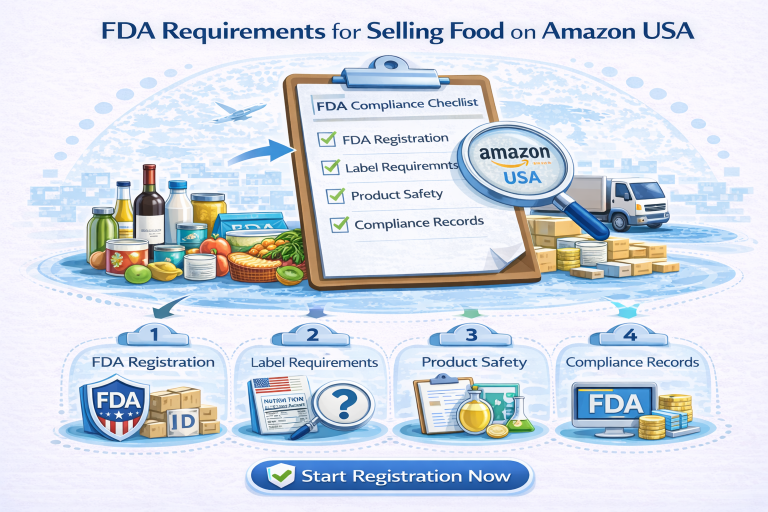
FDA Requirements for Selling Food on Amazon USA
The Two Amazon Food Seller Scenarios — and What Each Requires
Most Amazon food compliance problems start with sellers misidentifying their role. Here is the complete obligation map for each scenario:
Most Amazon private label food brands. You source from a foreign manufacturer and import to Amazon FBA — directly or through a 3PL.
- ✅FSVP — written hazard analysis + supplier verification for every foreign supplier under 21 CFR Part 1 Subpart L
- ✅Supplier FDA registration — verify your manufacturer is registered and current (biennial renewal)
- ✅U.S. Agent — your foreign manufacturer must have one with a physical U.S. address
- ✅FDA-compliant labeling — Nutrition Facts, allergens (incl. sesame), ingredient list, English text
- ✅Prior Notice — filed before every shipment; consignee = you, not Amazon
You manufacture, process, pack, repack, relabel, or hold food for U.S. distribution at your own facility — domestic or foreign.
- ✅FDA Food Facility Registration — required under 21 CFR Part 1 Subpart H before any food enters U.S. distribution
- ✅Biennial renewal — October–December of even years; missed renewal blocks all U.S.-bound shipments
- ✅U.S. Agent — required for all foreign-facility registrations
- ✅FSMA Preventive Controls — written food safety plan under 21 CFR Part 117
- ✅FDA-compliant labeling for all products distributed in the United States
Many Amazon sellers are both. A private label brand that imports products AND stores them at its own U.S. warehouse before shipping to Amazon FBA may need FSVP compliance as an importer AND facility registration for the domestic storage location if it repacks or relabels there. FDA Registration Assistance identifies which obligations apply to each part of your specific model.
Amazon's Own FDA Registration Does Not Cover Your Products
Amazon's fulfillment centers store food for distribution, which means Amazon itself maintains FDA food facility registrations for its FBA network as food holders. Many Amazon sellers assume this covers their compliance. It does not:
What Amazon's Registration Covers
Amazon's facility registrations cover Amazon's activity as a food holder — the physical act of storing food in its fulfillment centers. This is Amazon's own regulatory obligation for its own operations. It has no bearing on whether your manufacturing facility is registered, your labeling is compliant, or your FSVP is in place.
What You Still Need Separately
Your foreign food manufacturer must have its own separate FDA registration. You as the importer must have your own FSVP. Your products must carry FDA-compliant labels. Your Prior Notice must identify your manufacturing facility by its registration number. None of these are covered by Amazon's holding registration.
FDA Labeling Compliance — The Dual Risk of Amazon and FDA Enforcement
Labeling violations on Amazon food products create compounding risk: FDA enforcement at import or post-market AND Amazon account health action from customer complaints. The two enforcement paths are independent of each other — Amazon does not wait for FDA to act before taking listing or account action.
Missing Allergen Declarations
Undeclared allergens are the #1 cause of Amazon food listing holds and FDA import detentions. Nine major allergens must be declared: milk, eggs, fish, shellfish, tree nuts, peanuts, wheat, soybeans, and sesame (effective January 2023 under the FASTER Act). A customer complaint about an undeclared allergen triggers both an Amazon listing investigation and potentially an FDA inquiry simultaneously.
Wrong Serving Size
The Nutrition Facts panel must use the U.S. Reference Amount Customarily Consumed (RACC) for the product category — not a European or home-country serving size. For example, the U.S. RACC for chocolate candy is 40g; for cooking oil it is 1 tablespoon (15mL). Wrong serving sizes affect every nutrient declaration on the panel and are a common import detention cause.
Foreign-Language Labels
All required label information — statement of identity, ingredient list, allergen declarations, directions — must appear in English. Labels in a foreign language only, or with English text below a non-U.S.-format Nutrition Facts panel, are non-compliant and will be detained at import. Amazon also requires English as the primary label language for U.S. listings.
Prior Notice for Amazon FBA — Don't List Amazon as the Consignee
One of the most common Prior Notice errors for Amazon FBA sellers: listing Amazon as the ultimate consignee in the Prior Notice filing instead of the U.S. importer of record (the Amazon brand or company that owns the goods).
Who the Consignee Should Be
The ultimate consignee in FDA Prior Notice should be the U.S. importer of record — typically your Amazon brand's legal entity. This is the party responsible for FSVP compliance and the party to whom the food shipment is legally consigned at time of U.S. entry. The manufacturer must be the FDA-registered foreign food facility, not a trading company or freight forwarder.
What Happens When It's Wrong
An FDA Prior Notice listing Amazon or a freight forwarder as the manufacturer or consignee is an accuracy violation. Inaccurate Prior Notice triggers an FDA hold on the shipment — meaning your inventory sits at the port while detention fees accumulate and your FBA receiving appointment passes. FDA Registration Assistance reviews Prior Notice accuracy before every shipment.
7 FDA Compliance Mistakes That Derail Amazon Food Launches
Complete FDA Compliance Services for Amazon Food Sellers
Ready to Sell Food on Amazon USA with Full FDA Compliance?
FDA Registration Assistance provides complete FDA compliance for Amazon food sellers — FSVP, supplier registration, U.S. Agent, label review, Prior Notice guidance, and Amazon compliance documentation — all managed as one coordinated program. 1,000+ clients. 135+ countries. 15+ years of FDA regulatory experience.
Contact us at info@fdaregistrationassistance.com or call +1 (928) 275-8333.
Frequently Asked Questions — FDA Requirements for Selling Food on Amazon USA
1. What FDA requirements apply to selling food on Amazon USA?
If you import food (most Amazon private label brands): FSVP for each foreign supplier; supplier FDA registration verification; FDA-compliant labeling; and Prior Notice for every shipment. If you operate a food facility: FDA Food Facility Registration with biennial renewal. Most sellers are importers with FSVP obligations.
2. Do I need FDA registration to sell food on Amazon?
The food manufacturing or processing facility needs FDA registration — not your Amazon seller account. Your foreign manufacturer must be registered under 21 CFR Part 1. If you operate a U.S. food facility, that facility must register. Your Amazon seller account itself does not require FDA registration.
3. Am I the importer of record for my Amazon private label food brand?
In most Amazon private label scenarios, yes — if your brand's entity appears on the CBP entry as the consignee. The importer of record bears the FSVP obligations under 21 CFR Part 1 Subpart L. If goods go through a 3PL that takes consignment first, the 3PL may be the importer of record. FDA Registration Assistance reviews your supply chain structure to confirm who bears the FSVP obligation.
4. Does Amazon's FDA registration cover my products?
No. Amazon maintains its own FDA food facility registrations for its fulfillment centers as food holders. This covers Amazon's holding activity only — not your manufacturer's registration, not your labeling compliance, not your FSVP. Your foreign food manufacturer needs a separate, independent FDA registration.
5. What documents does Amazon request for FDA compliance?
Amazon may request: FDA Food Facility Registration number or verification letter for the manufacturing facility; FSVP documentation; third-party lab test reports for certain categories (supplements, baby food); allergen compliance attestations; and product compliance documentation. FDA Registration Assistance prepares all of these documents proactively so they are ready when Amazon asks.
6. Can Amazon suspend my account for FDA compliance issues?
Yes. Amazon can restrict listings or suspend accounts when FDA compliance issues surface — particularly undeclared allergens triggering customer complaints, import detentions blocking inventory, or FDA Warning Letters or recalls associated with ASINs. A labeling violation creates both FDA enforcement risk and Amazon account health risk simultaneously.
7. What is FSVP and why does it matter for Amazon sellers?
FSVP under 21 CFR Part 1 Subpart L requires U.S. food importers to verify foreign suppliers meet FDA food safety standards — written hazard analysis, documented supplier verification activities, corrective actions, 2-year recordkeeping. As an Amazon brand importing food, you are typically a U.S. food importer. FDA inspects FSVP records — missing programs result in Form 483 observations and Warning Letters.
8. What is Prior Notice and how does it affect Amazon FBA?
FDA Prior Notice is required before every food import — 8 hours for ocean. For Amazon FBA, the Prior Notice ultimate consignee should be the U.S. importer of record (your brand) — not Amazon. Listing Amazon as the consignee is an accuracy violation that triggers FDA holds and delays FBA receiving.
9. Does my foreign food manufacturer need a U.S. Agent?
Yes. Foreign food facilities registered with FDA must designate a U.S. Agent with a physical U.S. address. Amazon sometimes requests confirmation of the U.S. Agent on file as part of compliance documentation. FDA Registration Assistance provides U.S. Agent services for foreign food manufacturers supplying Amazon sellers.
10. What labeling requirements apply to Amazon USA food products?
Under 21 CFR Part 101: English statement of identity; net quantity in U.S. units; current U.S.-format Nutrition Facts panel with correct RACC serving size; complete ingredient list in descending order; allergen declarations for all nine FALCPA and FASTER Act allergens (including sesame since January 2023); and manufacturer/distributor name and address.
11. Is sesame allergen declaration required for Amazon food products?
Yes. Sesame became the 9th major U.S. food allergen under the FASTER Act effective January 1, 2023. All Amazon food products containing sesame seeds, sesame oil, sesame paste, or tahini must include a sesame allergen declaration. Amazon has taken listing action on products missing sesame declarations following customer complaints.
12. What are the most common FDA compliance mistakes Amazon food sellers make?
Most common: no FSVP program; supplier FDA registration expired or never completed; missing sesame allergen declaration; Nutrition Facts with wrong U.S. serving size; listing Amazon as the Prior Notice consignee; assuming co-packer compliance covers all import obligations; and going live on Amazon before FDA compliance is in place.
13. What happens if my Amazon FBA food shipment is detained by FDA?
Detention fees accumulate daily; FBA receiving appointments are missed; inventory is delayed or refused entry; Amazon stock levels drop; and serious cases trigger Amazon account reviews. FDA Registration Assistance identifies the cause and prepares the corrective response for fastest possible release.
14. Does selling on Amazon remove FDA requirements?
No. FDA requirements apply based on your role (importer, manufacturer, distributor) — not your sales channel. Amazon being between you and the consumer does not remove facility registration, FSVP, labeling, or Prior Notice obligations.
15. If I use a co-packer, do I still have FDA obligations?
Yes — depending on your structure. Domestic co-packer: your brand label makes you the responsible firm. Foreign co-packer: you are typically the importer of record with full FSVP obligations. Imported ingredients: FSVP may apply to ingredient imports even if a domestic co-packer does the formulation.
16. Do dietary supplements sold on Amazon need different FDA compliance?
Yes. Supplement facilities must comply with cGMP under 21 CFR Part 111. Supplements use Supplement Facts panels. Health and structure/function claim rules differ from food. Amazon requires third-party test reports for certain supplement categories. New ingredients introduced after October 15, 1994 require a 75-day NDI notification to FDA.
17. What is the difference between Direct-to-FBA and 3PL-to-FBA for FDA compliance?
Direct-to-FBA: you are typically the importer of record with full FSVP obligations; Prior Notice consignee is you, not Amazon. 3PL-to-FBA: the 3PL may be the importer of record depending on the consignment structure, which could shift FSVP obligation. FDA Registration Assistance reviews your logistics structure to confirm Prior Notice and FSVP responsibilities.
18. How does biennial renewal affect my Amazon supply chain?
If your foreign food supplier's FDA registration expires, every shipment from that facility can be detained — blocking new inventory from reaching Amazon FBA. Suppliers may not notify brands when their registration expires. FDA Registration Assistance monitors and manages biennial renewal for all supplier registrations.
19. Can FDA Registration Assistance prepare my Amazon compliance documentation?
Yes. FDA Registration Assistance prepares all FDA compliance documentation that Amazon may request — facility registration confirmation, verification letters, FSVP documentation, supplier verification records, and label compliance attestations — so your documentation is ready when Amazon asks.
20. Does Amazon verify FDA compliance before allowing a food listing?
Amazon does not verify FDA compliance before accepting most food listings. However, Amazon may request compliance documentation at any point post-listing — during account review, in response to customer complaints, or during periodic category audits. The absence of upfront verification does not mean compliance is optional.
21. What is an FSVP Agent and do Amazon food sellers need one?
An FSVP Agent develops, implements, and maintains the FSVP program on behalf of the U.S. importer. Most Amazon private label food brands benefit from using an FSVP Agent — particularly those importing from multiple suppliers or those who have launched without any FSVP in place. FDA Registration Assistance serves as FSVP Agent for Amazon food sellers.
22. What happens if my supplier gets an Import Alert?
An Import Alert on your supplier causes DWPE — every future shipment is automatically detained. Existing Amazon FBA inventory is not immediately affected but cannot be replenished once sold out. FDA Registration Assistance advises on Import Alert remediation and alternative supplier qualification to minimize Amazon inventory disruption.
23. Do U.S.-based Amazon food sellers need a U.S. Agent?
The U.S. Agent requirement applies to foreign food facilities — not to the U.S. Amazon brand. If you are a U.S. brand importing from a foreign manufacturer, the foreign manufacturing facility needs a U.S. Agent. Your U.S. brand entity itself does not need one.
24. What services does FDA Registration Assistance provide for Amazon food sellers?
Complete FDA compliance: FSVP program development and Agent services; supplier FDA registration verification and management; U.S. Agent services; food label compliance review; Prior Notice accuracy review; Amazon compliance documentation preparation; import detention resolution; and ongoing compliance maintenance. 1,000+ clients. 135+ countries.
25. How do I get started with FDA compliance for my Amazon food brand?
Contact FDA Registration Assistance at info@fdaregistrationassistance.com or call +1 (928) 275-8333. Provide your Amazon brand name, food products, foreign suppliers, countries of origin, and any existing compliance documentation. FDA Registration Assistance assesses your current compliance posture, identifies all gaps, and builds your complete FDA compliance program.