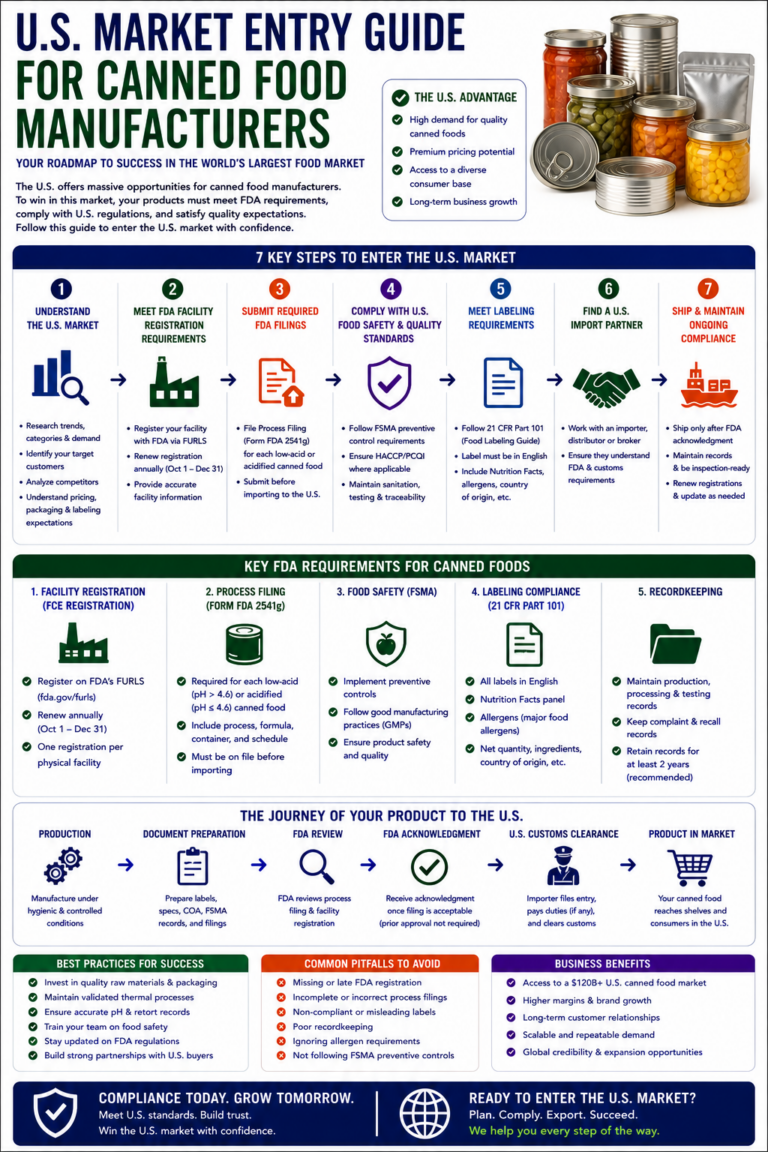
U.S. Market Entry for Canned Food Manufacturers
The full market-entry roadmap for canned food — centered on the FCE, scheduled process, and process-authority requirements that are unique to canned goods.
Key Takeaways
- Canned food = an extra layer — FCE, scheduled process, and process authority on top of the basics.
- Classification comes first — low-acid vs. acidified decides your whole path.
- FCE is separate from registration — and required before you can file.
- Every product needs a scheduled process — validated, and matching production.
- A process authority is mandatory — filings aren't accepted without validation.
- Higher scrutiny is by design — thermal-processed, sealed, shelf-stable foods carry real risk.
Step 1: Low-Acid or Acidified?
This single classification decides which rules, filings, and processing standards apply. Get it right first — everything downstream depends on it:
- Canned vegetables, meats, soups, beans, milk-based products
- Requires a validated thermal process for commercial sterility Part 113
- FCE registration + scheduled process filing
- Pickles, some sauces, salsas, marinated or brined products
- Governed by the acidified foods rules Part 114
- FCE registration + scheduled process filing
FCE → Scheduled Process → Process Authority
Once classified, LACF and acidified foods move through a chain that standard food imports don't have. Each link depends on the one before it:
Register as a Food Canning Establishment (FCE)
A separate registration from your Food Facility Registration, identifying the canning plant to FDA for LACF and acidified foods. It must be in place before you can file. Part 108
Have a process authority establish the process
A competent process authority determines and validates the scheduled thermal process — the time, temperature, pressure, and container factors that make the product safe. Filings rely on this; without it they aren't accepted.
File the scheduled process
File the validated process for each product, container size, and process variation. The filing must match actual production — mismatches and omissions are a top cause of holds.
Keep production true to the filing
Operate to the scheduled process and keep records. If you change formulation, container, or process, the filing (and often the validation) has to be updated too.
Why Canned Foods Face Higher Scrutiny
The added requirements aren't bureaucratic — they exist because of a specific hazard:
A sealed, shelf-stable environment
Low-acid canned foods are hermetically sealed and stored at room temperature — precisely the anaerobic, low-acid conditions where Clostridium botulinum can be dangerous if the process fails.
Safety rests on the process
There's no later kill step for the consumer — safety is built in at processing, through a validated thermal process achieving commercial sterility. That's why FDA requires the process to be established, filed, and followed.
Plus the Standard Entry Requirements
Alongside the canned-specific chain, canned food manufacturers still complete the same core requirements as any food exporter:
- Food Facility Registration + U.S. Agent — an active registration for the plant; foreign facilities designate a U.S. Agent.
- Compliant labeling — identity, Nutrition Facts, ingredients, allergens, net quantity, responsible party — matching your filing. See labeling rules.
- An FSVP-compliant importer — your U.S. importer runs the Foreign Supplier Verification Program and holds the records.
- Consistent documentation — invoice, bill of lading, packing list, specs, and any COAs, all matching your filings.
- Prior notice — filed to FDA before arrival, usually by your customs broker or importer.
The Canned-Food Entry Sequence
Classify the product
Low-acid canned or acidified — this sets the entire path.
Register the facility & FCE
Food Facility Registration (+ U.S. Agent) and Food Canning Establishment.
Establish the process with a process authority
Validate the scheduled thermal process for each product and container.
File scheduled processes
One per product, container, and variation — matching production.
Make the label & importer compliant
Label matches the filing; an FSVP importer is in place.
Prepare documents & prior notice
Consistent paperwork; prior notice filed before arrival.
Clear the Compliance Gate, Then Grow
FDA Registration Assistance handles the FDA side for canned food manufacturers end to end: Food Facility Registration and U.S. Agent, FCE registration, scheduled process filings with process-authority coordination, plus label and documentation review and FSVP support. Our focus is compliance — once your product can legally enter, the retail, e-commerce, and foodservice channels are yours to pursue.
Contact us at info@fdaregistrationassistance.com or call +1 (928) 275-8333. Food Facility Registration is available starting at $858. Trusted by companies across 135+ countries, with 15+ years of experience.
Frequently Asked Questions
1. What does a canned food manufacturer need to enter the U.S. market?
The standard import requirements — facility registration, a U.S. Agent for foreign facilities, a compliant label, an FSVP importer, documentation, and prior notice — plus a canned-food layer: classification as low-acid or acidified, Food Canning Establishment (FCE) registration, scheduled process filings, and process-authority validation. The canned-specific pieces are what most trip manufacturers up.
2. What makes canned food different from other food imports?
Safety depends on validated thermal processing. Low-acid canned and acidified foods are sealed and shelf-stable, which is exactly the environment where Clostridium botulinum can be dangerous if the process is wrong. So FDA layers extra requirements — FCE registration, filed scheduled processes, and process-authority validation — on top of the usual import rules.
3. Is my product low-acid or acidified?
A low-acid canned food (LACF) has a finished equilibrium pH above 4.6 and water activity above 0.85. An acidified food has acid or acidic ingredients added to bring a low-acid food to a finished equilibrium pH of 4.6 or below. Foods that are naturally acid (pH at or below 4.6 without added acid) generally fall under neither. This classification decides which rules and filings apply.
4. What is an FCE?
A Food Canning Establishment registration identifies your processing plant to FDA for low-acid canned and acidified foods (21 CFR Part 108). It's separate from your Food Facility Registration and must be in place before you can file scheduled processes — a missing FCE is a frequent cause of shipment delays.
5. What is a scheduled process filing?
It's the filed description of how each product is processed to be safe — time, temperature, pressure, container size, and other critical factors — for each product, container, and process variation. The filing must match actual production, and incorrect or missing filings can trigger FDA holds.
6. Do I need a process authority?
Yes, for regulated canned foods. A competent process authority establishes and validates the scheduled thermal process, confirming it achieves the required safety. Your filings rely on that validation — without it, they generally won't be accepted. It's the technical foundation the rest of the canned-food compliance sits on.
7. Do all canned foods require FCE and scheduled process filings?
Not all — but low-acid canned foods and acidified foods do, which covers a large share of shelf-stable canned products. Naturally acid foods and some other categories may not. That's why correct classification is the first step: it tells you whether the FCE and filing requirements apply to you.
8. Does FDA approve my canned food before sale?
No. FDA doesn't pre-approve the product or the label. But for canned foods it does require the FCE registration and scheduled process filings before you're operating lawfully, and it reviews shipments at import. There's no approval to win, but there are mandatory filings to complete.
9. Can labeling errors delay a canned food shipment?
Yes. Labeling is a common cause of holds, and for canned foods there's an extra dimension: the label must be consistent with your scheduled process filing and formulation. A label that contradicts the filing is a discrepancy that can stop the shipment.
10. Who submits prior notice?
Prior notice must reach FDA before the shipment arrives and is usually filed by your customs broker or importer. It needs to be accurate and consistent with your registration and filings; errors can lead to refusal at entry.
11. How long does it take to get compliant?
Registration and FCE can be arranged relatively quickly, but the process-authority validation and scheduled process filings take longer because they involve technical review of each product and container. Start well before your intended ship date, since these steps can't be rushed at the border.
12. Can I fix compliance issues after shipping?
In most cases, no. Missing FCE, filings, or validation can't be resolved once the shipment is at the border, and the product can be held, detained, or refused. Canned-food compliance has to be complete before export.
13. Do you also help with distribution or sales?
Our focus is regulatory compliance, not sales or distribution. What we do is clear the compliance gate — once your product can legally enter, the retail, e-commerce, and foodservice channels are open to you to pursue. We make sure nothing on the FDA side stands between your product and the market.
14. How does FDA Registration Assistance help canned food manufacturers?
We handle the FDA side end to end: Food Facility Registration and U.S. Agent, FCE registration, scheduled process filings, coordination with a process authority, plus label and documentation review and FSVP support — all aligned before you ship. Starting at $858 for registration, for companies across 135+ countries. Contact info@fdaregistrationassistance.com or +1 (928) 275-8333.