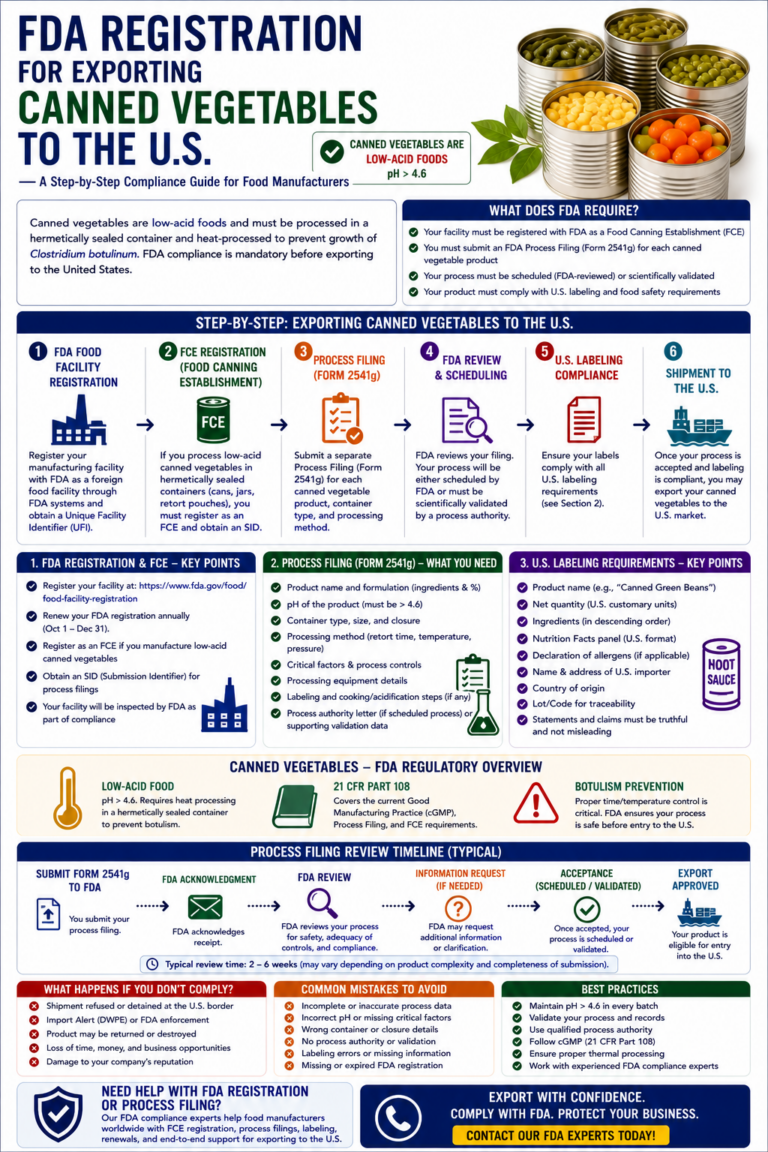
FDA Registration for Exporting Canned Vegetables to the U.S.
Trusted by 1,000+ companies across 135+ countries, with 15+ years of FDA regulatory experience. Below: why canned vegetables need the extra LACF layer, the full export checklist, and what each filing involves.
Canned Vegetables Are Low-Acid Canned Foods
Most canned vegetables have a finished pH above 4.6 and are shelf-stable in sealed containers — the exact conditions where Clostridium botulinum can grow and produce a deadly toxin if processing isn't validated. That's why the FDA treats them as low-acid canned foods (LACF) under 21 CFR Part 113, with requirements well beyond standard food registration.
Everything You Need to Export Canned Vegetables
Which Canned Vegetables Are LACF vs. Acidified?
The filing form depends on how safety is achieved. Most plain canned vegetables are low-acid; pickled or acid-added versions are acidified.
| Low-Acid Canned — file Form 2541d | Acidified — file Form 2541e |
|---|---|
| Corn, green beans, peas | Pickled cucumbers & gherkins |
| Carrots, beets, potatoes | Pickled peppers & banana peppers |
| Mushrooms, asparagus | Marinated or brined vegetables |
| Spinach, mixed vegetables | Acidified artichoke hearts |
Either way, FCE registration is required. When pH sits near the 4.6 line, a process authority confirms the correct classification before you file.
Export Your Canned Vegetables Without Delays
Send us your products, container sizes, and facility details. We'll handle food facility registration and U.S. Agent service, complete FCE and SID filings, coordinate a process authority, support FSVP, and review your labels — so your canned vegetables clear the FDA the first time. Email info@fdaregistrationassistance.com or call +1 (928) 275-8333.
Frequently Asked Questions — Exporting Canned Vegetables to the U.S.
Do canned vegetables need FDA registration to be exported to the U.S.?
Yes. The producing facility must complete FDA food facility registration, and because canned vegetables are low-acid canned foods, they also require FCE registration and a SID process filing. Foreign facilities additionally need a U.S. Agent.
Why are canned vegetables regulated more strictly than other foods?
Most canned vegetables are low-acid (pH above 4.6) and shelf-stable, which makes Clostridium botulinum (botulism) a real risk. The FDA requires a validated thermal process and process filings to control it.
What's the difference between food facility registration and FCE registration?
Food facility registration (Form FDA 3537) registers the establishment under 21 CFR Part 1 Subpart H. FCE registration (Form FDA 2541) is a separate registration specific to canned-food processors — see what foods require FCE/SID filing. Canned vegetables need both.
What is a SID for canned vegetables?
A Submission Identifier — the number assigned to each scheduled-process filing (Form FDA 2541d) for a specific product and container size. See our explainer on the SID number and process filing.
Do I need a process authority?
Yes. A qualified process authority establishes and validates the scheduled thermal process for your canned vegetables, and that determination supports your SID filing. The FDA expects one to be involved.
How much does FDA registration for canned vegetables cost?
Our FDA registration service fee is $858, which covers food facility registration and U.S. Agent service. The FDA itself charges $0 to register. FCE registration, SID process filings, and process-authority validation for low-acid canned foods are handled as additional scope.
Does the FDA charge a fee to register?
No. The FDA does not charge for food facility registration or for FCE and SID filings. Our fee covers completing and managing the process correctly so nothing is missed before shipping.
Is a DUNS Number required?
Yes. The DUNS Number is the required Unique Facility Identifier for food facility registration. We help you obtain one if you don't already have it, so it does not delay the filing.
Does FDA registration mean my canned vegetables are FDA approved?
No. The FDA does not approve foods. Registration and process filing are mandatory requirements, but they are separate from any notion of FDA “approval” — a distinction worth keeping clear in your marketing.
Which canned vegetables are low-acid canned foods?
Corn, green beans, peas, carrots, mushrooms, asparagus, potatoes, beets, spinach, and mixed vegetables are typically low-acid canned foods. Pickled or acidified vegetables follow the acidified-foods path instead.
Are pickled vegetables treated the same as canned vegetables?
Not quite. Pickled or acidified vegetables are acidified foods — acid added to reach pH 4.6 or below — and file on Form FDA 2541e, while low-acid canned vegetables file on Form FDA 2541d. Both still need FCE registration.
What happens if I skip FCE or SID filings?
Missing or incorrect FCE and SID filings are among the most common reasons canned vegetable shipments are detained or refused at the port of entry. They must be in place before shipping.
What labeling do canned vegetables need?
A compliant Nutrition Facts panel, ingredient list, product identity, net quantity in U.S. units, name and place of business, English text, and any allergen declarations — see fixing a food label before import. The label must match the filed process.
Who handles FSVP for canned vegetables?
The U.S. importer is responsible for the Foreign Supplier Verification Program, verifying your facility and keeping records. We can support FSVP and act as the FSVP Agent where needed.
Is Prior Notice required?
Yes. Every shipment of canned vegetables to the U.S. requires FDA Prior Notice before arrival. Errors in Prior Notice can cause immediate refusal at the port.
Do foreign canned vegetable producers need a U.S. Agent?
Yes. Every foreign facility that registers with the FDA must designate a U.S. Agent under 21 CFR 1.227 as its U.S. point of contact. We provide this service.
How long does the registration process take?
Food facility registration is often completed within a few business days once information and a valid DUNS Number are provided. FCE/SID filings and process-authority validation can take longer depending on your range of products and container sizes.
How many SID filings do I need?
Generally one per product, process, and container size. A producer with several canned vegetable products or can sizes needs multiple SID filings.
Does each can size need its own SID?
Usually yes. Because thermal processing depends on container size, different can or jar sizes generally require separate scheduled-process filings.
Do canned vegetables need to be renewed with the FDA?
Food facility registration must be renewed biennially — every two years, in even-numbered years. FCE registration and SID filings are updated whenever products, processes, or containers change.
Can you fix an issue after my shipment is held?
We can help respond to holds, detentions, and import alerts, but the goal is to complete every filing correctly before shipping, since process filings can't be created retroactively for a shipment already in transit.
What documents should accompany the shipment?
A commercial invoice, bill of lading or airway bill, packing list, product specifications, and certificates of analysis where applicable — all consistent with your filings and labels.
Do I need Better Process Control School?
Supervisors of low-acid canned food processing generally must be trained, typically through Better Process Control School, as part of meeting the 21 CFR Part 113 requirements.
Can you handle everything for me?
Yes. We complete food facility registration and U.S. Agent service, handle FCE registration and SID filings, coordinate a process authority, support FSVP, and review labeling so your canned vegetables clear the FDA.
How do I get started?
Contact FDA Registration Assistance with your products, container sizes, and facility details. Reach our team and we'll map the full LACF compliance path and begin the filings. Email info@fdaregistrationassistance.com or call +1 (928) 275-8333.