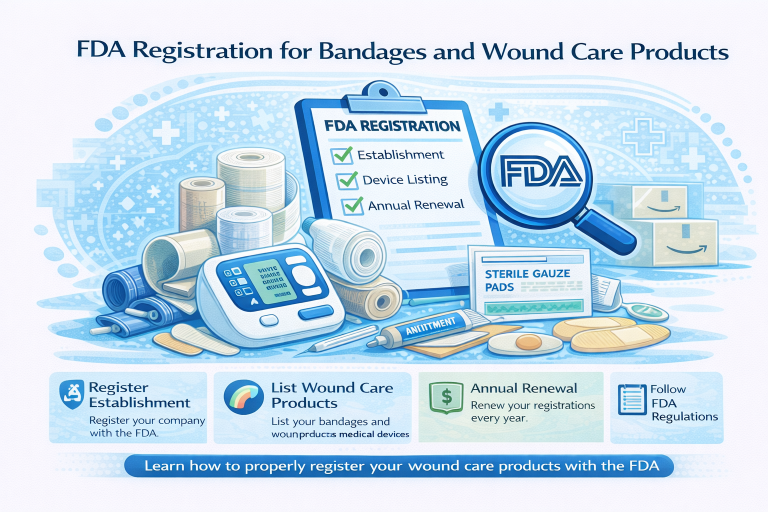
FDA Registration for Bandages & Wound Care Products
This guide covers the wound-care classification ladder, what 510(k)-exempt actually still requires, when a dressing crosses into a 510(k) or a drug, the QMSR transition that took effect in February 2026, and the registration, listing, labeling, and U.S. Agent steps for device makers and importers.
How Wound Care Products Are Classified — and What Each Needs
| Product | Typical Class | 510(k)? | Registration + Listing | Example Regulation |
|---|---|---|---|---|
| Adhesive bandages | Class I | Usually exempt | Required | 21 CFR 880.5240 |
| Gauze / sponge (external use) | Class I | Usually exempt | Required | 21 CFR 878.4014 |
| Hydrophilic / hydrocolloid dressing | Class I (often) | Often exempt | Required | 21 CFR 878.4018 |
| Antimicrobial / silver dressing | Class II | 510(k) Required | Required | Class II, antimicrobial product code |
| Dressing containing an antibiotic / active drug | Drug or combination | Drug / combination pathway | Required | Combination-product review |
Class and product code depend on materials and claims; this table is a guide, not a determination. We confirm the exact pathway per product.
“510(k)-Exempt” Doesn't Mean “Exempt From the FDA”
Many wound-care sellers see “exempt” and assume there is nothing to do. A 510(k) exemption only removes one step — premarket notification. Everything else still applies.
Note the difference from food: device establishment registration is not free. An annual FDA user fee applies, set each fiscal year, separate from any 510(k) fee.
When a Bandage Crosses Into a 510(k) — or a Drug
The product itself often matters less than the claim. The same dressing can sit in three different regulatory buckets depending on what you say it does.
Stays Class I (often exempt)
Covers and protects a wound, absorbs exudate, provides a moist environment, cushions or holds a dressing in place — physical, non-therapeutic functions with no drug and no antimicrobial claim.
Escalates to 510(k) or a drug
Antimicrobial / “kills bacteria” / silver → typically Class II (510(k)). Contains an antibiotic or claims to actively treat infection → drug or combination product. “FDA-approved” on a Class I/II device → a misbranding problem in itself.
What FDA Compliance Actually Involves for Device Makers
| Step | What It Covers |
|---|---|
| 1. Classification & product code | Confirm the device class, product code, and whether it is 510(k)-exempt, based on materials, intended use, and claims. |
| 2. Establishment registration + U.S. Agent | Register the establishment under 21 CFR Part 807 (annual FDA fee applies); foreign establishments designate a U.S. Agent under 807.40. |
| 3. Device listing | List each marketed device with its classification and product code; keep it current. |
| 4. 510(k) (if Class II) | Prepare and submit a 510(k) demonstrating substantial equivalence to a predicate, where the class requires it. |
| 5. Quality system (QMSR) | Maintain a quality management system under 21 CFR Part 820 — now the QMSR aligned with ISO 13485:2016, effective February 2, 2026. |
| 6. Labeling, UDI & MDR | Compliant labeling under 21 CFR Part 801, UDI under Part 830, and Medical Device Reporting under Part 803. |
The governing rules are at 21 CFR Part 807 (registration & listing) on eCFR, with device classification in Parts 878 and 880 and the quality system in Part 820.
How We Support Bandage & Wound Care Companies
Classification & pathway review
Determine class, product code, and whether your product is 510(k)-exempt or needs a 510(k) — based on your materials and claims. Related: are surgical tools 510(k)-exempt?
Registration, listing & U.S. Agent
Establishment registration and device listing, with U.S. Agent service for foreign manufacturers.
510(k) preparation
Predicate identification and 510(k) submission for Class II dressings such as antimicrobial and silver products.
Labeling & claim review
Review labeling, UDI, and antimicrobial / healing claims so they match the device's classification and do not over-reach.
Get Your Wound Care Products FDA-Compliant
From a basic adhesive bandage to an antimicrobial advanced dressing, we confirm the classification and handle registration, listing, U.S. Agent service, 510(k) when needed, and labeling so your products reach the U.S. market cleanly. Trusted by 1,000+ companies across 135+ countries, with 15+ years of FDA regulatory experience. Email info@fdaregistrationassistance.com or call +1 (928) 275-8333.
Frequently Asked Questions — FDA Registration for Bandages & Wound Care
Are bandages and wound care products regulated by the FDA?
Yes, as medical devices regulated by the FDA's Center for Devices and Radiological Health (CDRH). The category spans adhesive bandages, gauze, surgical dressings, hydrocolloid and hydrogel dressings, and advanced or antimicrobial wound care. Each must meet device requirements before it is legally marketed in the U.S.
What class are bandages and wound dressings?
Most basic products are Class I — for example adhesive bandages under 21 CFR 880.5240 and gauze under 21 CFR 878.4014 — and many are 510(k)-exempt. More advanced products, such as antimicrobial or silver dressings and some hydrogels with therapeutic claims, are Class II and require a 510(k).
Does “510(k)-exempt” mean I have no FDA obligations?
No — this is the most common misconception in wound care. A 510(k) exemption only removes premarket notification. You still must complete FDA establishment registration and device listing, comply with the Quality Management System Regulation, meet labeling and UDI rules, and report adverse events under MDR.
Do I have to register my establishment even for simple bandages?
Yes. Any establishment that manufactures, repackages, relabels, or (for foreign firms) exports bandages or dressings to the U.S. must register as a device establishment under 21 CFR Part 807 and list each device — including Class I exempt ones.
Is there an FDA fee to register a device establishment?
Yes. Unlike food facility registration, device establishment registration carries an annual FDA establishment registration user fee that is set each fiscal year. It is a government fee, separate from any professional service fee and separate from a 510(k) fee.
Do foreign bandage manufacturers need a U.S. Agent?
Yes. A foreign device establishment must designate a U.S. Agent under 21 CFR 807.40 as its FDA point of contact. Foreign manufacturers also typically work with a U.S. initial importer who is separately registered with the FDA.
When does a wound dressing need a 510(k)?
When it is a Class II device — most often because of an antimicrobial component (such as silver), an advanced or interactive material, or a therapeutic claim. A 510(k) demonstrates that the product is substantially equivalent to a legally marketed predicate device.
When does a bandage become a drug or combination product?
When it delivers a drug or makes a drug-type claim — for example, a dressing containing an antibiotic, or one that claims to actively treat an infection. These can be regulated as drugs or as drug-device combination products, which is a different and stricter pathway than a standard device.
Are antimicrobial or “antibacterial” dressings treated differently?
Yes. An antimicrobial claim, such as a silver dressing, typically makes the product Class II requiring a 510(k), and an antibiotic-containing dressing may be a combination product. The claim you make is what drives the classification and the pathway.
Does the FDA “approve” bandages?
No. Class I and Class II devices are not “approved” — they are either exempt or cleared through a 510(k). Only Class III devices go through Premarket Approval (PMA), which essentially never applies to standard wound care. Marketing a bandage as “FDA-approved” is itself a labeling problem.
What is the Quality Management System Regulation (QMSR)?
As of February 2, 2026, the FDA's longstanding Quality System Regulation (21 CFR Part 820) was replaced by the Quality Management System Regulation (QMSR), which incorporates ISO 13485:2016. Device manufacturers — including bandage and dressing makers — must maintain a compliant quality management system.
What labeling applies to wound care devices?
Device labeling under 21 CFR Part 801: device identification, intended use, adequate directions for use, and any required warnings, plus Unique Device Identification (UDI) where applicable. Antimicrobial and healing claims must match the device's cleared or permitted intended use.
What is device listing?
Device listing is the electronic submission to the FDA identifying each device you market, along with its classification, product code, and proprietary name. It accompanies establishment registration and must be kept current as your product range changes.
Do I need UDI on my bandages?
Most devices require a Unique Device Identifier on labels and packages under 21 CFR Part 830, with timelines that depend on device class. Some Class I and exempt devices have specific UDI exceptions, which should be confirmed for your exact product and class.
What is Medical Device Reporting (MDR)?
Under 21 CFR Part 803, manufacturers and importers must report certain device-related deaths, serious injuries, and malfunctions to the FDA. A wound care company needs an MDR procedure in place even for low-risk products.
Can I sell bandages on Amazon or online without registering?
No. Online and marketplace sales do not change device requirements. Establishment registration, device listing, QMSR, and labeling all still apply, and marketplaces increasingly verify device compliance before allowing listings.
What product codes and regulations cover common dressings?
Examples include the adhesive bandage (21 CFR 880.5240), the nonresorbable gauze or sponge for external use (878.4014), and the hydrophilic wound dressing (878.4018). The exact product code and class depend on the materials used and the claims made.
Are hydrocolloid and hydrogel dressings exempt?
Many basic hydrophilic dressings are Class I, but it depends on materials and claims. Added antimicrobials, a drug component, or advanced-healing claims can move a dressing to Class II (requiring a 510(k)) or to combination-product status. Classification should be confirmed product by product.
What are the most common wound-care compliance mistakes?
Assuming “exempt” means “nothing to do,” skipping establishment registration or listing, making antimicrobial or “healing” claims that exceed the device's classification, missing UDI, and foreign manufacturers operating without a U.S. Agent.
Do importers of wound care devices have obligations?
Yes. A U.S. initial importer must register, and the foreign manufacturer must register and designate a U.S. Agent. Non-compliant devices can be detained or refused at the border — see import refusal & detention help.
How long does device registration and listing take?
Registration and listing can often be completed quickly once classification is confirmed and the annual establishment fee is paid. A 510(k), when required, takes substantially longer because it involves an FDA review of substantial equivalence to a predicate device.
Do I need a 510(k) if my product is identical to an existing brand?
Possibly not, if it falls within a 510(k)-exempt category. If it is in a 510(k) class, you generally still need your own clearance, although you can cite a predicate device. “It looks like a product already on the market” is not a substitute for confirming your own pathway.
What happens if my wound care product is not compliant?
Devices can be detained or refused at import, subject to enforcement such as warning letters or seizures, or removed from marketplaces. Misbranding from claims that exceed the device's classification is one of the most frequent triggers.
Can you determine my product's classification and pathway?
Yes. We review your product's materials, intended use, and claims to determine its class and product code, whether it is 510(k)-exempt or needs a 510(k), and the registration, listing, QMSR, and labeling steps that follow — related reading: are surgical tools 510(k)-exempt?.
How do I get my bandages and wound care products FDA-compliant?
Contact FDA Registration Assistance with your product, its materials, and the claims you intend to make. Reach our team and we handle classification, establishment registration, U.S. Agent service, device listing, a 510(k) when needed, and labeling review. Email info@fdaregistrationassistance.com or call +1 (928) 275-8333.