
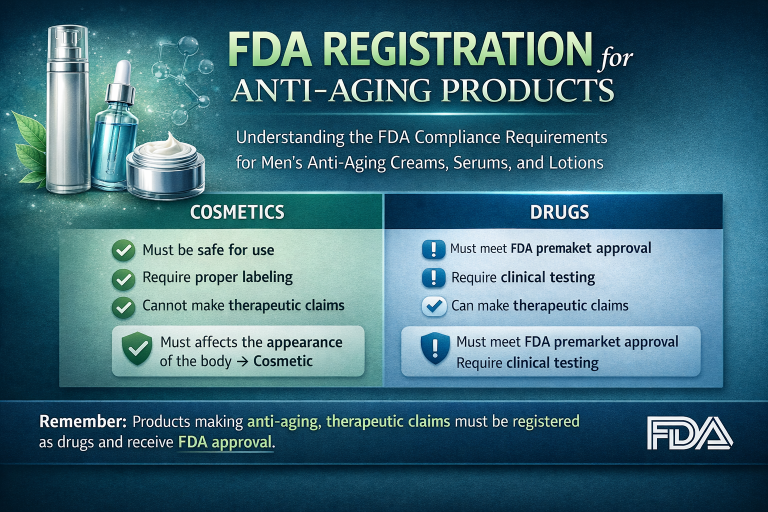
FDA Registration for Anti-Aging Products
When an anti-aging product is a cosmetic, the claims that turn it into a drug, and how to register — with links to the deeper skincare guides.
Key Takeaways
- Appearance claims = cosmetic — "reduces the appearance of wrinkles," "firmer-looking."
- Structure/function claims = drug — "boosts collagen," "rebuilds," "reverses aging."
- No OTC anti-aging monograph — a genuine anti-aging drug claim needs an NDA.
- SPF = drug — an anti-aging SPF moisturizer is a drug for its SPF.
- FDA reads your website too — not just the label.
- Keep claims to appearance — and registration ≠ approval.
Appearance (Cosmetic) vs Structure/Function (Drug)
| Cosmetic-safe (appearance) | Drug-triggering (structure/function or treat) |
|---|---|
| Reduces the appearance of fine lines & wrinkles | Boosts / stimulates collagen |
| Skin looks firmer / more refreshed | Rebuilds / repairs skin at a cellular level |
| Smooths & hydrates | Regenerates skin; reverses aging |
| Improves the look of tired skin | Treats a skin condition |
| "Anti-aging" positioning with appearance claims | Any SPF / sun-protection claim |
The Cosmetic (MoCRA) Path
- Facility registration + product listing + Responsible Person — via Cosmetics Direct; biennial renewal; U.S. Agent if foreign
- Safety substantiation — stability, preservative efficacy, and ingredient safety for the leave-on emulsion (retinol/peptides/acids)
- Adverse-event reporting — serious events within 15 business days; records kept
- Compliant labeling & claims — INCI, net quantity, adverse-event contact; appearance-only claims across label and website
Common Anti-Aging Mistakes
- Performance/mechanism claims — "boosts collagen," "rebuilds skin," "reverses aging" (a drug)
- Treating an SPF product as a cosmetic — SPF is a drug
- Ingredient-mechanism language — "retinol repairs the barrier"
- Website claims that exceed the label
- Incomplete product listings across the range
- Missing the U.S. Agent (foreign); "FDA approved" claims
Get Your Anti-Aging Line Compliant
FDA Registration Assistance reviews your claims (label, website, marketing) against the cosmetic/drug line, classifies each product in the range, and handles the right registration: MoCRA facility registration and product listing (with Responsible Person, U.S. Agent, safety, and labeling) for cosmetic anti-aging products, or drug establishment registration and Drug Facts for SPF or treatment products. (Marketing to men? See men's anti-aging.)
Contact us at info@fdaregistrationassistance.com or call +1 (928) 275-8333 for a quote. An independent compliance firm serving 1,000+ companies across 135+ countries, with 15+ years of experience.
Frequently Asked Questions — Anti-Aging Products
1. Do anti-aging products require FDA registration?
Most do, as cosmetics. Anti-aging creams, serums, eye treatments, and moisturizers are cosmetics when they're intended to improve the appearance of skin, so they follow MoCRA: facility registration, product listing, a Responsible Person, safety substantiation, adverse-event reporting, and labeling (U.S. Agent if foreign). FDA doesn't approve cosmetics, but registration and compliance are required. The exception is a product that makes a drug claim or contains SPF - that's an OTC drug on a different path.
2. When is an anti-aging product a cosmetic vs a drug?
Cosmetic when it improves appearance: "reduces the appearance of fine lines and wrinkles," "skin looks firmer," "smooths," "hydrates." Drug when it claims to affect the skin's structure/function or treat a condition: "boosts/stimulates collagen," "rebuilds/repairs skin at a cellular level," "regenerates," "reverses aging." And any SPF/sun-protection claim makes it a drug. The claims decide the category - the product can be identical either way.
3. Why does "boosts collagen" make it a drug?
Because increasing the skin's collagen production affects the skin's structure/function, which is the definition of a drug effect. "Reduces the appearance of wrinkles" (a look) is cosmetic; "boosts collagen" or "removes wrinkles" (a physiological change) is a drug claim. It's the single most common way an anti-aging cosmetic tips into being an unapproved drug.
4. Is there an OTC monograph for anti-aging?
No. There's no OTC monograph for anti-aging, so a genuine anti-aging drug claim (boosting collagen, reversing aging, repairing at a cellular level) can't take an OTC shortcut - it would need an approved application (NDA), a substantial undertaking. This is why most anti-aging brands keep their claims to appearance and stay cosmetics: the drug route for a real anti-aging claim is heavy.
5. Are anti-aging products with SPF drugs?
Yes. Any anti-aging product that adds SPF/sun protection is an OTC drug under the sunscreen monograph, regardless of the anti-aging positioning - so an "anti-aging SPF moisturizer" is on the drug pathway (drug establishment registration, NDC, Drug Facts, sunscreen monograph) for its SPF. Sun protection is one of the most common ways an otherwise-cosmetic anti-aging product becomes (partly) a drug.
6. What is the cosmetic (MoCRA) path for anti-aging products?
Register the manufacturing facility with FDA (via Cosmetics Direct, with an FEI, and a U.S. Agent if foreign), list each product, designate a Responsible Person, maintain safety substantiation, set up adverse-event reporting, and use compliant labeling with appearance-only claims. Facility registration renews every two years and listings update at least annually. It's the standard MoCRA path for skincare.
7. What safety data do anti-aging products need?
MoCRA requires adequate safety substantiation for every cosmetic. Anti-aging products are typically leave-on emulsions, so the key data is stability, preservative-efficacy (challenge) testing, microbial limits, and ingredient/toxicological safety - especially for active-sounding ingredients like retinol, peptides, or acids. Records must be kept and available to FDA. Note that describing those ingredients by mechanism ("retinol rebuilds the barrier") can itself create a drug claim.
8. Is marketing something as "anti-aging" itself a drug claim?
Not on its own - it depends on the supporting claims. Marketing a product as "anti-aging" while keeping claims to appearance ("reduces the look of wrinkles," "firmer-looking skin") keeps it a cosmetic. It's the specific mechanism/treatment claims attached to "anti-aging" - stimulating collagen, reversing aging, repairing at a cellular level - that turn it into a drug. So "anti-aging" is fine as positioning if the claims stay about appearance.
9. Do I list every product in an anti-aging line?
Yes - listing is at the product level, so each product in the line (moisturizer, serum, eye cream, etc.) is listed with FDA and updated at least annually. A regimen or "kit" is a set of individual products, each classified on its own - the eye cream might be a cosmetic while an SPF day cream is a drug. Registering the facility but not listing all the products is a common gap.
10. Does FDA check my website claims for anti-aging products?
Yes. FDA determines a product's intended use from all consumer-facing communications - the label, the website, social media, and influencer content - not just the package. Anti-aging marketing leans on performance language ("rebuilds," "restores," "clinically boosts collagen"), which can create drug claims even if the label is clean. Review the whole presentation, because FDA will.
11. Do foreign anti-aging brands need to register?
Yes. Any anti-aging product marketed in the U.S. must comply regardless of where it's made, and foreign facilities need a U.S. Agent. A foreign cosmetic anti-aging product registers under MoCRA with a U.S. Agent; a foreign SPF or treatment product registers as a drug establishment with a U.S. Agent. Home-country claim norms don't transfer - a claim routine abroad may reclassify the product as a drug here.
12. Do "natural" or "clean" anti-aging products still need to comply?
Yes. "Natural," "clean," and "organic" are marketing terms that don't change regulatory status. A natural anti-aging cream is still a cosmetic under MoCRA and needs registration, listing, safety substantiation, and labeling - and a "natural" product with a collagen or SPF claim is still a drug. These terms describe positioning, not compliance.
13. What labeling do anti-aging products need?
A cosmetic anti-aging product needs cosmetic labeling: a Principal Display Panel (statement of identity, net quantity) and an information panel (INCI ingredient declaration, responsible-party name/address, any required warnings, and the MoCRA adverse-event contact) - with appearance-only claims and no "FDA Approved." An SPF or treatment product (a drug) needs a Drug Facts panel. The label - and the website - must match the classification.
14. Does registering my anti-aging product mean it's FDA-approved?
No. FDA doesn't approve cosmetics, and OTC monograph drugs (like an SPF product) are "compliance, not approval." So an anti-aging cosmetic isn't "FDA-approved." Calling it that because it's registered is misleading. The accurate statement is that your facility is registered and your products are listed.
15. What are the most common anti-aging compliance mistakes?
Performance/mechanism claims that turn a cosmetic into a drug ("boosts collagen," "rebuilds skin," "reverses aging"); treating an SPF product as a cosmetic; ingredient-mechanism language ("retinol repairs the barrier"); website claims that exceed the label; assuming "natural" is exempt; incomplete product listings; missing the U.S. Agent (foreign); and "FDA approved." Almost all trace back to claims - keep them to appearance to stay a cosmetic.
16. How does FDA Registration Assistance help anti-aging brands?
We review your claims (label, website, marketing) against the cosmetic/drug line, classify each product in the range, and handle the right registration: MoCRA facility registration and product listing (with Responsible Person, U.S. Agent, safety, and labeling) for cosmetic anti-aging products, or drug establishment registration and Drug Facts for SPF or treatment products. We're an independent compliance firm serving 1,000+ companies across 135+ countries with 15+ years of experience. Contact info@fdaregistrationassistance.com or +1 (928) 275-8333.
