
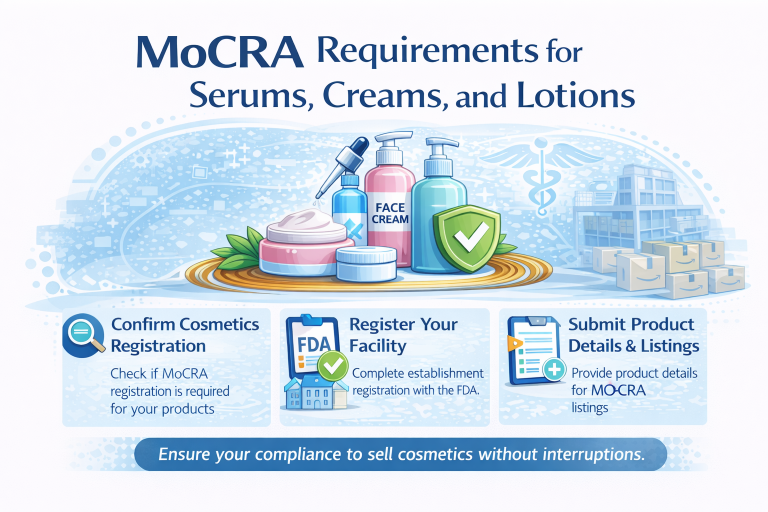
MoCRA Requirements for Serums, Creams & Lotions
The MoCRA path for skincare, the claims that turn a serum or cream into a drug, and the safety data these emulsions actually need.
Key Takeaways
- Leave-on skincare is a cosmetic — serums, creams, lotions almost always fall under MoCRA.
- The claim trap is the #1 risk — drug claims flip them out of MoCRA into the drug pathway.
- Appearance claims are safe — "moisturizes," "reduces the appearance of wrinkles."
- Structure/function & disease claims are drugs — "boosts collagen," "treats acne."
- Emulsion safety data — stability, preservative efficacy, microbial testing.
- Register, list each SKU, name a Responsible Person — plus a U.S. Agent if foreign.
Yes — These Are Cosmetics Under MoCRA
Facial serums, moisturizing creams and lotions, body butters, eye creams, hydrating and brightening formulations — leave-on skincare intended to moisturize or improve appearance is a cosmetic under the FD&C Act, so MoCRA applies. That brings facility registration, product listing, a Responsible Person, safety substantiation, adverse-event reporting, and labeling.
The Claim Trap — Cosmetic vs Drug
Serums, creams, and lotions are where drug claims most often slip in. The line is appearance (cosmetic) vs treating a condition or affecting the skin's structure/function (drug):
| Cosmetic-safe (appearance) | Drug-triggering (structure/function or disease) |
|---|---|
| Moisturizes / hydrates | Repairs / restores the skin barrier |
| Reduces the appearance of fine lines | Stimulates / boosts collagen |
| Improves the look of skin; skin looks firmer | Regenerates / renews skin cells |
| Brightens the look of dull skin | Lightens / treats hyperpigmentation |
| Smooths & softens | Treats acne, eczema, or rosacea |
Safety Substantiation for Emulsions
MoCRA requires adequate safety substantiation for every product and doesn't mandate a fixed test list — but serums, creams, and lotions are water-containing emulsions, so the scientifically robust data typically centers on:
- Stability testing — the emulsion holds up over shelf life and temperature
- Preservative-efficacy (challenge) testing — the preservative system controls microbial growth in a water-rich product
- Microbial limits — the finished product meets microbiological quality
- Packaging compatibility — the formula and container don't interact badly
- Ingredient & toxicological safety — the actives and their levels are supported
What You Actually File
- Facility registration — via Cosmetics Direct; biennial renewal; foreign facilities add a U.S. Agent
- Product listing — each SKU — every serum, cream, lotion, shade, and variant, updated at least annually
- Responsible Person — the label-named party accountable for the product
- Safety substantiation & adverse-event reporting — records kept; serious events reported within 15 business days
- Labeling — INCI ingredient declaration, net quantity, identity, and the Responsible Person's contact for adverse-event reports (21 CFR 701)
Common Mistakes with Serums, Creams & Lotions
- Drug claims on a cosmetic — anti-aging "collagen-boosting," barrier "repair," brightening "treats," acne "clears"
- Thin safety substantiation — missing stability or preservative-efficacy data for the emulsion
- Listing only the "line," not each SKU — every formulation/variant is listed individually
- Online claims that exceed the label — an Amazon/website claim that turns the product into a drug
- Assuming "natural/organic" changes the rules — it doesn't
- Calling it "FDA-approved" — cosmetics aren't approved; that's a labeling problem
Get Your Skincare Line MoCRA-Compliant
FDA Registration Assistance handles the MoCRA path for serums, creams, and lotions: facility registration (with a U.S. Agent for foreign facilities), product listing for each SKU, Responsible Person and safety-substantiation support, and label and claims review — flagging anti-aging, barrier, brightening, or acne claims that would turn your cosmetic into a drug before they cause a problem.
Contact us at info@fdaregistrationassistance.com or call +1 (928) 275-8333 for a quote. An independent compliance firm serving 1,000+ companies across 135+ countries, with 15+ years of experience.
Frequently Asked Questions — Serums, Creams & Lotions
1. Do serums, creams, and lotions fall under MoCRA?
Yes — almost always. Leave-on skincare like serums, creams, and lotions is intended to moisturize and improve appearance, which makes it a cosmetic under the FD&C Act, so MoCRA applies. That means facility registration, cosmetic product listing for each product, a Responsible Person, safety substantiation, adverse-event reporting, and compliant labeling. The main exception is when a product's claims or actives make it a drug instead (or in addition).
2. What's the biggest compliance risk for these products?
The claim trap. Serums, creams, and lotions are exactly where drug claims tend to creep in — "boosts collagen," "repairs the skin barrier," "regenerates cells," "treats acne," "lightens hyperpigmentation." Those affect the skin's structure/function or treat a condition, which makes the product a drug, not a MoCRA cosmetic. Appearance claims ("moisturizes," "reduces the appearance of wrinkles," "brightens the look of skin") keep it a cosmetic. The wording decides the category.
3. Which claims are safe (cosmetic) vs risky (drug)?
Cosmetic-safe (appearance): moisturizes, hydrates, reduces the appearance of fine lines, improves the look of skin, smooths, softens, brightens the look of dull skin. Drug-triggering (structure/function or disease): stimulates/boosts collagen, repairs/restores the skin barrier, regenerates or renews cells, treats acne/eczema/rosacea, lightens or treats hyperpigmentation. And note: there's no OTC monograph for anti-aging, so a genuine anti-aging drug claim would need an approved application (NDA), not a monograph.
4. What safety substantiation do serums, creams, and lotions need?
MoCRA requires adequate safety substantiation for every product, and it doesn't mandate a specific test list — but because serums, creams, and lotions are water-containing emulsions, the scientifically robust data typically includes stability testing, preservative-efficacy (challenge) testing, microbial limits, packaging compatibility, and ingredient/toxicological safety. These are the areas that matter most for leave-on emulsions, and the records must be kept and available to FDA.
5. Do I list every serum, cream, and lotion separately?
Yes. Cosmetic product listing is at the product level, so each formulation and SKU is listed individually with its ingredients and category, linked to the registered facility (submitted in SPL through Cosmetics Direct). Listings must be updated at least annually and when a product changes — so a reformulated cream or a new shade/variant generally needs its listing updated or added.
6. What labeling do these products need?
Standard cosmetic labeling (21 CFR Part 701): an ingredient declaration using INCI names, the net quantity of contents, the product identity, and the name and address of the manufacturer/packer/distributor — plus, under MoCRA, a domestic contact (address, phone, or electronic) through which the Responsible Person can receive adverse-event reports. Labeling errors are one of the most common reasons skincare gets flagged at import.
7. Does "anti-aging" make my cream a drug?
It depends on the claim. "Reduces the appearance of wrinkles" or "skin looks firmer" is cosmetic. But "removes wrinkles," "stimulates collagen production," or "rebuilds the skin" affects the skin's structure/function and is a drug claim — and since there's no anti-aging monograph, that would require an approved application. Most anti-aging serums and creams stay cosmetics by keeping claims to appearance. This is the single most common place skincare brands slip.
8. Is a brightening or dark-spot serum a cosmetic?
If it claims to brighten the look of skin or improve the appearance of dark spots, it can be a cosmetic. If it claims to lighten or treat hyperpigmentation — or uses hydroquinone — it's a drug. OTC skin-lightening products containing hydroquinone are actually unapproved new drugs and can't be marketed OTC. Brightening claims are a frequent gray area, so they should be reviewed carefully before launch.
9. Do foreign skincare brands have extra requirements?
Yes. A foreign facility that manufactures or processes the product must designate a U.S. Agent as part of its MoCRA facility registration, and the label's U.S.-market requirements (INCI, English, the adverse-event contact) apply. Home-country cosmetic approval doesn't transfer. Foreign skincare brands should map the roles — facility, Responsible Person, U.S. Agent — before entering the U.S.
10. How often does registration renew?
Cosmetic facility registration renews every two years (biennially), and product listings are updated at least annually (and when products change). Changes to registration information should be reported within 60 days. Keeping these current is part of staying compliant — a lapse can hold shipments or create import problems for your skincare line.
11. What about adverse events from a serum or cream?
The Responsible Person must report serious adverse events to FDA within 15 business days and keep adverse-event records for six years (three for small businesses). For skincare, serious events can include severe irritation, allergic reactions, or infections. Even a small brand exempt from registration/listing is not exempt from adverse-event reporting — so a reporting process should be in place before you sell.
12. Is there a small-business exemption for skincare?
Yes, a limited one: businesses with average annual U.S. cosmetic sales under $1 million over the prior three years are exempt from facility registration, product listing, and GMP — but not if the product contacts the eye's mucous membrane (some eye creams), is injected, is for internal use, or alters appearance for more than 24 hours. And no small business is ever exempt from safety substantiation, adverse-event reporting, or labeling.
13. Do "natural," "clean," or "organic" serums still need to comply?
Yes. "Natural," "clean," and "organic" are marketing terms that don't change a product's regulatory status. A natural moisturizing cream is still a cosmetic under MoCRA and needs the same registration, listing, safety substantiation, and labeling — and if it makes a drug claim, it's still a drug. These terms describe positioning, not compliance.
14. Can I sell my skincare on Amazon without MoCRA compliance?
You shouldn't. Marketplaces increasingly request evidence of FDA/MoCRA compliance for cosmetics, and non-compliant listings can be removed. Beyond that, online claims (titles, descriptions, images) count toward how FDA views the product — so an Amazon listing that adds a drug claim to an otherwise-cosmetic serum can create a problem the physical label didn't. Review the listing and the label together.
15. Does MoCRA registration mean my skincare is FDA-approved?
No. FDA doesn't pre-approve cosmetics. MoCRA registration and listing put your facility and products in FDA's system and create safety/labeling obligations — they aren't approval or an endorsement. Calling a serum, cream, or lotion "FDA-approved" because it's registered is misleading and can itself be a labeling problem.
16. How does FDA Registration Assistance help skincare brands?
We handle the MoCRA path for serums, creams, and lotions: facility registration (with a U.S. Agent for foreign facilities), product listing for each SKU, Responsible Person and safety-substantiation support, and label and claims review — flagging anti-aging, barrier, brightening, or acne claims that would turn your cosmetic into a drug before they cause a problem. We're an independent compliance firm serving 1,000+ companies across 135+ countries with 15+ years of experience. Contact info@fdaregistrationassistance.com or +1 (928) 275-8333.
