
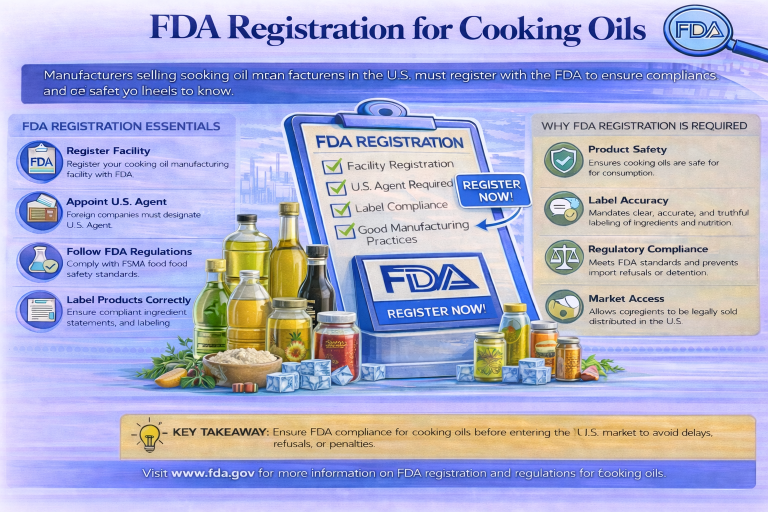
FDA Registration for Cooking Oils
This guide covers every FDA requirement for cooking oil importers — including standards of identity, the PHO prohibition, olive oil extra virgin labeling standards, the 1-tablespoon RACC serving size requirement, allergen declarations for nut oils, FSVP hazards specific to oils, and common claims issues.
21 CFR Part 166 — Standards of Identity for Edible Fats and Oils
FDA standards of identity for edible fats and oils are codified at 21 CFR Part 166. A product labeled with a specific oil type name must meet the standard for that name — otherwise it is misbranded under 21 U.S.C. § 343. The table below covers the key standards and labeling rules for common imported cooking oils:
| Oil / Product | CFR / Standard | Key Requirements & Labeling Rules |
|---|---|---|
| Olive Oil | 21 CFR 166.110 | Prepared by pressing from sound olives (Olea europaea). Must accurately reflect the grade. "Extra virgin" requires free acidity ≤ 0.8%, peroxide value ≤ 20 mEq/kg, and passing organoleptic evaluation per USDA/IOC standards. Misuse of "extra virgin" is the most commonly detected violation in imported olive oil. |
| Salad or Cooking Oil | 21 CFR 166.170 | Applies to refined vegetable oils including soybean, canola, corn, sunflower, cottonseed, and safflower. Must be refined and free of PHOs. Statement of identity must accurately identify the specific oil type(s). |
| Avocado Oil | No FDA standard yet | No specific FDA standard of identity. USDA has a voluntary standard defining extra virgin (cold-pressed, unrefined), virgin, refined, and blended grades. Labels must be accurate and non-misleading. Extra virgin avocado oil adulterated with cheaper oils is misbranded under general labeling rules. |
| Coconut Oil | No FDA standard | No specific standard of identity. "Virgin" or "extra virgin" coconut oil labels imply cold-pressed, unrefined oil. "Refined" coconut oil is processed at higher temperatures. Labels must accurately describe the processing method. No USDA organic certification needed unless "organic" is claimed. |
| Sesame Oil, Walnut Oil, Other Nut Oils | No FDA standard | No specific standards of identity. Must be accurately identified. Tree nut oils require allergen declarations under FALCPA. Highly refined versions may qualify for allergen labeling exemption with analytical documentation. |
| Blended Oils | 21 CFR 101.4 | All component oils must be listed individually in descending order by weight in the ingredient list. Generic terms like "vegetable oil" are not sufficient when a specific blend is used. Missing blend components are a labeling violation. |
Olive Oil "Extra Virgin" — Why This Label Gets Shipments Detained
Olive oil is the most detained imported cooking oil category in the United States. The reason is consistently the same: products labeled "extra virgin olive oil" that fail to meet the quality standards the label implies. The word "extra virgin" carries specific quality expectations that are actively monitored.
While FDA's standard of identity at 21 CFR 166.110 defines what olive oil is, the USDA voluntary olive oil standard (AMS-2610) defines the quality grades — aligned with International Olive Council (IOC) standards — that are used to evaluate whether "extra virgin" labeling is truthful and not misleading under 21 U.S.C. § 343:
Extra Virgin
Free acidity ≤ 0.8% (as oleic acid). Peroxide value ≤ 20 mEq O₂/kg. Passes organoleptic (sensory) evaluation. Cold-pressed or mechanically extracted without heat or chemical refining.
Virgin
Free acidity ≤ 2.0%. Peroxide value ≤ 20 mEq O₂/kg. Passes organoleptic evaluation. Mechanically extracted without chemical refining but may have slight sensory defects.
Refined / Pure / Light
Chemically or thermally refined oil, typically blended with virgin olive oil. "Pure" and "light" are commercial grade names — they do not indicate superior quality. "Light" refers to lighter flavor and color, not caloric content. Labels must not imply caloric reduction.
A product labeled "extra virgin olive oil" that tests above 0.8% free acidity or fails sensory evaluation is misbranded. FDA Registration Assistance reviews olive oil specifications before any shipment is made to confirm the labeling is supportable.
FDA Labeling Requirements for Cooking Oils
Nutrition Facts — The 1-Tablespoon Serving Size Requirement
The single most common Nutrition Facts labeling error on imported cooking oils is the wrong serving size. Under 21 CFR Part 101.12, the Reference Amount Customarily Consumed (RACC) for cooking oils is 1 tablespoon (15mL). Many foreign manufacturers label their oils with 10mL or 100mL servings to match their domestic markets. These do not comply with U.S. requirements. All nutrient declarations — calories, total fat, saturated fat, trans fat, polyunsaturated fat, monounsaturated fat — must be based on the 1-tablespoon RACC.
Allergen Declarations for Nut-Derived Oils
Tree nuts and peanuts are major food allergens under FALCPA and the FASTER Act. Cooking oils derived from these sources require allergen declarations:
Tree Nut Oils Requiring Declarations
Walnut oil, almond oil, hazelnut oil, macadamia nut oil, pecan oil, pistachio oil, and other tree nut oils must declare the specific tree nut: "Contains: Tree Nuts (Walnut)" or equivalent. Cold-pressed and unrefined nut oils retain allergenic protein and must be declared. Highly refined nut oils may qualify for an allergen exemption only with analytical documentation showing protein removal.
Peanut Oil
Peanut oil (groundnut oil) requires a peanut allergen declaration unless the refining process is documented to remove peanut protein to undetectable levels. Expeller-pressed, cold-pressed, or crude peanut oil retains protein and must declare peanut. Highly refined peanut oil may qualify for exemption but requires analytical supporting data.
Common Claims Issues for Cooking Oils
"Organic"
Regulated by USDA National Organic Program — not FDA. Must have USDA-accredited certifier certification. FDA has no jurisdiction over organic claims but enforces all other label elements independently.
"Light" or "Extra Light"
For olive oil, refers to lighter flavor and color from heavy refining — not fewer calories. The label must not imply a caloric reduction that does not exist. Using "light" to imply reduced fat or calories on a full-fat oil is a labeling violation under 21 CFR Part 101.56.
"Natural," "Pure"
"Natural" has no specific FDA definition but must not be false or misleading. "Pure" implies single-source, unadulterated oil — labeling a blended oil as "pure" is a violation. All claims must accurately reflect the product's actual composition and processing.
Cooking Oil-Specific FSVP Hazards & Service Cost
U.S. importers of cooking oils must maintain an FSVP program for each foreign oil supplier under 21 CFR Part 1 Subpart L. The hazard analysis for cooking oils must address these oil-specific hazards:
Mineral Oil Contamination
Petroleum-derived mineral oil (MOSH and MOAH) can contaminate edible oils through mineral-oil-lubricated processing machinery, jute-bag contact during harvesting and storage, and packaging migration. A documented hazard in olive oil, sunflower oil, and other plant-based oils. FSVP verification should address the supplier's equipment lubrication practices and packaging materials.
Economically Motivated Adulteration
Deliberate dilution of premium oils (extra virgin olive oil, avocado oil) with cheaper oils is a well-documented EMA pattern. FSVP programs for premium cooking oil imports should include authentication testing — laboratory chemometric analysis, fatty acid profiling, or other appropriate methods — as a supplier verification activity for high-risk premium oils.
Polycyclic Aromatic Hydrocarbons (PAHs)
PAHs are formed during high-temperature drying, smoking, or roasting of seeds and olives. Found at elevated levels in some cold-pressed and smoke-dried oils. FSVP supplier verification for affected oil types should review the supplier's processing temperature controls and PAH monitoring program.
Pesticide Residues
Pesticide residues in plant-derived oils are relevant FSVP chemical hazards, particularly for conventionally produced oils from regions with known pesticide use patterns. FSVP verification activities may include review of the supplier's pesticide monitoring data or certificates of analysis for pesticide residue testing.
Ready to Import Cooking Oils into the United States?
FDA Registration Assistance provides Food Facility Registration, cooking oil label review (21 CFR Part 101 and Part 166), olive oil grade compliance review, U.S. Agent designation, FSVP support, Prior Notice guidance, and Biennial Renewal management — for cooking oil manufacturers and importers in 135+ countries.
Contact us at info@fdaregistrationassistance.com or call +1 (928) 275-8333. 1,000+ clients. 15+ years of FDA regulatory experience.
Frequently Asked Questions — FDA Registration for Cooking Oils
1. Do cooking oils require FDA registration?
Yes. The manufacturing facility must register with FDA under 21 CFR Part 1 before any cooking oil is exported to the United States. Foreign facilities must designate a U.S. Agent. Registration renews every two years. Complete service: $858.
2. What are FDA standards of identity for cooking oils?
Standards of identity for edible fats and oils are at 21 CFR Part 166. Olive oil is defined at 21 CFR 166.110. Salad or cooking oils are at 21 CFR 166.170. Products labeled with a specific oil name must meet the standard for that name or they are misbranded under 21 U.S.C. § 343.
3. Can cooking oil be labeled "extra virgin olive oil" without meeting quality standards?
No. "Extra virgin" implies free acidity ≤ 0.8%, peroxide value ≤ 20 mEq/kg, and passing organoleptic evaluation per USDA/IOC standards. A product failing these standards while labeled "extra virgin olive oil" is misbranded. This is the most commonly detected violation in imported olive oil shipments.
4. Are partially hydrogenated oils (PHOs) still permitted in cooking oils?
No. FDA finalized the revocation of PHO GRAS status in 2015. PHOs are the primary source of artificial trans fat and cannot be used in any food product sold or imported in the United States. Cooking oils containing PHOs will be refused admission at U.S. ports as adulterated under 21 U.S.C. § 342. No exceptions.
5. How must trans fat be declared on cooking oil Nutrition Facts panels?
Trans fat is a mandatory line item on the Nutrition Facts panel under 21 CFR Part 101.9. For compliant cooking oils without PHOs, trans fat is declared as 0g. Some animal-derived fats may contain trace naturally occurring trans fat which must still be declared. A trans fat declaration above 0g on a vegetable oil is a red flag for PHO contamination.
6. What allergen declarations are required for nut-based cooking oils?
Tree nuts and peanuts are major allergens under FALCPA and the FASTER Act. Walnut oil, almond oil, hazelnut oil, macadamia oil, and peanut oil require allergen declarations unless the refining process has been analytically documented to remove allergenic protein to undetectable levels. Cold-pressed and unrefined nut oils always require allergen declarations.
7. What labeling is required on imported cooking oils?
Under 21 CFR Part 101: correct statement of identity; net quantity in U.S. and metric units; Nutrition Facts panel with 1-tablespoon (15mL) serving size; ingredient list for blended or flavored oils in descending order by weight; allergen declarations for nut oils; and manufacturer/distributor name and address. All text must be in English.
8. What is the serving size for cooking oils on the Nutrition Facts panel?
The RACC for cooking oils under 21 CFR Part 101.12 is 1 tablespoon (15mL). Many imported oils use 10mL or 100mL serving sizes matching foreign domestic requirements — these are non-compliant in the United States. All nutrient declarations must be based on the 1-tablespoon serving size.
9. Is "organic" cooking oil regulated by FDA or USDA?
Organic claims are regulated exclusively by USDA under the National Organic Program. FDA has no jurisdiction over organic certification. A cooking oil can only be labeled "organic" or carry the USDA Organic seal if certified by a USDA-accredited certifying agent. FDA and USDA compliance are separate and both required.
10. What do "light," "pure," and "natural" claims mean for olive oil?
"Light olive oil" refers to lighter flavor and color from heavy refining — not fewer calories. Implying caloric reduction violates 21 CFR Part 101.56. "Pure olive oil" indicates a commercial grade — typically a refined and virgin olive oil blend. "Natural" has no specific FDA definition but must not be false or misleading about the product's composition or processing.
11. What FSVP hazards are specific to cooking oils?
Key cooking oil FSVP hazards: mineral oil contamination (MOSH/MOAH from processing equipment and packaging); polycyclic aromatic hydrocarbons (PAHs) from high-temperature seed processing; economically motivated adulteration (dilution of premium oils with cheaper oils); pesticide residues; and allergen cross-contamination for multi-oil processing facilities.
12. What are the most common reasons cooking oil shipments are detained?
Most common detention reasons: olive oil labeled "extra virgin" failing chemical or sensory standards; wrong serving size on Nutrition Facts (not 1 tablespoon); missing allergen declarations for nut oils; unregistered manufacturing facility; missing or inaccurate Prior Notice; incomplete blended oil ingredient list; and misleading "organic," "pure," or "natural" claims.
13. Does FDA require Prior Notice for cooking oil shipments?
Yes. Every cooking oil shipment requires FDA Prior Notice under 21 CFR Part 1 Subpart I before arrival — 8 hours for ocean, 4 hours for most air, 2 hours for road. The manufacturer's active FDA registration number and correct product code must be included.
14. What FSVP requirements apply to U.S. importers of cooking oils?
U.S. importers must maintain an FSVP program for each foreign oil supplier under 21 CFR Part 1 Subpart L. Hazard analysis must address mineral oil contamination, PAHs, pesticide residues, economically motivated adulteration for premium oils, and allergen hazards for nut oil processing facilities.
15. What oil types have FDA standards of identity under 21 CFR Part 166?
21 CFR Part 166 covers olive oil (166.110) and salad or cooking oil (166.170). Avocado oil, coconut oil, sesame oil, and nut oils do not have specific FDA standards but must still carry accurate, non-misleading product identity statements and comply with all general food labeling requirements.
16. Do cooking oils require FSMA Preventive Controls compliance?
Yes. Cooking oil manufacturing facilities subject to FDA Food Facility Registration are also subject to FSMA Preventive Controls for Human Food under 21 CFR Part 117. Key preventive controls for oil facilities include allergen controls (for multi-oil facilities processing nut oils), sanitation controls, and process controls for critical parameters during refining.
17. Is highly refined peanut oil exempt from allergen labeling?
Possibly — but only with analytical documentation. FDA guidance indicates highly refined oils where allergenic protein has been removed through refining may not require allergen labeling. This exemption requires scientific data demonstrating protein removal to below detectable levels. It cannot be assumed. Cold-pressed, expeller-pressed, or crude peanut oil retains protein and must declare peanut.
18. What is economically motivated adulteration (EMA) in cooking oils?
EMA is the intentional dilution or substitution of a food product for economic gain. Extra virgin olive oil and avocado oil are the highest-risk categories — commonly diluted with cheaper refined olive oil or other vegetable oils. FSVP programs for premium oil imports should include authentication testing (fatty acid profiling, chemometric analysis) as a supplier verification activity.
19. Can cooking oils make health claims on their labels?
One authorized qualified health claim exists for oils high in oleic acid (≥ 70% oleic acid, such as certain olive oils and high-oleic sunflower or safflower oils) relating to reduced risk of coronary heart disease. Structure/function claims about general wellness are permitted if truthful and not misleading. Disease claims without FDA authorization are prohibited and make the product an unauthorized drug.
20. How much does FDA Food Facility Registration cost for a cooking oil manufacturer?
FDA charges $0 in government fees. FDA Registration Assistance charges $858 for the complete service — registration, DUNS Number procurement, U.S. Agent designation for foreign facilities, and Biennial Renewal management. See the full cost breakdown.
21. Do blended cooking oils need to list all component oils?
Yes. Under 21 CFR Part 101.4, all component oils in a blend must be listed individually in descending order by weight in the ingredient list. Generic terms like "vegetable oil" are insufficient when a specific blend is used. Missing or incorrect blend components are labeling violations that trigger shipment detention.
22. What are mineral oil contamination risks in cooking oils?
Mineral oil (MOSH and MOAH) can contaminate edible oils through mineral-oil-lubricated processing machinery, jute-bag contact during harvesting and storage, and packaging migration. FSVP hazard analyses for cooking oil imports should identify mineral oil contamination as a chemical hazard requiring supplier verification addressing processing equipment and packaging practices.
23. Can avocado oil be labeled as a specific grade?
No specific FDA standard of identity exists for avocado oil, but USDA has a voluntary standard defining extra virgin (cold-pressed, unrefined), virgin, refined, and blended grades. Labels must be accurate and non-misleading. "Extra virgin avocado oil" that is actually refined or adulterated with other oils is misbranded under FDA's general labeling requirements.
24. What are the most common FDA compliance mistakes for cooking oil importers?
Most common: extra virgin olive oil failing chemical or sensory standards; Nutrition Facts panel with wrong serving size (not 1 tablespoon RACC); missing tree nut or peanut allergen declarations; PHOs present in formulation (prohibited since 2015); blended oil ingredient list missing components; "organic" claim without USDA NOP certification; and no FSVP for the foreign oil supplier.
25. How do I get started with FDA compliance for my cooking oil products?
Contact FDA Registration Assistance at info@fdaregistrationassistance.com or call +1 (928) 275-8333. Provide your oil type, product specifications, current label, and facility location. FDA Registration Assistance will review your label against 21 CFR Parts 101 and 166, confirm standards of identity compliance, complete Food Facility Registration, and advise on FSVP. Complete service: $858.