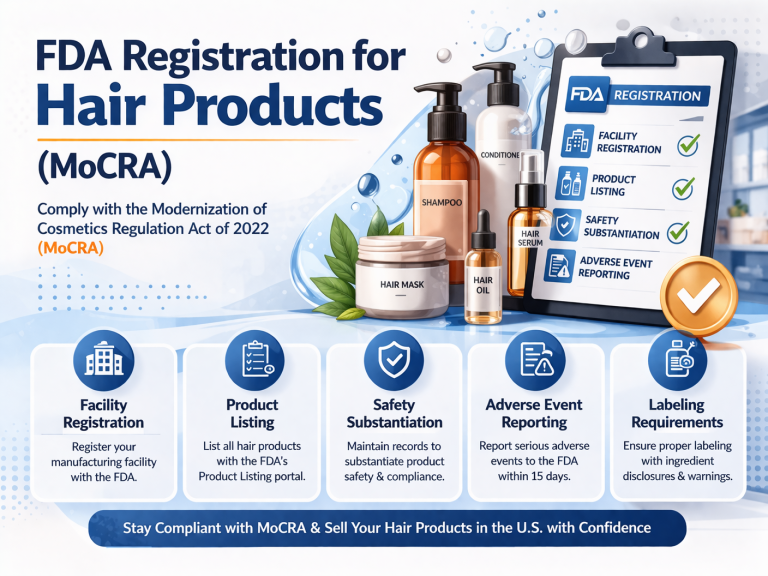
FDA Registration for Hair Products (MoCRA)
This guide explains which hair products are cosmetics vs. OTC drugs, the cosmetic/drug claims line for hair, MoCRA registration and product listing, the hair-specific safety issues (formaldehyde in smoothing treatments, coal-tar dyes, 1,4-dioxane), and what it costs.
What MoCRA Compliance Costs for Your Hair Care Brand
Cosmetic Hair Product vs. OTC Drug
For hair products, the cosmetic/drug line is sharper than almost any other cosmetic category — because whole product types (anti-dandruff, hair regrowth) are squarely OTC drugs. The classification is set by intended use, established by your claims.
What MoCRA Requires for Cosmetic Hair Products
The Safety Concerns Unique to Hair Products
Formaldehyde in Smoothing Treatments
Keratin and hair-smoothing treatments often contain formaldehyde or releasers (methylene glycol) that release formaldehyde gas when heated during application — a carcinogen and irritant risking salon workers and consumers. FDA has proposed restricting formaldehyde in hair-smoothing products. Must be disclosed; raises serious safety substantiation concerns.
Coal-Tar Hair Dyes
Coal-tar hair dyes have a special statutory status — exempt from color additive approval if they carry the required caution statement and patch-test (skin allergy test) instructions on the label. Lead acetate in progressive dyes has been banned by FDA. The caution statement must appear where applicable.
1,4-Dioxane in Shampoos
A contaminant byproduct in ethoxylated surfactants (some sulfates like sodium laureth sulfate). A potential carcinogen that doesn’t appear on the ingredient list — controlled through manufacturing (vacuum stripping). Some states regulate its levels. Safety controls should address it.
Keep Your Hair Products on the Right Side of the Cosmetic/Drug Line
FDA Registration Assistance handles the full MoCRA stack for hair care brands and assesses your claims so you don’t accidentally sell a drug as a cosmetic: $849 facility registration, $200 per product listing, and $250 per label review (with a cosmetic-vs-OTC-drug claims assessment). We also support U.S. Agent designation for foreign manufacturers and can advise if a product is actually an OTC drug. 1,000+ clients. 135+ countries. 15+ years of FDA regulatory experience.
Contact us at info@fdaregistrationassistance.com or call +1 (928) 275-8333.
Frequently Asked Questions — Hair Products & MoCRA
1. Do hair products require FDA registration under MoCRA?
Yes. Hair products for cosmetic use — shampoos, conditioners, oils, gels, leave-ins, masks that cleanse, condition, style, or improve appearance — are cosmetics under MoCRA. No FDA approval, but they must meet MoCRA requirements: facility registration, product listing, safety substantiation, adverse event reporting, GMP, and labeling. We provide MoCRA compliance: facility registration $849; product listing $200/product; label review $250/label. The key complication for hair is that many products cross into OTC drug territory.
2. How much does MoCRA compliance cost for hair products?
MoCRA facility registration is $849; product listing is $200 per product; label review is $250 per label. Facility registration is the baseline; product listing applies per SKU; the label review checks INCI declarations under 21 CFR 701.3 and assesses whether claims keep the product a cosmetic or push it into OTC drug status. FDA charges no government fee for cosmetic registration. These fees don’t include safety or clinical testing, which the brand provides.
3. Which hair products are cosmetics and which are OTC drugs?
Set by intended use (claims). Cosmetic: regular shampoos, conditioners, oils, gels, mousses, leave-ins, serums, masks that cleanse, condition, style, or improve appearance. OTC drug: anti-dandruff shampoos (pyrithione zinc, selenium sulfide, coal tar, ketoconazole), hair loss/growth products (minoxidil), and products claiming to treat scalp psoriasis, seborrheic dermatitis, or regrow hair. OTC drug hair products follow a different pathway — eDRLS drug registration, OTC monograph compliance, Drug Facts labeling — not MoCRA.
4. Are anti-dandruff shampoos cosmetics or drugs?
OTC drugs. Because they treat dandruff (a condition), they fall under the OTC drug framework. The actives (pyrithione zinc, selenium sulfide, coal tar, ketoconazole, salicylic acid, sulfur) are addressed in FDA’s OTC monograph system for dandruff/seborrheic dermatitis/psoriasis. An anti-dandruff shampoo needs monograph compliance, a Drug Facts panel, and drug establishment registration through eDRLS — not the MoCRA cosmetic pathway. A 2-in-1 anti-dandruff-and-conditioning shampoo is both a drug and a cosmetic.
5. Are hair loss and hair growth products cosmetics or drugs?
OTC drugs. Minoxidil, the active in most OTC regrowth products, is covered by the OTC monograph for hair grower drug products (2% and 5%). A product claiming to regrow hair, prevent hair loss, or stimulate follicles is a drug — requiring monograph compliance (or an NDA), Drug Facts labeling, and eDRLS drug registration. A cosmetic can’t claim to regrow hair. Marketing hair-growth claims through the cosmetic pathway is a serious error that makes it an unapproved drug.
6. What is the difference between a cosmetic claim and a drug claim for hair?
Cosmetic claims describe cleansing, conditioning, styling, or appearance: cleanses; adds shine; smooths; detangles; improves manageability; moisturizes; volumizes; reduces frizz appearance; protects color. Drug claims describe treating a condition or affecting structure/function: treats dandruff; controls seborrheic dermatitis; regrows hair; prevents hair loss; treats scalp psoriasis; stimulates follicles. Borderline claims like “strengthens hair” depend on context. Wording the claims correctly keeps the product a cosmetic.
7. What MoCRA requirements apply to cosmetic hair products?
Facility registration (biennial); product listing per product; a Responsible Person; adequate safety substantiation; adverse event reporting (serious events to FDA within 15 business days); GMP; and fragrance allergen labeling. The label must comply with cosmetic rules including INCI declaration. We handle facility registration ($849), product listing ($200/product), and label review ($250/label) for cosmetic hair brands.
8. What is the Responsible Person for a hair product under MoCRA?
The manufacturer, packer, or distributor whose name appears on the label. They must ensure the product is listed, ensure safety substantiation, maintain adverse event records, and report serious adverse events to FDA. Every cosmetic hair product must identify a Responsible Person. For imports, a U.S.-based responsible party should be identified. Failing to designate one is a common MoCRA gap.
9. What safety issues are specific to hair products?
Formaldehyde and releasers (methylene glycol) in smoothing/keratin treatments — release formaldehyde gas when heated; FDA has proposed restricting them. 1,4-dioxane contamination in ethoxylated surfactants (sulfates) in shampoos. Hair dye concerns about PPD sensitization and (historically) lead acetate, which FDA banned. Safety substantiation should address these, and the label must disclose ingredients and required warnings.
10. How are hair dyes and hair color products regulated?
Generally cosmetics, with special rules. Coal-tar hair dyes are exempt from the usual color additive approval requirement if they bear the required FD&C Act caution statement and patch-test instructions on the label — a unique provision. Lead acetate in progressive dyes has been banned. Hair dyes still meet MoCRA facility registration, product listing, and labeling requirements, and the coal-tar caution statement and patch-test instructions must appear where applicable.
11. What is the issue with formaldehyde in hair-smoothing products?
Many smoothing/keratin treatments contain formaldehyde or releasers (methylene glycol). When heated during application (blow-drying, flat-ironing), they release formaldehyde gas — a known carcinogen and irritant risking salon workers and consumers. FDA has proposed restricting or banning formaldehyde and releasers in hair-smoothing products. These products raise significant safety substantiation and labeling concerns under MoCRA, and the releasers must be disclosed in the ingredient list.
12. How are leave-in treatments, hair oils, and serums classified?
Generally cosmetics when they cleanse, condition, moisturize, smooth, add shine, or improve appearance and manageability — requiring MoCRA registration, product listing, a Responsible Person, safety substantiation, and INCI labeling. But the same caution applies: a leave-in or serum that claims to regrow hair, prevent loss, treat the scalp, or stimulate follicles is making drug claims. “Nourishes and adds shine” = cosmetic; “stimulates growth and reverses thinning” = drug. The claims, not the format, determine classification.
13. What labeling is required on cosmetic hair products?
Under 21 CFR Part 701: product identity; net quantity; name and place of business; warnings/directions where needed; and INCI ingredient declaration in descending order (21 CFR 701.3). MoCRA adds fragrance allergen labeling. Coal-tar hair dyes need the required caution statement and patch-test instructions. Claims must be truthful and must not describe a drug effect. For imports, all required info in English with INCI names.
14. Do foreign hair product manufacturers need to register under MoCRA?
Yes. Every facility manufacturing or processing cosmetic products for U.S. distribution — domestic or foreign — must register, and each product must be listed. Foreign manufacturers should ensure a Responsible Person is identified for the U.S. market and may need U.S. Agent arrangements. Foreign claims that would be drug claims in the U.S. (such as anti-hair-loss claims) cannot be carried over.
15. Does a foreign hair product manufacturer need a U.S. Agent?
Foreign cosmetic manufacturers, including hair product makers, should ensure appropriate U.S. representation. A U.S. Agent is a point of contact with FDA for the foreign facility. We provide U.S. Agent services for foreign hair product manufacturers as part of MoCRA cosmetic compliance, alongside facility registration, product listing, and label review.
16. What happens if a cosmetic hair product makes a drug claim?
FDA may classify it as an unapproved new drug or a misbranded/adulterated drug. It would then need to comply with the OTC drug framework (monograph or NDA, Drug Facts, eDRLS registration) rather than MoCRA. Marketing an unapproved new drug is a prohibited act under the FD&C Act — exposing the company to Warning Letters, import detention, seizure, injunction, and recall. The single biggest hair-product risk: making a treatment claim through the cosmetic pathway.
17. Can a hair product be both a cosmetic and a drug?
Yes. If it has both a cosmetic and a drug intended use. The classic example: a 2-in-1 anti-dandruff shampoo that controls dandruff (drug) and cleans/conditions (cosmetic). Such a product must comply with BOTH the drug requirements (OTC monograph, Drug Facts, eDRLS registration) AND the cosmetic requirements (MoCRA registration, product listing, INCI labeling). Combining a treatment claim with cosmetic benefits creates this more complex dual-regulation situation.
18. What is 1,4-dioxane and why does it matter for shampoos?
A contaminant (not an added ingredient) that can form as a byproduct in making certain ethoxylated ingredients like some sulfate surfactants (e.g., sodium laureth sulfate) in shampoos. A potential carcinogen that doesn’t appear on the ingredient list — controlled through manufacturing (vacuum stripping). Some states regulate its levels in personal care. Safety substantiation and supplier controls should address potential 1,4-dioxane contamination in ethoxylated ingredients.
19. How should ingredients be listed on a hair product label?
Under 21 CFR 701.3, in descending order of predominance by weight using INCI names. Ingredients at 1% or less, and color additives, may be listed in any order after those above 1%. Fragrance and flavor may be declared as “fragrance” or “flavor,” though MoCRA adds fragrance allergen disclosure. For imports, the INCI declaration must be present and in English. Non-INCI names or omitting the declaration is a common violation for imported hair products.
20. Does FDA approve cosmetic hair products before marketing?
No. FDA doesn’t approve cosmetics or pre-review them (unlike drugs). The Responsible Person ensures the product is safe, properly labeled, listed under MoCRA, and that claims are truthful and don’t cross into drug territory. FDA enforces after the fact (Warning Letters, import actions, recalls). The burden is on the brand to ensure compliance — including keeping claims cosmetic — before market.
21. What records must a hair product company keep under MoCRA?
Safety substantiation records (addressing hair-specific concerns like formaldehyde releasers or 1,4-dioxane where relevant); MoCRA facility registration and product listing confirmations; adverse event records (with serious events reported to FDA); and labeling and formulation records. If FDA questions safety or a claim, the company must produce the records. Maintain them before any inquiry, not after.
22. What are the most common MoCRA compliance failures for hair products?
Treating an anti-dandruff, hair-loss, or scalp-treatment product as a cosmetic when it’s an OTC drug; no MoCRA registration or product listing; no Responsible Person; drug claims on a cosmetic; improper INCI labeling; not disclosing formaldehyde releasers in smoothing treatments; missing the coal-tar dye caution statement and patch-test instructions; importing foreign hair products with claims that are drug claims in the U.S.; and inadequate safety substantiation for products with known hair-specific concerns.
23. Are professional and salon hair products regulated differently?
They’re still cosmetics (or drugs, by claims/ingredients) subject to MoCRA registration and product listing. Labeling can differ — professional-only products not sold to consumers may have different labeling requirements than retail — but they’re not exempt from the core MoCRA requirements. Professional smoothing treatments raise particular formaldehyde concerns due to the heat applied. Don’t assume the professional channel exempts a product from registration, listing, or safety substantiation.
24. How does FDA Registration Assistance help hair product brands with MoCRA?
Complete MoCRA compliance: facility registration ($849); product listing ($200/product); cosmetic-vs-OTC-drug claims assessment; safety substantiation guidance including hair-specific concerns; Responsible Person designation; cosmetic label review ($250/label) including INCI declarations and the coal-tar dye caution statement; and U.S. Agent services for foreign manufacturers. We keep hair brands on the correct side of the cosmetic/drug line. 1,000+ clients. 135+ countries.
25. How do I get started with MoCRA registration for my hair products?
Contact FDA Registration Assistance at info@fdaregistrationassistance.com or call +1 (928) 275-8333. Provide your product type (shampoo, conditioner, oil, styling product, smoothing treatment, hair dye), the claims you want to make, your ingredient list, your label artwork, and whether you’re domestic or foreign. We assess whether your products are cosmetics under MoCRA or OTC drugs, complete your facility registration ($849) and product listing ($200/product), and review your label ($250/label). FDA charges no government fee for cosmetic registration.