
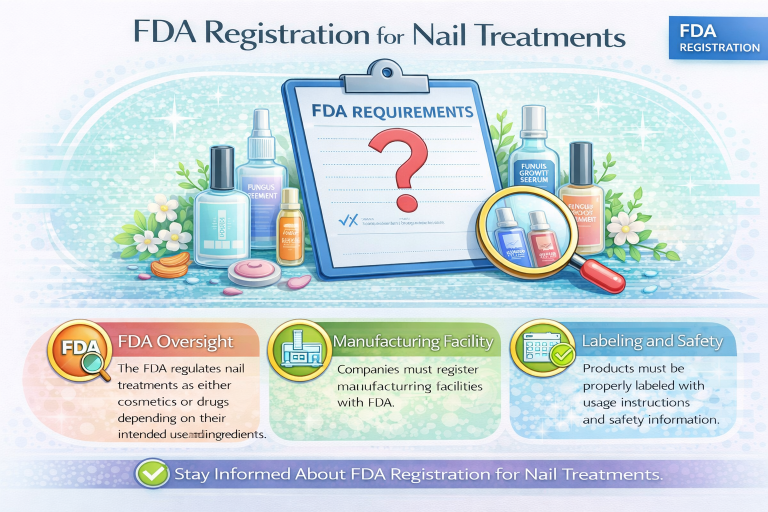
FDA Registration for Nail Treatments
When a nail treatment is a cosmetic, the claims that turn it into a drug, and how to keep "treatment" marketing compliant.
Key Takeaways
- Strengthen/condition/appearance = cosmetic — hardeners, cuticle oils, ridge fillers (MoCRA).
- Treat a disease / grow nails = drug — the word "treatment" invites scrutiny.
- Nail fungus = drug, and prescription-only — OTC topical can't treat nails.
- "Makes nails grow" = structure/function drug — like a hair-growth claim.
- Formaldehyde hardeners — a sensitizer/allergen safety-and-labeling issue.
- Registration ≠ approval — classify by the claims first.
The "Treatment" Claim Trap
"Nail treatment" is a loaded phrase — it can describe a cosmetic (improving the nail's condition/appearance) or a drug (treating a disease). The claim decides:
| Cosmetic-safe (condition / appearance) | Drug-triggering (disease / growth) |
|---|---|
| Strengthens nails; reduces breakage | Treats nail fungus / infection |
| Conditions cuticles; hydrates | Makes nails grow (faster/longer) |
| Smooths ridges; improves appearance | Repairs nails as a medical condition |
| Hardens / protects the nail surface | Stimulates the nail matrix / structure |
Cosmetic Nail Treatments
These are cosmetics (MoCRA) when marketed for the nail's condition and appearance:
- Nail strengtheners & hardeners — harden/strengthen the nail's condition (watch formaldehyde)
- Cuticle oils & creams — condition and soften cuticles
- Ridge fillers & base coats — smooth and improve the nail surface
- Conditioning / hydration treatments — improve the look and feel of nails
Nail Fungus & Nail Growth Are Drug Claims
Nail fungus. Treating a fungal nail infection (onychomycosis) is a drug claim — and there's a twist: OTC topical antifungals aren't recognized as effective on nails, so nail fungus is a prescription matter. An OTC nail treatment claiming to cure nail fungus is an unapproved new drug. See antifungal drug registration.
Nail growth. Claiming to actually make nails grow — grow faster, longer, or thicker as a physiological effect — is a structure/function drug claim, the same principle as a hair-growth product. "Strengthens nails so they break less" (condition/appearance) is cosmetic; "stimulates nail growth" (a physiological effect) is a drug claim.
The Cosmetic (MoCRA) Path
- Facility registration + product listing + Responsible Person — via Cosmetics Direct; biennial renewal; U.S. Agent if foreign
- Safety substantiation — sensitizers (formaldehyde, (meth)acrylates), solvents, stability
- Adverse-event reporting — serious events within 15 business days; records kept
- Compliant labeling — INCI, net quantity, adverse-event contact; no drug claims, no "FDA Approved"
- Claims review — keep "treatment" marketing on the cosmetic side
Common Nail Treatment Mistakes
- "Treats nail fungus" — a prescription-only drug claim on a "cosmetic"
- "Makes nails grow" — a structure/function drug claim
- Formaldehyde in a hardener without addressing safety/labeling
- Unsubstantiated "non-toxic / free-of" claims
- Registering the facility but not listing all products
- Missing the U.S. Agent (foreign); "FDA approved" claims
Get Your Nail Treatment Classified & Registered
FDA Registration Assistance classifies each product first — cosmetic (strengthener, conditioner, cuticle care, ridge filler) or drug (fungus/growth/disease claims) — then handles the right registration: MoCRA facility registration and product listing (with Responsible Person, U.S. Agent, safety, and labeling) for a cosmetic nail treatment, or the drug pathway for a treatment/growth product — and we review the claims so "treatment" marketing stays compliant.
Contact us at info@fdaregistrationassistance.com or call +1 (928) 275-8333 for a quote. An independent compliance firm serving 1,000+ companies across 135+ countries, with 15+ years of experience.
Frequently Asked Questions — Nail Treatments
1. Do nail treatments require FDA registration?
Yes, and the classification hinges on the word "treatment." A nail treatment that strengthens, conditions, or improves the appearance of nails (a hardener, strengthener, cuticle oil, ridge filler, or conditioner) is a cosmetic and registers under MoCRA: facility registration, product listing, a Responsible Person, safety substantiation, adverse-event reporting, and labeling (U.S. Agent if foreign). But a nail treatment that claims to treat a nail disease (like fungus) or to make nails grow is a drug. So the claims decide the path.
2. When is a nail treatment a cosmetic?
When it improves the appearance or condition of the nail without treating a disease or affecting the body's structure/function. Nail strengtheners and hardeners (that harden/strengthen the nail's condition), cuticle oils and creams, ridge fillers, base coats, and conditioning treatments are cosmetics when marketed that way. "Strengthens nails," "reduces breakage," "conditions cuticles," and "smooths ridges" are cosmetic claims. These follow the MoCRA cosmetic path.
3. When is a nail treatment a drug?
When it claims to treat or prevent a disease, or to affect the nail's structure/function. The two big cases: treating a nail fungal infection (onychomycosis) - a drug claim - and claiming to make nails grow (grow faster/longer), which is a structure/function claim like a hair-growth product. "Repairs damaged nails" framed as fixing a medical condition is also a drug claim. The word "treatment" invites this scrutiny, so treatment-style claims need careful review.
4. Can a nail treatment claim to cure nail fungus?
Not as an OTC cosmetic or OTC drug. Treating nail fungus is a drug claim, and OTC topical antifungals are recognized as "not effective on nails," so nail fungus (onychomycosis) is a prescription matter. An OTC nail treatment claiming to cure nail fungus is an unapproved new drug - a compliance and safety problem. A cosmetic nail treatment can strengthen and improve the look of nails, but it cannot claim to treat a fungal infection.
5. Is a nail-growth "treatment" a drug?
If it claims to actually make nails grow - grow faster, longer, or thicker as a physiological effect - that's a structure/function claim, which makes it a drug (the same principle as a hair-growth product). "Strengthens nails so they break less" (about condition/appearance) is a cosmetic claim; "stimulates nail growth" (a physiological effect) is a drug claim. The distinction is appearance/condition versus producing growth, and it's easy to slip across in marketing.
6. Is a nail hardener a cosmetic?
Generally yes - a nail hardener/strengthener that hardens or strengthens the nail's condition and appearance is a cosmetic. One thing to watch: some hardeners have historically used formaldehyde, a known skin sensitizer/allergen, so if it's in the formula it's a safety-substantiation and labeling consideration (and drives "formaldehyde-free" claims). A hardener stays a cosmetic as long as it doesn't claim to treat a nail disease.
7. How is this different from nail polish?
They overlap and share the same rules - both are cosmetics under MoCRA unless they make drug claims. Nail polish is primarily about color (and so is color-additive-heavy), while nail treatments are about the nail's condition (strengtheners, cuticle care, ridge fillers). The classification analysis is identical: cosmetic for appearance/condition, drug for disease/growth claims. If you make both, they're listed as separate products but follow the same path.
8. What is the cosmetic (MoCRA) path for a nail treatment?
Register the manufacturing facility with FDA (via Cosmetics Direct, with an FEI, and a U.S. Agent if foreign), list each product, designate a Responsible Person, maintain safety substantiation, set up adverse-event reporting, and use compliant labeling. Facility registration renews every two years and listings update at least annually. Screen the formula for sensitizers like formaldehyde, and make sure treatment-style claims stay on the cosmetic side.
9. What safety data does a nail treatment need?
MoCRA requires adequate safety substantiation for every cosmetic. For nail treatments, the focus is on sensitizers (formaldehyde in some hardeners, (meth)acrylates in some systems), solvents, and stability - plus toxicological/ingredient safety. Given the ingredient scrutiny in nail products, a solid safety file matters, and the records must be available to FDA on request.
10. Do I list every nail treatment product?
Yes - listing is at the product level, so each formulation (strengthener, cuticle oil, ridge filler, etc.) is listed with its ingredients and category, linked to the registered facility, and updated at least annually. Registering the facility but not listing all the products is a common gap. If a product line spans cosmetic treatments and a drug product, they're on different pathways and listed accordingly.
11. Do foreign nail treatment brands need to register?
Yes. Any nail treatment marketed in the U.S. must comply regardless of where it's made, and foreign facilities need a U.S. Agent. A foreign cosmetic nail treatment registers under MoCRA with a U.S. Agent; a foreign nail product making a treatment/disease claim (a drug) registers as a drug establishment with a U.S. Agent. Home-country classification doesn't transfer, so confirm the path before entering the U.S.
12. Does "natural" or "non-toxic" nail treatment still need to comply?
Yes. "Natural," "non-toxic," "clean," and "X-free" are marketing terms that don't change regulatory status or create an exemption. A natural nail treatment is still a cosmetic under MoCRA and needs registration, listing, safety substantiation, and labeling - and its "free-of" claims must be truthful and substantiated. And a "natural" product that claims to treat fungus or grow nails is still a drug.
13. What labeling does a nail treatment need?
Cosmetic labeling: a Principal Display Panel (statement of identity, net quantity) and an information panel (INCI ingredient declaration, responsible-party name/address, any required warnings, and the MoCRA adverse-event contact) - with no drug claims and no "FDA Approved." A nail-treatment drug product (fungus/growth) would need a Drug Facts panel. The label must match the classification, and treatment-style claims must not cross into drug territory.
14. Does registering my nail treatment mean it's FDA-approved?
No. FDA doesn't approve cosmetics. Registration and listing make you compliant and put your facility and products in FDA's system - they aren't approval or an endorsement. Calling a nail treatment "FDA-approved" because it's registered is misleading. The accurate statement is that your facility is registered and your products are listed.
15. What are common nail treatment mistakes?
The word "treatment" leading to drug claims - especially "treats nail fungus" (a prescription-only drug matter) and "makes nails grow" (a structure/function drug claim). Others: formaldehyde in a hardener without addressing safety/labeling; unsubstantiated "non-toxic/free-of" claims; registering the facility but not listing all products; missing the U.S. Agent (foreign); and "FDA approved" claims. Most trace back to letting treatment-style marketing cross the cosmetic-drug line.
16. How does FDA Registration Assistance help nail treatment brands?
We classify each product first - cosmetic (strengthener, conditioner, cuticle care, ridge filler) or drug (fungus/growth/disease claims) - then handle the right registration: MoCRA facility registration and product listing (with Responsible Person, U.S. Agent, safety substantiation, and labeling) for a cosmetic nail treatment, or the drug pathway for a treatment/growth product. We also review the claims so treatment-style marketing stays compliant. We're an independent compliance firm serving 1,000+ companies across 135+ countries with 15+ years of experience. Contact info@fdaregistrationassistance.com or +1 (928) 275-8333.
