
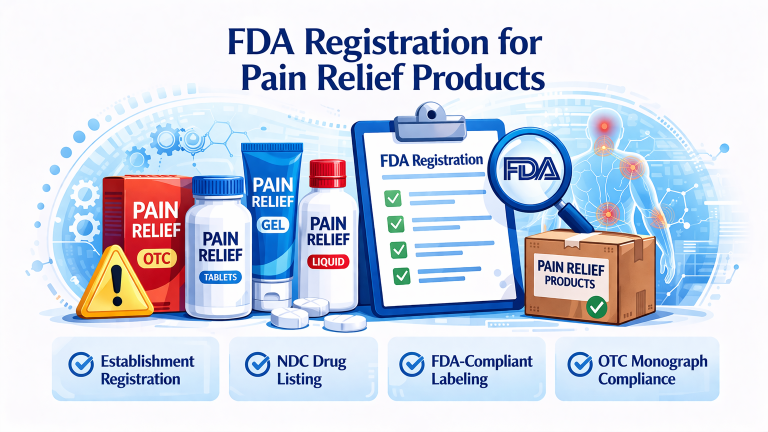
FDA Registration for Pain Relief Products
The topical vs oral monographs, eligible actives and indications, the mandatory Drug Facts warnings, and the registration requirements.
Key Takeaways
- Pain relievers are OTC drugs — both topical rubs and oral tablets.
- Two monographs — external analgesic (topical, 348/M017) vs internal analgesic (oral, 343).
- A topical muscle rub is a drug — not a cosmetic.
- Mandatory warnings — acetaminophen liver; NSAID stomach-bleeding; aspirin Reye's.
- Full OTC apparatus — registration, NDC listing, Drug Facts, cGMP, OMUFA, U.S. Agent.
- Match the monograph first — it drives actives, claims, and warnings.
Why Pain Relievers Are OTC Drugs
Relieving pain — and reducing fever — is a drug purpose, so pain-relief products are regulated as OTC drugs under an analgesic monograph. That's true whether the product is swallowed or rubbed on.
Topical (External) vs Oral (Internal)
| External analgesic (topical) | Internal analgesic (oral) | |
|---|---|---|
| Monograph | 21 CFR 348 (OTC Monograph M017) | 21 CFR 343 |
| Forms | Creams, gels, sprays, patches | Tablets, capsules, liquids |
| Common actives | Menthol, methyl salicylate, camphor, capsaicin, lidocaine | Acetaminophen, aspirin, ibuprofen, naproxen |
| Indication | Minor aches/pains of muscles & joints | Minor aches/pains + reduce fever |
The Mandatory Warnings
Analgesic warnings are specific, required, and a frequent failure point. The main ones for oral pain relievers:
| Active | Required warning |
|---|---|
| Acetaminophen | Liver warning — severe liver damage if the max dose is exceeded, taken with other acetaminophen products, or with 3+ alcoholic drinks/day |
| NSAIDs (aspirin, ibuprofen, naproxen) | Stomach-bleeding warning (age 60+, ulcer history, blood thinners, alcohol, higher/longer dosing) + heart-attack/stroke warnings |
| Aspirin | Reye's syndrome warning — for children and teenagers with chickenpox or flu symptoms |
Requirements
- Drug establishment registration — 21 CFR Part 207, with DUNS/FEI (foreign facilities also need a U.S. Agent)
- Labeler code & NDC listing — each product listed in SPL
- Monograph-compliant active — an eligible analgesic at a permitted concentration
- Drug Facts label — active & purpose, uses, the required warnings, directions, inactive ingredients (21 CFR 201.66)
- cGMP + OMUFA + annual renewal — quality manufacturing (21 CFR 211), the OTC facility fee, and the Oct–Dec renewal
Get Your Pain-Relief Product Compliant
FDA Registration Assistance handles the OTC drug side of pain relievers: drug establishment registration, NDC drug listing (SPL), Drug Facts label and warnings review against the applicable analgesic monograph (external or internal), U.S. Agent for foreign firms, and import documentation — so your product is compliant before you manufacture, label, list, import, or sell.
Contact us at info@fdaregistrationassistance.com or call +1 (928) 275-8333 for a quote. An independent compliance firm serving 1,000+ companies across 135+ countries, with 15+ years of experience.
Frequently Asked Questions — Pain Relief Products
1. Do pain relief products require FDA registration?
Yes. Pain relievers are regulated as OTC drugs, because relieving pain (and reducing fever) is a drug purpose. So the manufacturing facility must complete drug establishment registration, each product must be listed with an NDC (SPL), and the product needs a compliant Drug Facts label, cGMP, OMUFA fees, and (for foreign facilities) a U.S. Agent. This applies to both topical rubs and oral pain relievers.
2. Is a topical pain-relief cream a drug or a cosmetic?
A drug. A muscle rub, pain gel, or medicated patch that relieves aches and pains is an OTC external analgesic - a drug - even though it's a topical product that might look like a cosmetic. The pain-relief claim is what makes it a drug. Treating a topical pain reliever as a cosmetic (skipping registration/listing/Drug Facts) is a common and costly misclassification.
3. What are the two pain-relief monographs?
External analgesics (topical) fall under 21 CFR Part 348 (OTC Monograph M017) - these are the rubs, gels, sprays, and patches for minor muscle and joint aches. Internal analgesics/antipyretics (oral) fall under 21 CFR Part 343 - the tablets and liquids that relieve pain and reduce fever. Which monograph applies drives the eligible actives, the claims, and the required warnings, so identifying the right one is the first step.
4. What active ingredients can a topical pain reliever use?
Under the external analgesic monograph, common actives include methyl salicylate, menthol, camphor, and capsaicin (counterirritants) and lidocaine and similar local anesthetics, each at specified concentrations. They're labeled to relieve minor aches and pains of muscles and joints (backache, arthritis, strains, sprains, bruises). An active or concentration outside the monograph means the monograph pathway isn't available.
5. What active ingredients can an oral pain reliever use?
Under the internal analgesic/antipyretic monograph, the actives are acetaminophen, aspirin (and other salicylates like magnesium and sodium salicylate), ibuprofen, and naproxen sodium (and ketoprofen), at specified strengths. They're labeled for temporary relief of minor aches and pains and to reduce fever. Each active carries specific mandatory warnings, which is a big part of getting the label right.
6. What warnings does an oral pain reliever have to carry?
They're specific and mandatory. Acetaminophen requires a liver warning (severe liver damage risk if you exceed the max dose, take other acetaminophen products, or have 3+ alcoholic drinks a day). NSAIDs (aspirin, ibuprofen, naproxen, ketoprofen) require a stomach-bleeding warning (higher risk with age 60+, ulcer history, blood thinners, alcohol, or higher/longer dosing) and heart-attack/stroke warnings. Aspirin also requires a Reye's syndrome warning for children and teenagers. Missing or wrong warnings make the product misbranded.
7. What warnings does a topical pain reliever carry?
External analgesics carry their own monograph warnings: for external use only, avoid contact with eyes and mucous membranes, don't apply to wounds or damaged skin, don't bandage tightly, stop use and see a doctor if condition worsens or persists, and (for some products) heat/flammability cautions. The exact warnings depend on the active. As with all OTC drugs, the label warnings have to match the monograph and the SPL listing.
8. What are the FDA requirements to sell a pain-relief product?
Drug establishment registration (21 CFR Part 207) with a DUNS/FEI; a labeler code and NDC drug listing (SPL); a monograph-eligible active at a permitted concentration; a compliant Drug Facts label with the required warnings; cGMP manufacturing (21 CFR 211); OMUFA facility fees; a U.S. Agent for foreign facilities; and annual renewal. It's the standard OTC drug apparatus, with the applicable analgesic monograph governing actives, claims, and warnings.
9. Do foreign pain-relief manufacturers need a U.S. Agent?
Yes. A foreign OTC pain-relief establishment must complete drug establishment registration and designate a U.S. Agent (21 CFR 207.69) - the U.S.-based contact for FDA communications and inspections. Without a valid, confirmed U.S. Agent the registration isn't complete, and the establishment's products can be refused at the border.
10. What is drug listing / NDC for a pain reliever?
Each pain-relief product is listed with FDA and assigned a National Drug Code (NDC), submitted in Structured Product Labeling (SPL) format. The listing captures the active ingredient and strength, dosage form, package, and labeling. Registration covers the facility; listing covers each product; both must be accurate and current, and listing errors are a common cause of delays.
11. Does a pain reliever need to comply with cGMP?
Yes. As an OTC drug, a pain reliever must be manufactured under current Good Manufacturing Practice (21 CFR Part 211), supporting consistent potency and quality. A product not made under cGMP is considered adulterated and can be detained or recalled, regardless of a clean registration and listing.
12. Is there a fee, and does the registration renew?
Yes to both. OTC monograph drug manufacturers - including pain-relief makers - pay the annual OMUFA facility fee. And drug establishment registration renews annually, October–December (21 CFR 207.29), with drug listings kept current. A lapse makes the product misbranded and can inactivate the listing, so it's ongoing compliance, not a one-time filing.
13. Are combination pain-relief products allowed?
Sometimes - certain ingredient combinations are permitted under the monographs (for example, some external analgesic counterirritant combinations, or an analgesic combined with another OTC ingredient in a cold/flu product), but only where the monograph allows it and with the combined warnings. Combinations outside what the monographs permit would need an approved application. Combination labeling and warnings are a frequent review point.
14. What are the most common pain-relief compliance mistakes?
Treating a topical pain reliever as a cosmetic; using an active or concentration outside the monograph; omitting or misstating the mandatory warnings (acetaminophen liver, NSAID stomach-bleeding, aspirin Reye's); non-compliant Drug Facts formatting; skipping establishment registration or NDC listing; and overlooking OMUFA and annual renewal. Most are caught by matching the product to the right monograph before launch.
15. Does registering a pain reliever mean it's FDA-approved?
No. Registration identifies the facility, listing identifies the product, and monograph compliance lets you market without an NDA - but none of these is FDA "approval." Claiming a pain reliever is "FDA-approved" because it's registered or listed is misbranding. It's compliance, not approval.
16. How does FDA Registration Assistance help with pain-relief products?
We handle the OTC drug side: drug establishment registration, NDC drug listing (SPL), Drug Facts label and warnings review against the applicable analgesic monograph (external or internal), U.S. Agent for foreign firms, and import documentation - so your pain-relief product is compliant before you manufacture, label, list, import, or sell. We're an independent compliance firm serving 1,000+ companies across 135+ countries with 15+ years of experience. Contact info@fdaregistrationassistance.com or +1 (928) 275-8333.
