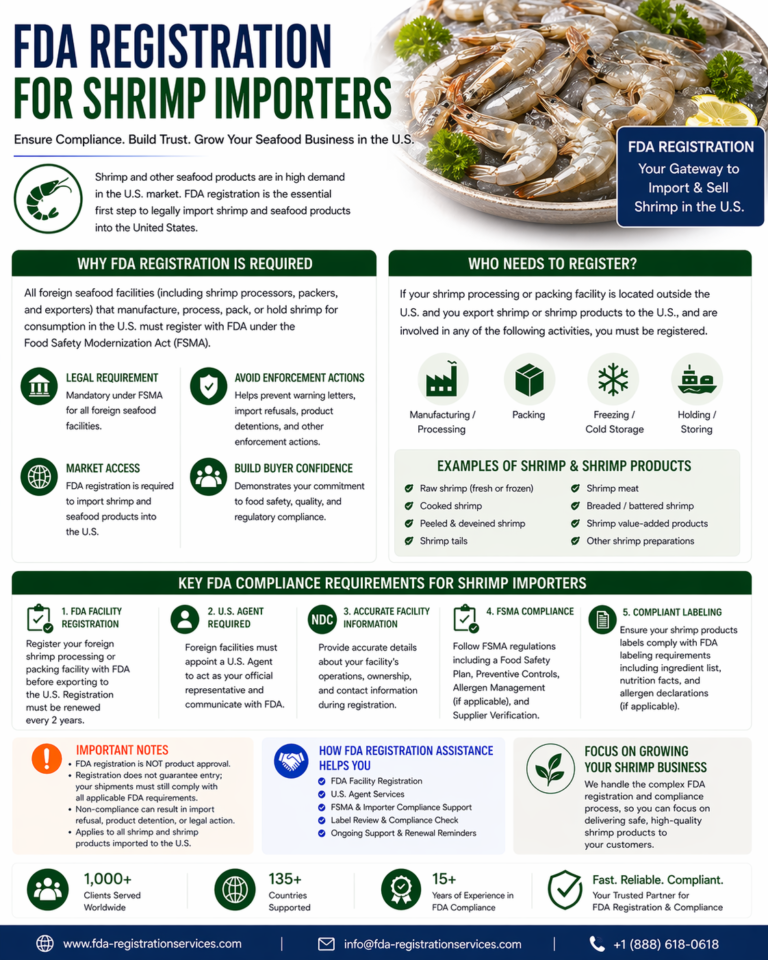
FDA Registration for Shrimp Importers
This guide covers everything a shrimp importer needs — facility registration, Seafood HACCP and the 123.12 importer verification requirement, the FSVP exemption most people get wrong, banned drugs and shrimp Import Alerts, net-weight/glaze and allergen labeling, and how to keep shipments moving.
Key Takeaways
- The processing facility must complete FDA Food Facility Registration (biennial renewal; a U.S. Agent for foreign facilities), and every shipment needs Prior Notice.
- Shrimp is a fishery product, so it must be processed under Seafood HACCP (21 CFR Part 123).
- Seafood is exempt from FSVP. The importer's verification duty is met under Seafood HACCP importer verification (21 CFR 123.12) — a point many importers get wrong.
- Banned aquaculture antibiotics (nitrofurans, chloramphenicol, fluoroquinolones, malachite green, and others) are the #1 detention driver — FDA has approved no drugs for shrimp farming, so residues make the shrimp adulterated.
- Processors and countries can be placed on Import Alerts, triggering Detention Without Physical Examination (DWPE) — automatic holds without inspection.
- Labeling must show the correct species/market name, net weight excluding glaze, country of origin, and the Crustacean shellfish allergen.
- FDA charges $0 to register; complete service is $858.
Seafood HACCP & the FSVP Exemption Most Importers Miss
Because shrimp is a fishery product, it falls under FDA's Seafood HACCP regulation (21 CFR Part 123) — a mandatory food-safety system covering finfish, crustaceans (shrimp), and mollusks. The processor must run a hazard analysis and control biological, chemical, and physical hazards.
Under 123.12, the importer must either source from a country with an FDA equivalence agreement, or take affirmative verification steps — such as keeping the processor's HACCP and sanitation records for the lot, holding an English-language copy of the HACCP plan and a written guarantee, periodically testing the product, or obtaining a government/third-party certificate — and maintain written procedures and records.
Banned Drugs & Shrimp Import Alerts
These are the residues FDA finds most often in refused shrimp. None are approved for shrimp aquaculture, so a detectable amount can render the product adulterated:
| Drug / Class | Type | FDA Status in Shrimp |
|---|---|---|
| Nitrofurans (AOZ, AMOZ, SEM, AHD) | Antibiotic | Banned — a leading refusal cause; Import Alert 16-129 |
| Chloramphenicol | Antibiotic | Banned — zero tolerance; Import Alert 16-127 |
| Fluoroquinolones | Antibiotic | Prohibited in aquaculture animals |
| Malachite green / leucomalachite green | Antifungal / dye | Unapproved — prohibited |
| Gentian violet / leucogentian violet | Antifungal / dye | Unapproved — prohibited |
| Sulfonamides (e.g., sulfadoxine), other animal drugs | Antibiotic | Not approved for shrimp aquaculture |
Import Alerts That Put Shrimp on DWPE
When a processor or country is named on an Import Alert, its shrimp is subject to Detention Without Physical Examination — held automatically, without inspection, until the importer proves compliance:
| Import Alert | Scope |
|---|---|
| IA 16-124 | Aquaculture seafood products due to unapproved drugs |
| IA 16-127 | All seafood due to chloramphenicol |
| IA 16-129 | Seafood products due to nitrofurans |
| IA 16-131 | Aquacultured shrimp, dace & eel from China & Hong Kong — drugs/additives |
| IA 16-136 | Aquacultured shrimp & prawn from Peninsular Malaysia — drugs/additives |
| IA 16-120 | Seafood from processors not compliant with Seafood HACCP (Part 123) |
Shrimp Labeling: Species, Glaze & Allergen
Beyond food safety, shrimp labels have category-specific pitfalls that lead to holds:
Species / Market Name
The statement of identity must use the acceptable market name for the species. Species substitution or misdescription is an enforcement concern.
Net Weight Excludes Glaze
For frozen shrimp, the declared net weight must be the shrimp only — not the protective ice glaze. Overglazing and short-weighting is a labeling and economic-adulteration issue.
Crustacean Shellfish Allergen
Shrimp is one of the 9 major allergens. The label must declare it — e.g., "Contains: Shellfish (Shrimp)." Country of origin is also required under U.S. Customs rules.
How to Import Shrimp into the U.S.
Getting shrimp compliance right from the start is far cheaper than a refusal at the port. The sequence:
Register the foreign processing facility
Confirm the processor is registered with FDA through FURLS, with a DUNS Number and a designated U.S. Agent.
Confirm the processor's Seafood HACCP plan
Verify a compliant HACCP plan (Part 123) covering the shrimp's biological, chemical, and physical hazards.
Meet the importer verification requirement
Satisfy Seafood HACCP importer verification under 21 CFR 123.12 — records, guarantees, and periodic testing. (Seafood is exempt from FSVP.)
Screen for banned drugs & import alerts
Confirm the shrimp is free of banned drugs and check whether the processor or country is on a shrimp Import Alert.
Prepare a compliant label
Correct species/market name, net weight excluding glaze, count/size, country of origin, and the shellfish allergen.
File Prior Notice & manage renewal
File Prior Notice before each shipment arrives, and renew the registration every even-numbered year.
Importing Shrimp into the United States?
FDA Registration Assistance provides Food Facility Registration for shrimp processors, U.S. Agent designation, Seafood HACCP import verification support under 21 CFR 123.12, shrimp label review (allergen and net-weight requirements), Prior Notice guidance, and Biennial Renewal management — for importers worldwide.
Contact us at info@fdaregistrationassistance.com or call +1 (928) 275-8333. 1,000+ clients across 135+ countries. 15+ years of FDA regulatory experience.
Frequently Asked Questions — FDA Registration for Shrimp Importers
1. Do I need FDA approval to import shrimp?
No — FDA does not approve shrimp before import. The responsibility is on the importer to ensure compliance: Food Facility Registration of the processor, Seafood HACCP, importer verification, labeling, and Prior Notice. Missing any of these can lead to detention or refusal.
2. Is Food Facility Registration required for shrimp?
Yes. Any facility that processes, packs, or holds shrimp for the U.S. must be registered under 21 CFR Part 1 and stay active. Foreign facilities also need a U.S. Agent, and registration renews every two years.
3. Is Seafood HACCP required for shrimp?
Yes. Shrimp is a fishery product, so it must be processed under a Seafood HACCP plan per 21 CFR Part 123, controlling biological, chemical, and physical hazards. Shrimp from a processor without a compliant HACCP plan is at high risk of detention.
4. What is Seafood HACCP (21 CFR Part 123)?
FDA's mandatory food-safety system for fish and fishery products — finfish, crustaceans (shrimp), and mollusks. Processors run a hazard analysis, set critical control points with monitoring and corrective actions, maintain sanitation controls, and keep records. Importers have their own verification obligations under Part 123.
5. Do shrimp importers need FSVP or Seafood HACCP verification?
A common confusion. Under 21 CFR 1.501(b), seafood from a supplier in compliance with Seafood HACCP is exempt from FSVP. Instead, the shrimp importer complies with the importer verification requirement of 21 CFR 123.12. So the correct framework for shrimp is Seafood HACCP importer verification — not FSVP.
6. What are the importer verification options under 123.12?
Either import from a country with an FDA equivalence agreement, or take affirmative steps: obtain the processor's HACCP and sanitation records for the lot; obtain a government or third-party certificate; inspect the facility; keep an English copy of the HACCP plan and a written guarantee; and periodically test the product. Written procedures and records are required.
7. Why is shrimp so heavily regulated?
Farmed shrimp has a long history of banned-antibiotic residues, Salmonella, and processing/labeling problems. FDA has approved no drugs for shrimp aquaculture, so residues are a frequent refusal basis. As a result, shrimp is one of the most closely monitored and detained seafood imports.
8. What antibiotics are banned in imported shrimp?
FDA has approved no drugs for shrimp aquaculture, so detectable residues generally make the shrimp adulterated. Those most often found include nitrofurans, chloramphenicol, fluoroquinolones, malachite green and leucomalachite green, gentian violet, and sulfonamides like sulfadoxine. These are the leading cause of shrimp refusals.
9. Is there a tolerance for antibiotics in shrimp?
For these banned/unapproved drugs, effectively zero. Because FDA hasn't approved them for shrimp, any detectable residue can make the shrimp adulterated and the shipment refusable — which is why sourcing controls and testing matter.
10. What is Detention Without Physical Examination (DWPE)?
FDA can detain a shipment at the port without physically examining it, based on the processor's or country's compliance history. Once on an Import Alert red list, a processor's shrimp is held automatically, and the importer must prove compliance — often via independent lab testing of consecutive shipments — before release.
11. What Import Alerts apply to shrimp?
Key ones include IA 16-124 (aquaculture seafood — unapproved drugs), IA 16-127 (seafood — chloramphenicol), IA 16-129 (seafood — nitrofurans), IA 16-131 (shrimp/dace/eel from China & Hong Kong), IA 16-136 (shrimp/prawn from Peninsular Malaysia), and IA 16-120 (processors not compliant with Seafood HACCP).
12. How do I get a processor off an Import Alert?
Generally by petitioning FDA with evidence the problem is corrected — for drug alerts, independent lab analyses of multiple consecutive clean shipments plus corrective actions; for HACCP alerts, documentation of Part 123 compliance. Shipments stay subject to detention until removal.
13. Is Salmonella a concern in shrimp?
Yes. Salmonella is a recurring detention reason for seafood. A HACCP plan should address pathogens, and finished-product testing is commonly used to verify control. Repeat findings can lead to Import Alert listing and DWPE.
14. Do shrimp importers need a U.S. Agent?
Yes, for foreign facilities. The U.S. Agent is FDA's domestic point of contact, physically present in the U.S. and reachable during business hours. An invalid or unresponsive agent can invalidate the registration.
15. Is Prior Notice required for shrimp imports?
Yes. Every shipment requires Prior Notice under 21 CFR Part 1 Subpart I before arrival, referencing the processor's active registration number. Without it, the shipment can be delayed or refused.
16. Do I need a DUNS Number?
Yes. A valid DUNS Number is required for Food Facility Registration and must match the facility's legal details. FDA won't confirm a registration or renewal without one.
17. How must imported shrimp be labeled?
With the correct statement of identity (the acceptable market name for the species), net quantity, ingredient statement where applicable, responsible-firm name and address, and the Crustacean shellfish allergen. Country of origin is required under Customs rules. Species substitution is an enforcement concern.
18. Does the net weight include the ice glaze?
No. For frozen shrimp, the declared net weight must reflect the shrimp only, not the ice glaze. Declaring a net weight that includes glaze water (overglazing/short-weighting) is a labeling and economic-adulteration concern.
19. Is shrimp a major food allergen?
Yes — shrimp is a Crustacean shellfish, one of the 9 major allergens. The label must declare it, e.g., "Contains: Shellfish (Shrimp)." Missing this declaration is a labeling violation.
20. Can I import shrimp from any country?
From many countries, yes — but the processor's and country's compliance history matters. Some processors and countries are on shrimp-specific Import Alerts and subject to DWPE. Check the supplier's alert status and Seafood HACCP compliance before committing.
21. What happens if my shrimp shipment is refused?
A refused shipment must be destroyed or re-exported, meaning significant loss and delay — and it can contribute to future DWPE for the processor. Getting compliance right before shipping is far cheaper than a refusal.
22. Can one mistake stop my shipment?
Yes. An unregistered processor, invalid U.S. Agent, missing Prior Notice, incomplete verification records, a banned-drug residue, or a labeling error can each trigger detention or refusal. Confirm every element before the first shipment.
23. How often must registration be renewed?
Every two years, during the biennial window from October 1 to December 31 of each even-numbered year. A facility that doesn't renew has its registration expire, and shipments can be refused.
24. How much does registration cost?
FDA charges $0 in government fees. FDA Registration Assistance charges $858 for the complete service — registration, DUNS Number, U.S. Agent designation for foreign facilities, and Biennial Renewal management, with Seafood HACCP verification and label review alongside.
25. How long does registration take?
Typically a day or two once the required information and a valid DUNS Number are provided. Building the surrounding compliance — importer verification records, drug screening, and labeling — takes additional time and should be arranged before the first shipment.
26. What are the most common shrimp compliance mistakes?
Assuming registration alone is enough; treating shrimp under FSVP instead of Seafood HACCP verification; a processor without a compliant HACCP plan; incomplete verification records; ignoring banned-drug and Import Alert risk; net weight including glaze; missing the shellfish allergen; and an invalid U.S. Agent cancelling the registration.
27. How does FDA Registration Assistance help shrimp importers?
FDA Registration Assistance provides complete compliance — Food Facility Registration ($858 complete service), U.S. Agent designation, Seafood HACCP import verification support under 21 CFR 123.12, shrimp label review, Prior Notice guidance, and Biennial Renewal management — for importers in 135+ countries.
28. How do I get started importing shrimp?
Contact FDA Registration Assistance at info@fdaregistrationassistance.com or call +1 (928) 275-8333. Share your processor details, the shrimp products and countries involved, and your current label. Registration, U.S. Agent, HACCP verification, and labeling are handled end to end. Complete service: $858.