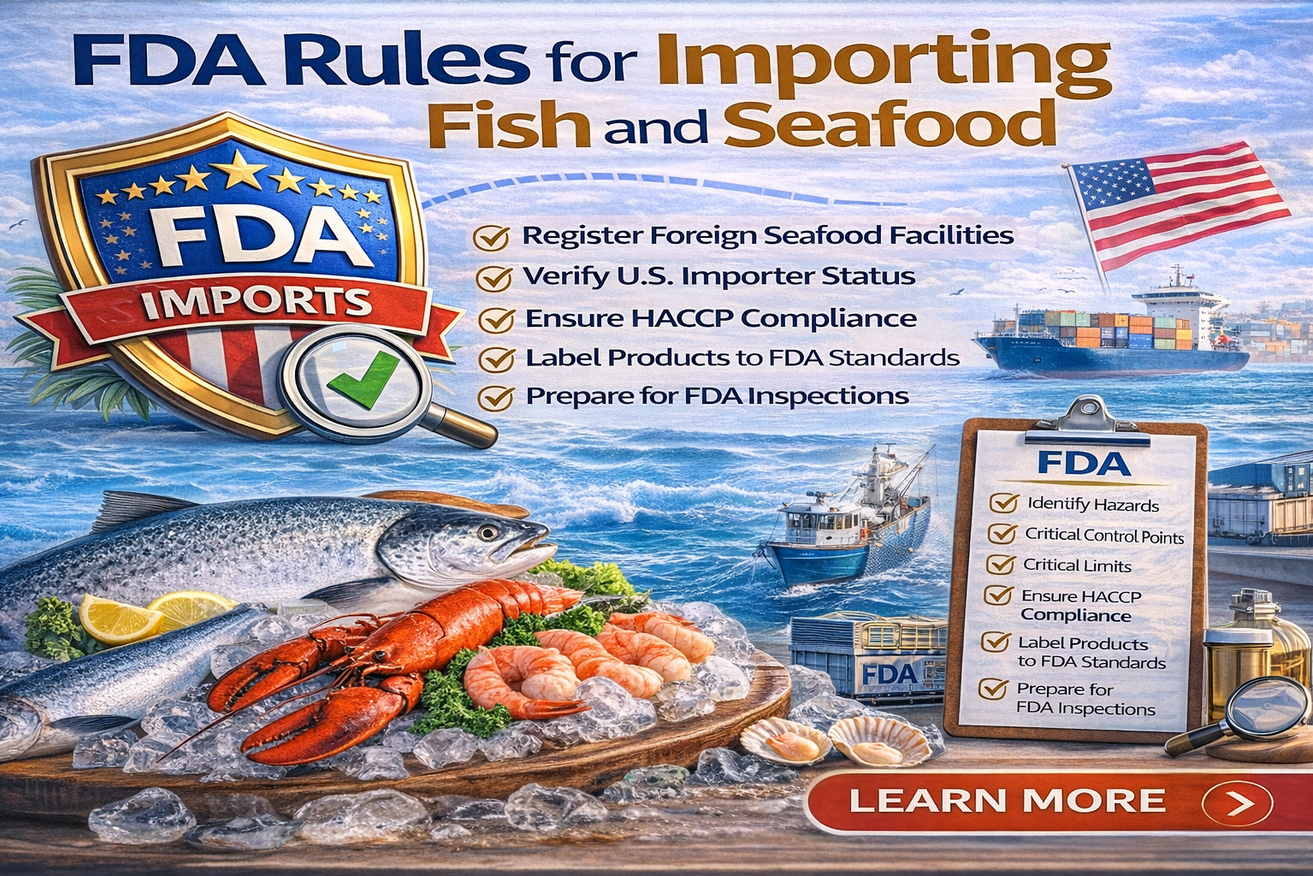
FDA Rules for Importing Fish & Seafood
Importing fish and seafood into the United States requires careful FDA compliance planning. Seafood importers must understand Seafood HACCP, Foreign Supplier Verification Program responsibilities, FDA Food Facility Registration, Prior Notice, labeling, entry documentation, import alerts, and detention risks before the shipment arrives at a U.S. port.
Before Importing Seafood, Review These Items
Seafood Imports Are One of FDA’s Most Carefully Reviewed Food Categories
Seafood HACCP Applies
Fish and fishery products are subject to FDA’s Seafood HACCP regulation. Importers should confirm that the foreign processor has appropriate hazard analysis, HACCP plans where required, monitoring records, corrective actions, and verification documentation.
FSVP May Also Apply
Seafood importers may need FSVP compliance in addition to seafood-specific requirements. Importers should verify the foreign supplier, product hazards, supplier controls, shipment records, and documentation before importation.
FDA Can Detain Seafood
FDA may detain seafood because of Import Alerts, labeling issues, unsafe residues, microbiological concerns, decomposition, histamine, species substitution, facility registration issues, missing documents, or incomplete importer verification records.
Importing Fish and Seafood Requires More Than a Customs Broker
A Customs Broker can file entry documents, but FDA seafood compliance requires more than an entry filing. The importer should understand the product, species, foreign processor, facility registration, Seafood HACCP records, supplier controls, labels, Prior Notice, product coding, and FSVP responsibilities before the seafood shipment arrives.
Seafood imports can include fresh fish, frozen fish, canned seafood, smoked seafood, dried seafood, shrimp, crab, lobster, tuna, salmon, surimi, molluscan shellfish, roe, fish oil, seafood meals, ready-to-eat seafood, and mixed products containing fish or shellfish. Each product can create different FDA concerns, especially when allergens, temperature control, histamine, pathogens, aquaculture drug residues, decomposition, or processing controls are involved.
FDA Registration Assistance helps seafood importers, foreign processors, brokers, distributors, Amazon sellers, and food companies review FDA requirements before importing fish and seafood into the United States.
FDA Requirements For Importing Fish and Seafood Into the U.S.
FDA Food Facility Registration
Foreign facilities that manufacture, process, pack, or hold seafood for U.S. consumption may need FDA Food Facility Registration. The registration should match the actual seafood facility, legal name, physical address, U.S. Agent, and DUNS/UFI information.
Seafood HACCP
Seafood processors and importers must consider FDA’s Seafood HACCP requirements under 21 CFR Part 123. The importer should obtain and review supplier HACCP records, hazard analysis, process controls, sanitation records, and corrective action documentation where applicable.
FSVP for Seafood Importers
The U.S. importer may need to maintain FSVP records verifying the foreign seafood supplier. FSVP review can include supplier approval, hazard analysis, supplier performance, COAs, certificates, testing, and shipment documentation.
Prior Notice
FDA must receive Prior Notice before imported food, including seafood, is offered for import into the United States. Prior Notice is often handled by the customs broker, but the importer should make sure the information is accurate.
Seafood Labeling
Seafood labels should accurately identify the product, species, ingredients, allergens, net weight, responsible firm, country of origin where applicable, storage conditions, and required food label elements. Mislabeling can lead to detention or refusal.
Import Alert Review
Seafood products and processors may appear on FDA Import Alerts for issues such as aquaculture drug residues, pathogens, decomposition, histamine, filth, misbranding, or DWPE concerns. Import Alert screening should be completed before shipment.
Key FDA Seafood Import Rules and What They Mean
| Compliance Area | Who It Affects | Common Import Risk | Recommended Review |
|---|---|---|---|
| Seafood HACCP | Seafood processors and importers of fish and fishery products. | Foreign supplier does not provide adequate HACCP records or hazard control evidence. | Review HACCP plan, hazard analysis, monitoring records, sanitation records, and corrective actions. |
| Food Facility Registration | Foreign seafood facilities manufacturing, processing, packing, or holding seafood for U.S. consumption. | Registration is missing, expired, mismatched, or not tied to the actual facility. | Confirm registration number, U.S. Agent, DUNS/UFI, facility name, and physical address before shipment. |
| FSVP | U.S. importers of seafood from foreign suppliers. | Importer cannot show supplier verification records during FDA review or inspection. | Build an FSVP file with supplier evaluation, hazard review, verification activities, and shipment records. |
| Prior Notice | Imported seafood shipments offered for import into the United States. | Incorrect manufacturer, shipper, product, quantity, arrival, or facility information delays entry. | Coordinate with broker and verify that Prior Notice details match the shipment and product documents. |
| Labeling | Retail seafood, packaged seafood, prepared seafood, and imported food products containing seafood. | Species name, allergens, ingredients, nutrition information, storage instructions, or country details are incorrect. | Review labels before printing, importing, Amazon listing, or retailer submission. |
| Import Alerts | Seafood products, manufacturers, countries, or firms with known compliance concerns. | Shipment is detained without physical examination because the firm or product matches an Import Alert. | Screen supplier and product before shipment and prepare evidence where Import Alert risk exists. |
Seafood HACCP is Central to FDA Seafood Import Compliance
FDA’s Seafood HACCP regulation requires seafood processors to identify food safety hazards that are reasonably likely to occur and implement controls where required. Importers should not rely only on a supplier’s sales documents or export certificate. They should request records that show the foreign processor understands and controls relevant seafood hazards.
Official FDA and Federal Seafood Import Resources
Seafood importers should rely on FDA and eCFR sources when evaluating compliance. FDA maintains seafood guidance, import resources, Prior Notice information, and Import Alert tools that help importers understand risks before shipment.
FDA Seafood Import Resources
FDA provides information about imported seafood safety and the Fish and Fishery Products Hazards and Controls Guidance used by seafood processors, importers, and regulators.
Federal Seafood Regulations and Import Tools
Seafood HACCP requirements are found in 21 CFR Part 123. Importers should also understand Prior Notice and FDA Import Alerts before shipping seafood to the United States.
Why Seafood Shipments are Detained by FDA
Seafood is a high-priority import category because problems can involve food safety, public health, species identity, allergens, temperature control, decomposition, aquaculture drugs, pathogens, toxins, or import alert history. Importers should address compliance before the shipment is already at port.
Common Seafood Import Mistakes Companies Make
Assuming the Broker Handles FDA Compliance
Customs brokers handle entry filing and communication, but they do not automatically build Seafood HACCP records, verify foreign suppliers, review labels, correct facility registration, or create an FSVP program.
Importing without Supplier HACCP Records
A supplier certificate or invoice is not enough. Seafood importers should request HACCP records, hazard analysis, COAs, certificates, sanitation records, and verification records before shipment.
Ignoring FSVP Responsibilities
Seafood importers may still need FSVP records. The importer should know who is responsible, what supplier verification has been done, and what records can be shown if FDA asks.
Waiting Until the Shipment is Detained
Once Seafood is detained, storage costs, demurrage, product deterioration, missed delivery windows, and refusal risk can increase quickly. Compliance review should happen before shipment.
When Should Seafood Importers Review FDA Requirements?
Seafood importers should review FDA requirements before selecting a supplier, placing a purchase order, booking freight, filing Prior Notice, sending products to Amazon, or shipping seafood to a distributor or cold storage facility. Seafood is time-sensitive, and compliance problems can become expensive once the shipment is in transit.
Need Help Importing Fish or Seafood into the United States?
FDA Registration Assistance helps seafood importers, foreign processors, brokers, Amazon sellers, distributors, and food companies with FDA Food Facility Registration, U.S. Agent service, DUNS/UFI support, Seafood HACCP document review, FSVP compliance support, label review, import documentation review, Import Alert screening, and FDA detention support.
FDA Registration Assistance is located in Miami, Florida, USA and assists seafood companies nationwide and internationally. We have helped 1,000+ companies across 135+ countries with 15+ years of combined regulatory experience. Contact us at info@fdaregistrationassistance.com.
Frequently Asked Questions About FDA Rules For Importing Fish and Seafood
1. Does FDA regulate imported seafood?
Yes. FDA regulates fish and fishery products imported into the United States and is responsible for helping ensure seafood is safe, sanitary, wholesome, and honestly labeled.
2. Do seafood importers need FDA approval before importing?
FDA generally does not pre-approve individual seafood shipments, importers, or labels before importation. However, seafood imports must comply with FDA requirements, including registration, Seafood HACCP, FSVP, Prior Notice, labeling, and import rules.
3. What is Seafood HACCP?
Seafood HACCP is FDA’s hazard analysis and critical control point system for fish and fishery products. It requires processors to identify and control food safety hazards that are reasonably likely to occur.
4. Does 21 CFR Part 123 apply to imported seafood?
Yes. FDA’s seafood HACCP regulation at 21 CFR Part 123 applies to fish and fishery products, including imported seafood. Importers must ensure that imported seafood has been processed in compliance with applicable requirements.
5. Do foreign seafood facilities need FDA Food Facility Registration?
Many foreign seafood facilities that manufacture, process, pack, or hold food for U.S. consumption must register with FDA and identify a U.S. Agent if they are foreign facilities required to register.
6. Do seafood importers need FSVP?
Many U.S. seafood importers need FSVP records verifying their foreign suppliers. FSVP requirements depend on importer role, product type, supplier, documentation, and whether an exemption or modified requirement applies.
7. Is FSVP the same as Seafood HACCP?
No. Seafood HACCP applies to seafood processing controls, while FSVP focuses on the importer’s verification of foreign suppliers. Seafood importers may need to consider both requirements.
8. Is Prior Notice required for seafood imports?
Yes. Prior Notice is required for food imported or offered for import into the United States, including fish and seafood, unless a specific exclusion applies.
9. Who files Prior Notice for seafood shipments?
Prior Notice is often filed by the customs broker, importer, or another authorized party. The importer should still ensure that the information is accurate and matches the shipment documents.
10. Can FDA detain imported seafood?
Yes. FDA may detain seafood for labeling problems, unsafe residues, pathogens, decomposition, histamine, Import Alert matches, registration issues, product coding problems, missing records, or other compliance concerns.
11. What is detention without physical examination?
Detention without physical examination, or DWPE, occurs when FDA detains a shipment based on Import Alert criteria without physically examining every shipment. Seafood firms and products can be subject to DWPE if listed on an Import Alert.
12. What documents should seafood importers request from suppliers?
Seafood importers should request HACCP plans, hazard analysis, monitoring records, corrective action records, sanitation records, COAs, testing records, certificates, product specifications, labels, and traceability documentation where applicable.
13. What seafood hazards does FDA commonly review?
Common seafood hazards include histamine, pathogens, parasites, natural toxins, decomposition, allergens, aquaculture drug residues, environmental contaminants, temperature abuse, and process-related hazards.
14. Do seafood labels need allergen statements?
Yes. Fish and crustacean shellfish are major food allergens under U.S. labeling law. Labels should properly declare allergens, species, ingredients, and product identity where required.
15. Can seafood species mislabeling cause FDA problems?
Yes. Incorrect species identity, misleading names, substitution, or inaccurate product descriptions can lead to misbranding concerns, detention, customer rejection, and enforcement risk.
16. Do canned seafood products have additional requirements?
Canned seafood may raise additional issues such as low-acid canned food, acidified food, FCE, SID, thermal process, and scheduled process requirements depending on the product and processing method.
17. Do smoked seafood products have special risks?
Smoked seafood can raise specific hazards such as pathogen growth, toxin formation, temperature control, reduced oxygen packaging concerns, and ready-to-eat product risks. HACCP and supplier records should be reviewed carefully.
18. Can imported shrimp be detained by FDA?
Yes. Imported shrimp may be detained for aquaculture drug residues, pathogens, decomposition, labeling problems, Import Alert concerns, or documentation issues. Importers should screen suppliers before shipment.
19. Can imported fish be sold on Amazon?
Seafood sold on Amazon must comply with FDA requirements and Amazon policies. Importers should review labels, storage conditions, facility registration, FSVP, supplier documents, and shipping controls before listing seafood products.
20. Does the customs broker handle Seafood HACCP?
No. A customs broker may help file entry data and Prior Notice, but Seafood HACCP review, supplier verification, FSVP records, and label compliance are the importer’s responsibility and may require regulatory support.
21. Can FDA Registration Assistance help with Seafood Imports?
Yes. FDA Registration Assistance helps seafood importers with FDA Food Facility Registration, U.S. Agent service, Seafood HACCP document review, FSVP compliance support, label review, Import Alert screening, and detention support.
22. What Information is needed for Seafood Import Compliance review?
Useful information includes product type, species, country of origin, supplier name, facility address, labels, ingredient list, HACCP documents, COAs, certifications, shipment documents, importer details, and broker communications.
23. Should Seafood Importers Screen Import Alerts before Shipment?
Yes. Importers should screen suppliers, products, and countries against FDA Import Alerts before shipment. Import Alert risk can lead to detention without physical examination and significant delays.
24. When should Seafood Importers request FDA Compliance help?
Seafood importers should request help before shipment, before choosing a new supplier, before importing a new species or SKU, before responding to FDA, or as soon as a broker reports a hold, document request, detention, or Import Alert issue.
25. Why Work with FDA Registration Assistance?
FDA Registration Assistance has helped 1,000+ companies across 135+ countries with 15+ years of combined regulatory experience. We help seafood importers understand FDA rules, organize supplier records, review labels, prepare FSVP documentation, and reduce avoidable import delays.