FDA Requirements for “Clinically Proven” Skincare
This guide explains the cosmetic vs. drug claims line, when a “clinically proven” claim triggers drug status, MoCRA registration and product listing, the Responsible Person and safety substantiation requirements, and the FTC evidence standard for clinical claims.
What MoCRA Compliance Costs for Your Skincare Brand
Cosmetic Claim vs. Drug Claim — Set by Intended Use
Under the FD&C Act, a product’s classification is determined by its intended use, which is established by its claims. A cosmetic (§ 201(i)) is intended to cleanse, beautify, or improve appearance. A drug (§ 201(g)) is intended to treat or prevent disease or affect the structure or function of the body. The same skincare product can be a cosmetic or a drug depending entirely on how the claim is worded.
What Happens If a “Clinically Proven” Claim Crosses Into Drug Territory
You Must Hold the Data
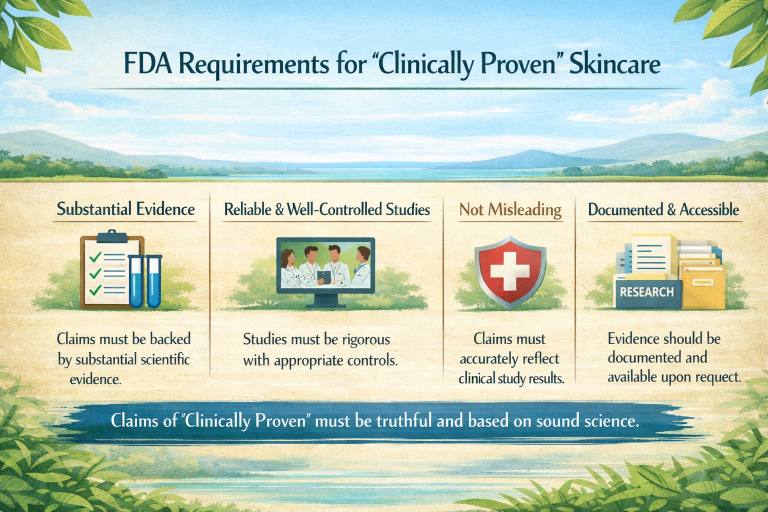
A “clinically proven” claim implies controlled testing. The FTC requires competent and reliable scientific evidence — typically well-designed clinical studies appropriate for the specific claim. A study showing hydration improvement does not substantiate a “clinically proven anti-wrinkle” claim. Both FDA (labeling) and FTC (advertising) can act on unsubstantiated claims. Hold the evidence before making the claim, not after a challenge.
Foreign Claims Don’t Carry Over
A claim that is a permitted cosmetic claim in the EU or another country may be a drug claim in the U.S. And a foreign clinical study only supports a U.S. claim if it genuinely substantiates that specific claim under U.S. standards. Importing skincare with foreign “clinically proven” claims is a common way brands accidentally market an unapproved drug.
What MoCRA Requires for Clinically Proven Skincare
Make Your “Clinically Proven” Claim Defensible — And Get MoCRA-Compliant
FDA Registration Assistance handles the full MoCRA stack for skincare brands and reviews your claims so you stay on the right side of the cosmetic/drug line: $849 facility registration, $200 per product listing, and $250 per label review (including a drug-claim risk assessment). We also support U.S. Agent designation for foreign cosmetic manufacturers and can advise if a product crosses into drug territory. 1,000+ clients. 135+ countries. 15+ years of FDA regulatory experience.
Contact us at info@fdaregistrationassistance.com or call +1 (928) 275-8333.
Frequently Asked Questions — Clinically Proven Skincare & MoCRA
1. Are clinically proven skincare products regulated by FDA?
Yes. Marketed as clinically proven, skincare is regulated as a cosmetic under MoCRA as long as it only improves appearance and makes no drug claims. “Clinically proven” is a marketing claim, not a regulatory classification. The product must comply with MoCRA facility registration, product listing, safety substantiation, labeling, and adverse event reporting. If the claim describes a therapeutic effect, the product may be reclassified as a drug.
2. How much does MoCRA cosmetic compliance cost for skincare?
MoCRA cosmetic facility registration is $849; cosmetic product listing is $200 per product; and MoCRA label review is $250 per label. Facility registration is the baseline; product listing applies per SKU; the label review checks INCI declarations under 21 CFR 701.3 and assesses whether your “clinically proven” claims stay within cosmetic territory. FDA charges no government fee for cosmetic registration. These fees do not include clinical study or safety substantiation testing, which the brand provides.
3. What does clinically proven mean under FDA rules?
FDA does not formally define “clinically proven.” But FDA and FTC both require claims to be truthful, not misleading, and supported by adequate evidence. The claim implies controlled testing whose results support the specific claim made. Without reliable scientific data to substantiate it, the claim is misleading and the product is misbranded. The evidence must be what qualified experts consider sufficient for that specific claim.
4. When does a clinically proven claim turn a cosmetic into a drug?
When it describes a therapeutic effect or an effect on the structure or function of the body. A cosmetic (§ 201(i)) improves appearance; a drug (§ 201(g)) treats disease or affects structure/function. Drug-triggering claims: treats acne; reduces inflammation; repairs skin damage; stimulates collagen; heals; restores; regenerates. A product making such claims is an unapproved new drug requiring an NDA or OTC monograph compliance — a serious enforcement risk.
5. What is the difference between a cosmetic claim and a drug claim?
Whether the claim describes improving appearance (cosmetic) or affecting the body’s structure, function, or a disease (drug). Cosmetic: moisturizes; improves the appearance of fine lines; reduces the appearance of wrinkles. Drug: treats acne; reduces inflammation; reduces wrinkles by stimulating collagen. “Improves the appearance of wrinkles” is cosmetic; “reduces wrinkles by stimulating collagen” is a drug claim. The same product can be either depending on the wording.
6. What is MoCRA and how does it apply to skincare?
MoCRA (the Modernization of Cosmetics Regulation Act of 2022) is the biggest update to U.S. cosmetic regulation since 1938. It requires: mandatory facility registration (biennial); product listing per product; Responsible Person designation; safety substantiation; adverse event reporting and recordkeeping; GMP; and fragrance allergen labeling; and gives FDA recall authority. Clinically proven skincare that is a cosmetic must comply with all applicable MoCRA requirements.
7. What is the Responsible Person under MoCRA?
The manufacturer, packer, or distributor whose name appears on the label. Obligations: ensuring the product is listed; ensuring adequate safety substantiation; maintaining adverse event records; and reporting serious adverse events to FDA. Every cosmetic distributed in the U.S. must identify a Responsible Person. For imports, a clear U.S. responsible party must be identified. Failing to designate one is a common compliance gap.
8. What safety substantiation does a clinically proven skincare product need?
Under MoCRA, the Responsible Person must ensure adequate substantiation of the product’s safety — tests, studies, or other evidence considered sufficient by qualified experts to support a reasonable certainty of safety. Separately, the “clinically proven” efficacy claim requires substantiation of that specific claim, typically well-designed clinical studies. Safety substantiation (MoCRA) and efficacy substantiation (to support the claim) are two distinct requirements.
9. What evidence does the FTC require for a clinically proven claim?
The FTC requires competent and reliable scientific evidence — generally well-designed, well-conducted clinical studies appropriate for the specific claim, evaluated objectively by qualified persons. A hydration study does not substantiate a clinically proven anti-wrinkle claim. Both FDA (labeling) and FTC (advertising) can act on unsubstantiated claims. A clinically proven claim without adequate clinical evidence is both an FDA misbranding issue and an FTC deceptive advertising issue.
10. Does a foreign skincare manufacturer need to register under MoCRA?
Yes. Every facility manufacturing or processing cosmetics for U.S. distribution — domestic or foreign — must register, and each product must be listed. A foreign manufacturer should ensure a Responsible Person is identified for the U.S. market. Foreign claims that are drug claims in the U.S. cannot be carried over. The same MoCRA registration, listing, and substantiation requirements apply to imported skincare.
11. What labeling is required on a clinically proven skincare cosmetic?
Under 21 CFR Part 701: product identity; net quantity; name and place of business; warnings/directions where needed; and ingredient declaration in descending order using INCI names (21 CFR 701.3). MoCRA adds fragrance allergen labeling. The clinically proven claim must be truthful, substantiated, and must not describe a drug effect. All required information in English.
12. What happens if a clinically proven skincare product makes a drug claim?
FDA may classify it as an unapproved new drug, which cannot be legally marketed without an approved NDA or OTC monograph compliance. Marketing an unapproved new drug is a prohibited act under the FD&C Act — exposing the company to Warning Letters, import detention and refusal, seizure, injunction, and recall. The product would also need drug establishment registration through eDRLS. This is the single biggest risk for clinically proven skincare brands.
13. Can a skincare product be both a cosmetic and a drug?
Yes — if it has both a cosmetic intended use and a drug intended use. Examples: moisturizer with SPF; anti-dandruff conditioner; foundation with SPF. Such a product must comply with BOTH cosmetic requirements (MoCRA registration, listing, INCI labeling) AND drug requirements (OTC monograph or NDA, eDRLS registration, Drug Facts labeling). A clinically proven claim that pushes a product into drug territory creates this dual-regulation situation.
14. What are examples of cosmetic-safe clinically proven claims?
Claims describing appearance without affecting structure, function, or disease: clinically proven to improve skin hydration; clinically tested to improve the appearance of fine lines; clinically shown to leave skin feeling smoother; clinically proven to improve radiance; clinically tested for improved texture appearance. Even these must be backed by appropriate clinical data to use “clinically proven” or “clinically tested” language.
15. What are examples of clinically proven claims that trigger drug status?
Clinically proven to treat acne; reduce inflammation; repair the skin barrier; stimulate collagen production; reduce wrinkles (attributed to a physiological mechanism); heal or restore damaged skin; reduce acne scars by promoting cell turnover. These describe disease treatment or physiological change, making the product a drug. A clinically proven claim is especially risky because it asserts a proven physiological effect.
16. What is the difference between MoCRA cosmetic registration and drug establishment registration?
MoCRA cosmetic registration applies to cosmetic manufacturers — facility registration and product listing through FDA’s cosmetics systems, renewed every two years. Drug establishment registration applies to drug manufacturers — through eDRLS under 21 CFR Part 207, with SPL drug listing and annual renewal. A skincare product that crosses into drug territory must comply with the drug system. Which applies depends entirely on the product’s claims.
17. How should ingredients be listed on a clinically proven skincare label?
Under 21 CFR 701.3, in descending order of predominance by weight using INCI names. Ingredients at 1% or less, and color additives, may be listed in any order after those above 1%. Fragrance and flavor may be declared as “fragrance” or “flavor.” MoCRA adds fragrance allergen disclosure. For imports, the INCI declaration must be present and in English.
18. Does FDA approve cosmetic products or clinically proven claims before marketing?
No. FDA does not approve cosmetics or pre-review claims (unlike drugs). The Responsible Person ensures the product is safe, properly labeled, listed under MoCRA, and that all claims are truthful, not misleading, and substantiated. FDA enforces after the fact (Warning Letters, import actions, recalls); FTC enforces against deceptive advertising. The burden is on the company to ensure its clinically proven claim is defensible before market.
19. What records must a clinically proven skincare company keep?
Safety substantiation records (MoCRA); the clinical/scientific evidence substantiating the efficacy claim; adverse event records (with serious events reported to FDA); MoCRA facility registration and product listing confirmations; and labeling and formulation records. If FDA or FTC questions the claim, the company must produce the substantiating evidence. Hold the data before making the claim, not after a challenge.
20. Can I use a foreign clinical study to support a clinically proven claim in the U.S.?
Only if it provides competent and reliable scientific evidence for the specific U.S. claim — well-designed, appropriate, and objectively evaluated. Common problems: the study supports a different claim; it isn’t rigorous enough for the FTC standard; or the foreign claim was a cosmetic claim abroad but is a drug claim in the U.S. The question is not where the study was done but whether it genuinely substantiates the specific U.S. claim.
21. How does MoCRA adverse event reporting apply to skincare?
The Responsible Person must report serious adverse events in the U.S. to FDA within 15 business days and maintain records of all adverse events for a specified period. A serious adverse event includes death, a life-threatening experience, hospitalization, disability, congenital anomaly, the need for medical/surgical intervention, or significant disfigurement. The label must include a U.S. contact for reporting. Clinically proven brands need an adverse event system in place.
22. What is the cosmetic GMP requirement under MoCRA?
MoCRA directs FDA to establish Good Manufacturing Practice regulations for cosmetics — covering methods, facilities, and controls to ensure products are not adulterated. While FDA finalizes the detailed rules, manufacturers (including clinically proven skincare makers) are expected to follow good manufacturing practices. GMP supports both safety substantiation and the integrity of any clinically proven claim, since claims rely on a consistent, well-controlled product.
23. What are the most common compliance failures for clinically proven skincare?
Making the claim without holding adequate clinical data; a claim that describes a drug effect (turning the cosmetic into an unapproved drug); no MoCRA facility registration or product listing; no Responsible Person; improper INCI labeling; missing safety substantiation records; importing foreign skincare with claims that are drug claims in the U.S.; and using a foreign study that doesn’t support the specific U.S. claim.
24. How does FDA Registration Assistance help with clinically proven skincare compliance?
Complete MoCRA cosmetic compliance and claims support: facility registration ($849); product listing ($200/product); claims review and drug-claim risk assessment; safety substantiation guidance; Responsible Person designation; cosmetic label review ($250/label) including INCI declarations under 21 CFR Part 701; and U.S. Agent designation for foreign manufacturers. We help position clinically proven claims defensibly and keep products on the correct side of the cosmetic/drug line. 1,000+ clients. 135+ countries.
25. How do I get help with FDA compliance for my clinically proven skincare product?
Contact FDA Registration Assistance at info@fdaregistrationassistance.com or call +1 (928) 275-8333. Provide your product name and type, the specific clinical claims you want to make, your label artwork, ingredient list, the clinical/scientific evidence you hold, and whether you are domestic or foreign. We assess whether your claims keep the product within cosmetic territory or risk drug classification, complete your MoCRA facility registration ($849) and product listing ($200/product), and review your label ($250/label).