
SIMP Compliance for Seafood Importers
Understand NOAA's permit, harvest-data, and chain-of-custody requirements without confusing them with FDA seafood safety duties.
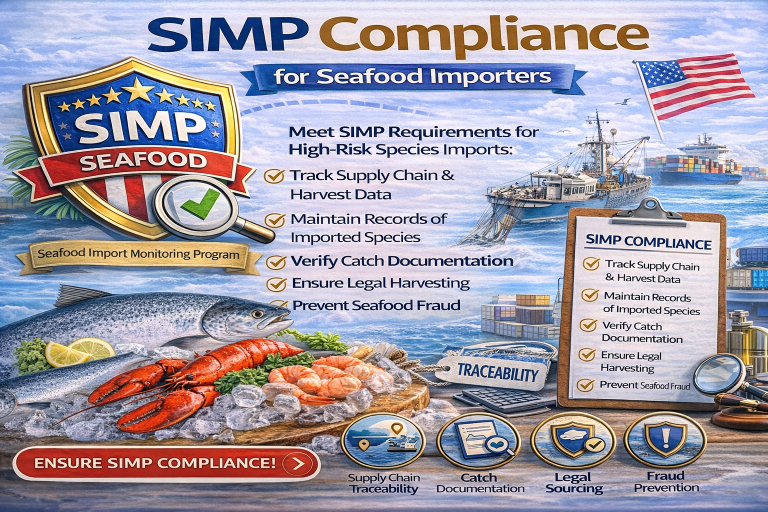
Need to coordinate NOAA traceability and FDA seafood obligations? Share the species, harvest origin, processing chain, IFTP arrangement, and entry stage so we can discuss the documentation and related FDA support your shipment needs.
Request My SIMP Documentation AssessmentConfirm the actual species and product coverage
NOAA's current guide identifies 13 covered species or species groups. Establish the scientific identity and product form rather than deciding solely from a broad commercial name. Check current NOAA and entry-filing instructions before the shipment. NOAA species and product coverage.
- Abalone; Atlantic cod; Pacific cod; Atlantic blue crab; red king crab.
- Dolphinfish (mahi mahi); grouper; northern red snapper; sea cucumber.
- Sharks; shrimp; swordfish.
- Covered tunas: albacore, bigeye, bluefin, skipjack, and yellowfin.
Identify the IFTP holder and the filing arrangement
The International Fisheries Trade Permit is the NOAA permit used for the relevant covered trade activities. NOAA's SIMP guide identifies the IFTP holder as the importer of record for SIMP responsibility, including data collection, reporting, and recordkeeping. NOAA permit-holder responsibilities.
That definition should not be treated as identical to every CBP importer-of-record or commercial DDP arrangement. NOAA's guide expressly distinguishes those roles. Identify who holds the IFTP and who transmits the entry data; a broker's participation does not remove the holder's responsibilities. NOAA importer and broker distinctions.
Gather harvest, landing, and chain-of-custody evidence
NOAA requires information about the harvesting or producing entity, harvest event, and the IFTP holder, with supporting chain-of-custody records through U.S. import. Reported data can include species, vessel or farm information, harvest area, gear, landing details, and weights as applicable. NOAA required data guidance.
Record processing, reprocessing, commingling, transshipment, and changes in custody. A catch certificate may contribute to the file, but it does not by itself document every subsequent transformation or transfer. Records should explain the path from harvest to the imported product. NOAA chain-of-custody guidance.
Agree with suppliers and the entry filer on the information needed before arranging a shipment. Do not wait until entry to discover that the scientific identity, harvest records, or permit-holder arrangement is unclear.
Retain records and prepare for an audit
NOAA's guide specifies two-year retention and describes random and targeted audits. The permit holder must be able to produce the required records, review their accuracy, and support the legality and identification of the seafood. NOAA recordkeeping and audit guidance.
For SIMP, NOAA says English translation is not required, but the U.S. importer must be able to review and verify accuracy. Do not apply that statement to FDA seafood importer-verification records, for which FDA guidance requires English. NOAA language guidance; FDA seafood verification guidance.
SIMP is not a substitute for FDA seafood compliance
NOAA focuses on traceability and legally harvested, accurately identified seafood. FDA's seafood HACCP and importer-verification requirements are a separate workstream; fulfilling one program does not establish compliance with the other. NOAA SIMP guide; FDA seafood HACCP guidance.
Use the FDA seafood import guide to assess the seafood-specific verification route, conditional FSVP exemption, and related facility and shipment questions.
Frequently Asked Questions
Is SIMP an FDA program?
No. The Seafood Import Monitoring Program is administered by NOAA Fisheries. FDA food-safety obligations are separate. NOAA guidance
Who is responsible under SIMP?
NOAA's guide identifies the IFTP holder as the SIMP importer of record responsible for reporting and maintaining the required records. This is not always the same designation used for a customs arrangement. NOAA guidance
Does using a customs broker remove the IFTP holder's duties?
No. A broker may transmit entry data, but the IFTP holder remains responsible for the SIMP information and records. NOAA guidance
How long must SIMP records be retained?
NOAA's current compliance guide specifies two years. Maintain the required chain-of-custody and related evidence so it can be provided during an audit. NOAA guidance
Do SIMP records have to be translated into English?
NOAA's guide says translation is not required for SIMP records, but the U.S. importer must be able to review and verify their accuracy. FDA seafood verification records have a different English-language requirement. NOAA guidance; FDA guidance
Is a catch certificate always a complete SIMP file?
No. A certificate can be one part of the records, but the chain of custody, product transformations, and custody changes through U.S. import still need to be supported. NOAA guidance
Coordinate the records without confusing the two agencies
We can discuss SIMP data and recordkeeping coordination alongside the FDA seafood work. The scope should identify the permit holder, entry filer, suppliers, and available evidence rather than treating one certificate as complete compliance.
- Discuss covered-species identification and the IFTP/reporting arrangement.
- Organize harvest, landing, processing, and chain-of-custody information.
- Scope related FDA seafood verification, registration, labeling, or shipment support separately.
See our related service and review scope.
Request My SIMP Documentation AssessmentFDA Registration Assistance is a private consulting firm, not FDA. Professional assistance is not government approval or a guarantee of a regulatory outcome.
Request SIMP / Seafood Documentation Support
Tell us the species or scientific name, product form, wild-caught or farmed origin, harvest and processing countries, IFTP holder arrangement, and planned entry date. Describe missing harvest or chain-of-custody records and any NOAA or broker request.
Submitting this inquiry does not purchase a service or authorize paid work. Our team can discuss the scope and required materials before you commission the review. Fields marked with an asterisk are required.