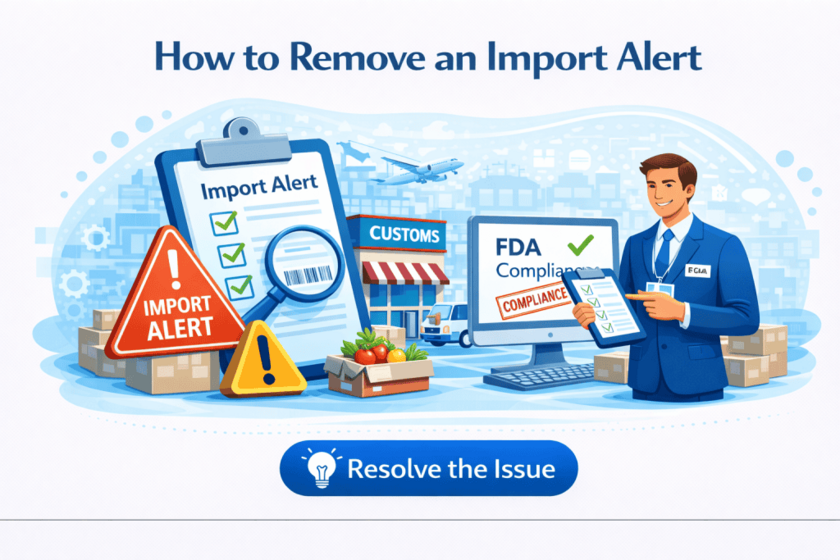
How to Remove an FDA Import Alert
This is the step-by-step process. If you'd rather hand it off, the import alert removal service covers the done-with-you version.
Key Takeaways
- Removal = off the Red List, ideally onto the Green List (no more auto-detention).
- The standard: violation resolved + FDA confidence in future compliance (RPM Ch. 9-8).
- Five consecutive compliant entries, commercial-size, third-party lab tested.
- Clearing a shipment ≠ removal — you still must file a separate petition.
- Petition goes to the Division of Import Operations; FDA charges $0 to file.
- Timeline: commonly six months to over a year, depending on the violation.
Clearing a Shipment Is Not Removal
Getting a shipment released
You submit testing and lab analysis for a detained entry, and FDA releases that shipment into commerce. Useful — and it's how you build a compliant entry history. But your firm is still on the alert.
Getting removed from the alert
A separate written petition, filed after you've cleared enough entries and fixed the root cause, that asks FDA to take you off the Red List. Until that's approved, every new shipment is still detained.
The Removal Process, Step by Step
Identify the exact violation
Read the import alert to find the specific charge against your firm or product, and check the alert's Guidance section plus RPM Chapter 9-8 for removal requirements.
Root-cause analysis + corrective action
Investigate why it happened (supplier, sanitation, process, documentation) and implement corrective and preventive actions with dates and owners.
Verify the fix works
Prove effectiveness through retesting, audits, or monitoring. FDA rarely accepts a single passing test as evidence a systemic problem is solved.
Clear five consecutive compliant entries
Ship at least five consecutive commercial-size entries that FDA examines and releases, each with third-party lab analysis. No splitting one container to reach the count.
Submit the removal petition
Send a written petition to the Division of Import Operations with firm ID, the alert citation, the corrective-action narrative, and the evidence package.
Decision — and stay compliant
FDA weighs the totality of evidence and issues a decision letter. If removed, you move to the Green List; keep monitoring entries so a new issue doesn't re-list you.
What the Removal Package Contains
| Element | What it shows |
|---|---|
| Firm identification | Name, address, FEI number, U.S. Agent |
| Import alert citation | The specific alert and charge you're addressing |
| Root-cause analysis | Why the violation occurred |
| Corrective & preventive actions | What you changed, with dates and owners |
| Verification of effectiveness | Retesting, audits, monitoring results |
| Evidence index | Lab analyses, GMP/HACCP records, inspection reports, labeling, COAs |
| Entry history | The five consecutive compliant, released entries |
Why It Takes Months, Not Days
Each entry takes weeks
A compliant entry can take several weeks to clear — and you need five in a row. That alone stretches over months.
Evidence must be real
A quick fix won't do. FDA wants a documented root cause, corrective action, and proof it works.
Review adds time
After you file, FDA reviews the totality of evidence before issuing a decision. End-to-end often runs six months to over a year.
Get Help Removing Your Import Alert
FDA Registration Assistance helps identify the root cause, build the corrective-action plan, structure and monitor the consecutive compliant entries, and prepare and submit the removal petition to the Division of Import Operations. See the import alert removal service for the full scope.
Contact us at info@fdaregistrationassistance.com or call +1 (928) 275-8333. Trusted by companies across 135+ countries, with 15+ years of experience.
Frequently Asked Questions
1. What does removing an import alert actually mean?
Getting your firm or product off the alert's "Red List" (subject to DWPE) and ideally onto the "Green List." Once removed, shipments are no longer automatically detained. It's a formal petition process, not an automatic reset.
2. What standard does FDA use to remove an alert?
FDA must see that the conditions behind the violation are resolved and have confidence future entries will comply. Evidence varies by alert and violation. The framework is in RPM Chapter 9-8, and the alert's own Guidance section may add requirements.
3. How many compliant shipments do I need?
Typically at least five consecutive, commercial-size entries that FDA examines and releases, each with third-party lab analysis. You can't split one container into smaller shipments to reach the count faster.
4. What goes into the removal petition?
A written petition to the Division of Import Operations: firm ID (name, address, FEI, U.S. Agent), the alert citation, a root-cause analysis, corrective/preventive actions, verification they work, and an evidence index — lab results, GMP/HACCP records, inspection reports, labeling, COAs.
5. Is clearing a detained shipment the same as removal?
No. Getting individual shipments released is separate from being removed from the Red List. Your firm stays on the alert until a separate removal petition is filed and approved, even after you've cleared entries.
6. Where do I send the petition?
To FDA's Division of Import Operations — by email to importalerts2@fda.hhs.gov or by mail to the address FDA lists for removals. FDA charges nothing to file. You get an acknowledgement, then a decision letter after review.
7. How long does removal take?
Usually months, not weeks. Each of the five compliant entries takes several weeks to clear, and FDA's review adds more. End-to-end frequently runs about six months to over a year.
8. Why do removal petitions get denied?
Common reasons: not showing the root cause was fixed, evidence that doesn't rebut the specific charge, and missing entry documentation for five consecutive compliant shipments. FDA rarely accepts a single passing test as proof.
9. What's the legal basis for import alerts?
Section 801(a) of the FD&C Act (products that "appear" to violate the law — often adulteration under 402 or misbranding under 403), with detention procedures at 21 CFR 1.94. That "appearance" standard shifts the burden to the importer.
10. Does the alert apply to all my products?
It depends on how the alert is written — some list a specific product, others apply to a firm broadly so all its products can be detained. Reading the exact scope is part of the strategy.
11. Do I need to keep records after removal?
Yes — keep entry records, lab results, supplier audits, and corrective-action evidence. For food, FSMA record provisions apply (e.g., FSVP records at 21 CFR 1.510). Ongoing monitoring helps avoid re-listing.
12. Can I still ship while on an import alert?
You can send shipments, but they'll be detained and held until you provide enough compliance evidence per entry. That's how the five consecutive compliant entries accumulate — but it's costly, so fixing the root cause first matters.
13. How is this different from the DWPE page?
DWPE is the mechanism an alert uses to hold your shipments; our DWPE explainer covers what it is and how firms end up on an alert. This page focuses on the removal process itself.
14. How does FDA Registration Assistance help?
It helps identify the root cause, build the corrective-action plan, structure and monitor the compliant entries, and prepare and submit the petition. See the removal service page, or contact info@fdaregistrationassistance.com or +1 (928) 275-8333.