Selling Supplements in the U.S.? Your Label Is the Gatekeeper
Here's the full path to legally selling supplements in the U.S., with the label as the anchor everything else is built around.
Key Takeaways
- The label is market access — it decides whether you can legally sell, not just what's on the package.
- Claims can reclassify your product — a disease claim turns a supplement into an unapproved drug.
- Selling in the U.S. takes four things: compliant label, registration, cGMP, and (if imported) FSVP.
- Foreign brands need a U.S. responsible party on the label and a U.S. Agent for FDA.
- Amazon adds a layer — FDA-compliant is necessary but no longer sufficient there.
- Fix it before production — early setup is far cheaper than a stalled launch.
The Four Pieces of U.S. Market Entry
Beyond a good product, legally selling supplements in the U.S. rests on four pillars — with the label first, because it's the one every gatekeeper checks:
1. A compliant label
Identity, Supplement Facts panel, claims, allergens, required elements, and lawful ingredients. It's the gatekeeper — so it comes first. Full detail in our label review guide.
2. Facility registration
The manufacturing facility registers with FDA; a foreign facility also appoints a U.S. Agent as its contact with the agency.
3. cGMP manufacturing
Supplements must be made under cGMP 21 CFR 111. It underpins both FDA compliance and, increasingly, marketplace requirements.
4. Import setup (if overseas)
Prior notice for each shipment and a Foreign Supplier Verification Program on the U.S. importer. See reviewing labels before customs.
Your Label Decides Your Product's Category
Most labeling errors are fixable formatting issues. One is not: a claim that crosses from structure/function into disease territory doesn't just break a rule — it can move your product into a different regulatory category entirely.
How a Bad Label Blocks Market Access
| Gatekeeper | What a non-compliant label triggers |
|---|---|
| FDA (post-market) | Warning letter, and potential enforcement for a misbranded product |
| Customs (imports) | Detention or refusal at the border — re-export or destruction |
| Amazon | Listing suppression or removal, with stranded inventory |
| Retailers | Rejection at onboarding; many require compliance review upfront |
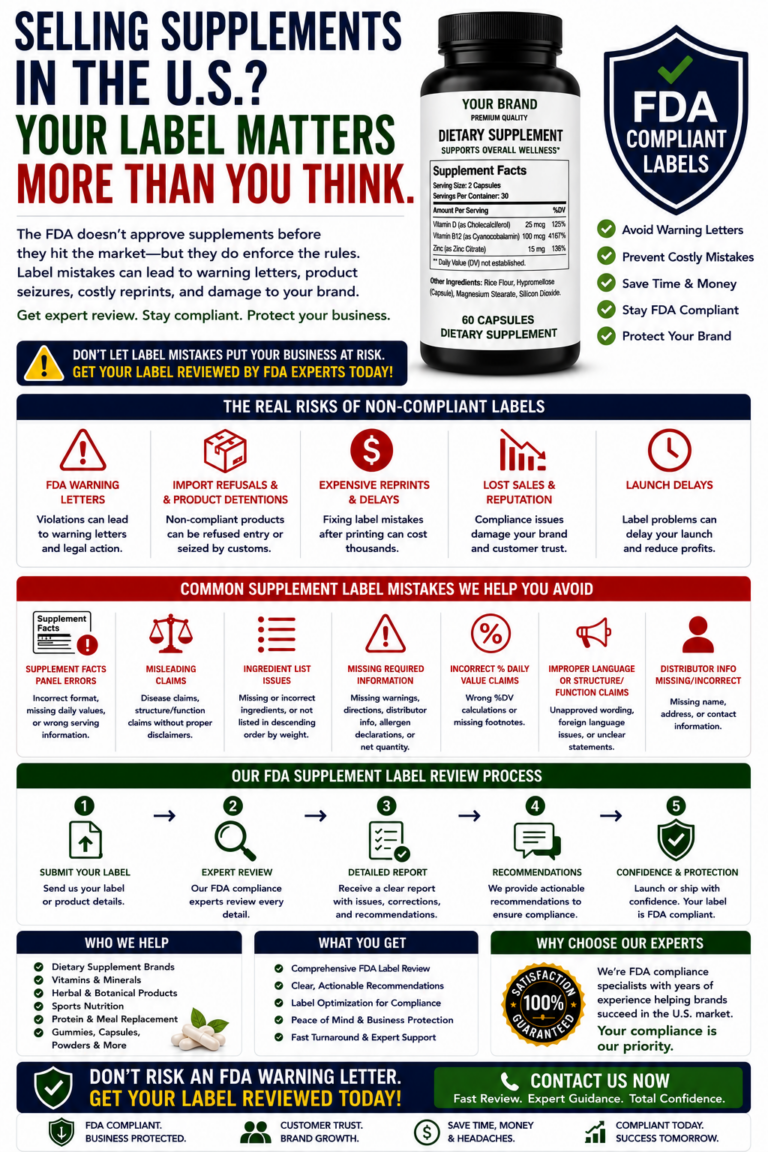
| Your budget | Reprints, relabeling, storage fees, and a delayed launch |
Your Path Depends on Your Situation
FDA Label Review
The complete guide to every required element and the areas that cause most violations.
Label guide →Review Before Customs
Get the label right before a shipment reaches the border and risks detention.
Import timing →Amazon Compliance
Amazon's 2026 rules add cGMP verification and claim-to-label alignment on top of FDA.
Amazon layer →How to Start Selling in the U.S.
Get the label right first
Identity, Supplement Facts, claims, allergens, elements, ingredient legality.
Register the facility
FDA registration; foreign facilities appoint a U.S. Agent.
Confirm cGMP manufacturing
Ensure your manufacturer meets 21 CFR Part 111.
Set up imports if overseas
Prior notice per shipment and an FSVP on the U.S. importer.
Match your sales channel
Add customs timing or Amazon's marketplace requirements.
Launch & maintain
Enter the market compliant; keep the label current as things change.
Enter the U.S. Supplement Market With Confidence
FDA Registration Assistance handles the full path: making your label compliant, registering the facility, serving as U.S. Agent, guiding cGMP, and setting up prior notice and FSVP for imports — then aligning to your sales channel, whether that's customs or Amazon.
Contact us at info@fdaregistrationassistance.com or call +1 (928) 275-8333. Food Facility Registration is available starting at $858. Trusted by companies across 135+ countries, with 15+ years of experience.
Frequently Asked Questions
1. Do I need FDA approval to sell supplements in the U.S.?
No. FDA doesn't approve dietary supplements or their labels before sale. But it strictly enforces the rules afterward, so you must comply from day one — especially on labeling. Non-compliance can make a product misbranded and block it from the market through detention, warning letters, or marketplace removal.
2. Why is the label the gatekeeper to selling in the U.S.?
Because the label is what FDA, customs, retailers, and marketplaces all read to decide whether your product may be sold. A misbranded label can stop the product at the border, trigger enforcement, or get a listing pulled — regardless of how good the product is. In practical terms, the label decides market access.
3. Can my label change how my product is regulated?
Yes — this is the deepest risk. If your label or claims say or imply the product treats, cures, or prevents a disease, FDA can classify it as an unapproved drug rather than a supplement. That reclassification is far more serious than a formatting error: an unapproved drug can't be legally sold, so the label literally determines your product's regulatory category.
4. What does it take to legally sell supplements in the U.S.?
Four things beyond a good product: a compliant label; a facility registered with FDA (with a U.S. Agent if the facility is foreign); manufacturing under cGMP (21 CFR Part 111); and, for imports, prior notice plus a Foreign Supplier Verification Program. Selling on Amazon adds a marketplace layer. The label is the anchor the rest is built around.
5. What happens if my label isn't compliant?
The product can be considered misbranded, which opens the door to FDA warning letters, shipment detention or refusal at the border, Amazon listing removal, retail rejection, and costly reprints or relabeling. These are market-access consequences — they stop you from selling — not just paperwork.
6. What are the required elements on the label?
A statement of identity (including "dietary supplement"), net quantity, the Supplement Facts panel (21 CFR 101.36), an "Other ingredients" list, an allergen declaration, and a U.S. responsible party. Structure/function claims add a DSHEA disclaimer. Our label-review guide breaks each element down.
7. Which claims are allowed?
Structure/function claims — describing how an ingredient supports normal body function ("supports immune health") — are allowed with substantiation, a 30-day FDA notification, and the DSHEA disclaimer. Disease claims ("treats diabetes") are not allowed and turn the product into an unapproved drug. Claims are the most common reason products are flagged.
8. Do I need a U.S. address on the label?
Yes. A U.S. responsible party — the name and address of the manufacturer, packer, or distributor, with a U.S. contact for adverse-event reports — must appear on the label. Foreign facilities also need a U.S. Agent for FDA communications, which is a separate requirement from the label's responsible party.
9. Can I use my existing international label?
No. Labels compliant in other markets are built around those markets' rules, not U.S. requirements — different panel format, different claim rules, different required elements. An international label almost always needs to be rebuilt to U.S. standards before you can sell here.
10. Does selling on Amazon change anything?
Yes. Amazon runs its own supplement compliance standard on top of FDA's — and as of its 2026 update it added mandatory third-party cGMP verification and claim-to-label alignment, enforced by fast listing suppression. Being FDA-compliant is necessary but no longer sufficient on Amazon; see our Amazon compliance guide.
11. I'm a foreign brand — can I still sell in the U.S.?
Yes, and many do. You'll need your facility registered, a U.S. Agent appointed, a U.S. responsible party on the label, prior notice for shipments, and an FSVP on the importer side — plus a label rebuilt to U.S. rules. We routinely set this up for brands entering the U.S. from abroad.
12. When should I sort all this out?
Before you print, import, or list — ideally before you commit to production. Fixing a label or supply-chain gap at the design stage costs a revision; fixing it after inventory is made or shipped costs reprints, storage, or a stalled launch. Early setup is far cheaper than late correction.
13. Does a compliant label mean I'm fully covered?
It's the biggest single piece, but not the whole picture. You still need registration, a U.S. Agent if foreign, cGMP manufacturing, and import verification. A clean label removes the most common failure point; the surrounding requirements keep the rest of your market access intact.
14. How does FDA Registration Assistance help?
We handle the full path to selling supplements in the U.S.: making the label compliant, registering the facility, serving as U.S. Agent, guiding cGMP, and setting up prior notice and FSVP for imports — then aligning to your sales channel, whether customs or Amazon. Starting at $858 for registration, for companies across 135+ countries. Contact info@fdaregistrationassistance.com or +1 (928) 275-8333.