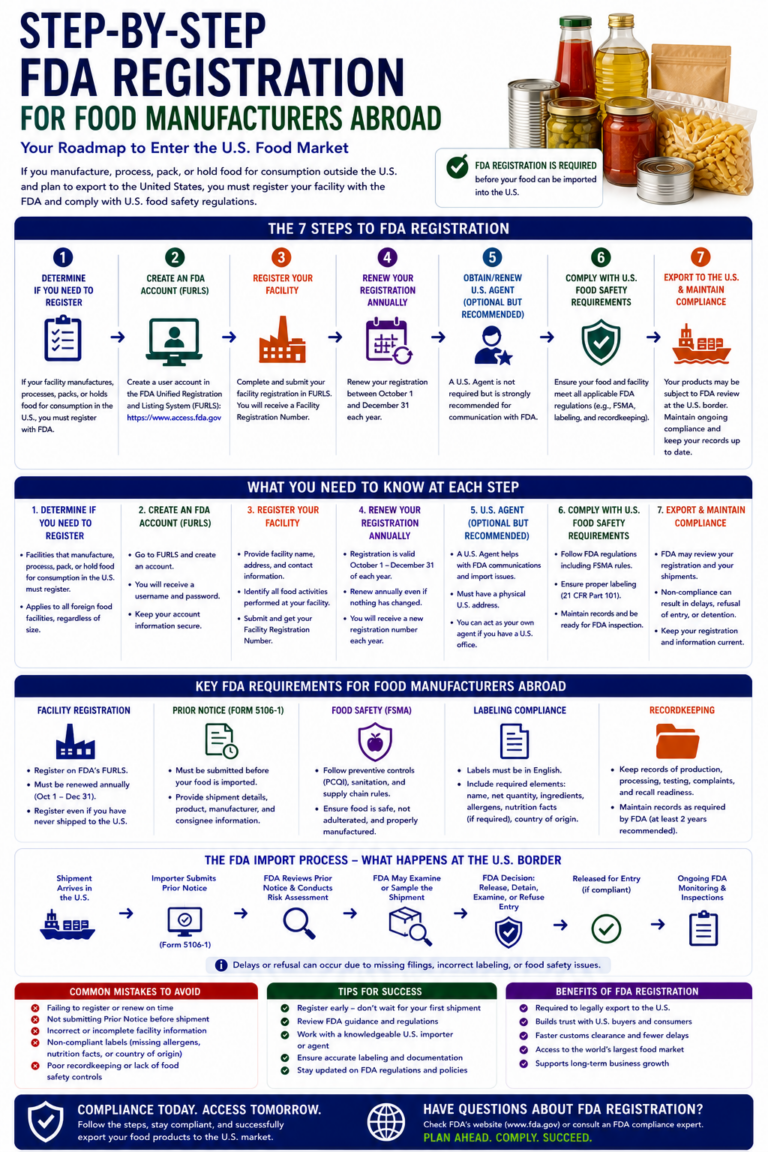
Step-by-Step FDA Registration for Food Manufacturers Abroad
Trusted by 1,000+ companies across 135+ countries, with 15+ years of FDA regulatory experience. Below: the full ordered process, the two product-specific branches, renewal, and what registration is and isn't.
The Step-by-Step Path
When Your Product Adds a Step
Most of the path above is the same for any food. Two product types add their own required layer:
| Branch | When it applies | What it adds |
|---|---|---|
| FCE + SID process filing | Low-acid canned (Part 113) or acidified (Part 114) foods | FCE (Form 2541) + scheduled process (2541d/2541e) via a process authority |
| Seafood / Juice HACCP | Seafood or juice products | A HACCP plan under Part 123 (seafood) or Part 120 (juice) |
Keep It Active: Biennial Renewal
Registration isn't one-and-done. Food facility registration renews biennially — every two years, during the FDA's October-to-December window in even-numbered years — and must be updated whenever key facility details change.
What Registration Is — and Isn't
It Is
Mandatory before you export, free from the FDA ($0), the foundation that FSVP, Prior Notice, and any process filings build on.
It Isn't
FDA "approval" or endorsement, a substitute for FCE/SID or labeling compliance, or something you can complete after the shipment has left.
Register Right — Before Your First Shipment
Send us your facility details, your products, and your suppliers, and we'll map the exact steps for your case — then register the facility, provide U.S. Agent service, complete FCE/SID where needed, coordinate a process authority, review labeling, support FSVP, and guide Prior Notice, all before you ship. Email info@fdaregistrationassistance.com or call +1 (928) 275-8333.
Frequently Asked Questions — Foreign Food Manufacturer Registration
Do foreign food manufacturers need FDA registration?
Yes. Any foreign facility that manufactures, processes, packs, or holds food for U.S. consumption must register with the FDA under 21 CFR Part 1, Subpart H, before its products can legally enter the country.
What's the first step?
Classification. Confirm what your product is — shelf-stable, refrigerated, or frozen; food, beverage, or supplement; and whether it's a low-acid canned or acidified food — because that determines which extra filings apply.
Do I need a U.S. Agent?
Yes. Every foreign food facility must designate a U.S. Agent under 21 CFR 1.227, who serves as the FDA's U.S. point of contact and must consent to the role. We can act as your U.S. Agent.
Is a DUNS Number required?
Yes. The DUNS Number is the mandatory Unique Facility Identifier for food facility registration. The registration cannot be completed and verified without a valid DUNS Number for the facility.
Where is the registration filed?
In the FDA's FURLS system — the Unified Registration and Listing System — using the Food Facility Registration module, where you provide facility details, food categories, and the U.S. Agent.
How much does FDA registration cost?
The FDA charges $0 to register a food facility. Costs come from doing it correctly, the DUNS Number if you don't already have one, and any added filings, U.S. Agent, or labeling work.
Does FDA registration mean my food is approved?
No. The FDA does not approve food or facilities. Registration is mandatory but is a listing, not an approval or endorsement of your product, and shouldn't be marketed as approval.
What information do I need to register?
Your legal company name, full facility address, a contact person, your business activities (manufacturer, packer, holder), food product categories, the U.S. Agent, and a DUNS Number for the facility.
Do all foods need FCE and SID filings?
No. Only low-acid canned and acidified foods need FCE registration and a SID scheduled-process filing. Most other foods don't, but misclassifying one is a common, costly error.
What's a process authority and when do I need one?
For low-acid canned and acidified foods, a process authority establishes and validates the scheduled process — pH, time, temperature — that underlies the SID filing. The FDA expects one to be involved for those products.
What about seafood or juice?
Seafood needs a HACCP plan under 21 CFR Part 123, and juice under Part 120, in addition to facility registration. These are product-specific branches on top of the core registration steps.
What does the FDA require on the label?
A Nutrition Facts panel, ingredients in descending order, allergen declarations, net quantity in U.S. units, name and place of business, and English — matching your formulation. See fixing a food label before import.
What is FSVP and who runs it?
The Foreign Supplier Verification Program (Subpart L) is the U.S. importer's duty to verify that you meet U.S. food-safety standards. The importer maintains it, and we can act as the FSVP Agent.
Is Prior Notice required?
Yes. Prior Notice (Subpart I) must be filed before each shipment arrives in the U.S. It's usually submitted by the importer or broker, and errors can cause immediate refusal at the port.
How long does registration take?
The facility registration itself is often completed within a few business days once your information and a DUNS Number are ready. FCE/SID, labeling, and process validation take additional time.
How often do I renew?
Food facility registration renews biennially — every two years, during the FDA's October-to-December window in even-numbered years. You must also update the registration whenever key details change.
What happens if my registration lapses?
An inactive or expired registration means your facility isn't validly registered, so its food can't legally be imported and shipments can be held or refused until it's corrected and reactivated.
Can I ship first and register later?
No. Registration and the related filings must be complete before your product reaches a U.S. port — trying to fix compliance after shipping usually leads to holds or refusals.
Is food facility registration the same as FCE registration?
No. They're separate. Food facility registration applies to all food facilities, while FCE registration is an additional step only for low-acid canned and acidified food processors.
Who designates the U.S. Agent — me or the importer?
The foreign facility designates its own U.S. Agent during registration, and the agent must consent. It's distinct from the importer and the FSVP importer, though one firm can support several roles.
What are the most common mistakes?
Misclassifying the product, skipping FCE/SID when required, having no DUNS Number, an unreliable U.S. Agent, non-compliant labeling, no FSVP importer, and Prior Notice errors. Nearly all are preventable.
Do supplements follow the same steps?
Largely yes. Dietary supplements are regulated as foods, so they register as food facilities and follow cGMP (Part 111) and Supplement Facts labeling, with a few of their own nuances.
Does this apply to small producers or samples?
Generally yes. Being a small producer or sending samples doesn't remove registration requirements if you're a covered facility shipping food to the U.S. The activity, not the size, drives the obligation.
Can one firm handle the whole process?
Yes. We classify the product, register the facility, provide U.S. Agent service, complete FCE/SID where needed, coordinate a process authority, review labeling, support FSVP, and guide Prior Notice — before you ship.
How do I get started?
Send us your facility details, your products, and your suppliers. Contact our team and we'll map the exact steps for your case and complete the registration and filings. Email info@fdaregistrationassistance.com or call +1 (928) 275-8333.