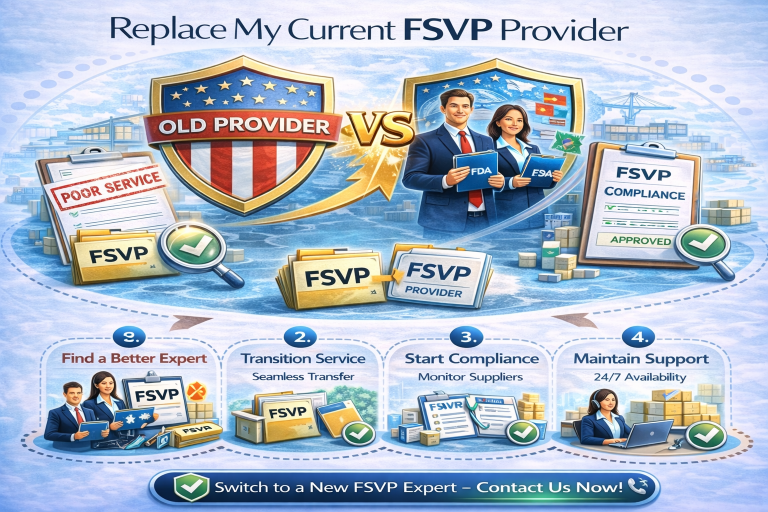
Replace My Current FSVP Provider
The real risk in switching isn't the paperwork — it's walking away without the records FDA can demand from you tomorrow.
Key Takeaways
- You are the FSVP importer — the U.S. owner/consignee is legally responsible, not the provider.
- Recover your records — you must produce your FSVP records to FDA within 24 hours (1.510).
- Confirm importer identification at entry — the right FSVP importer and DUNS number (1.509).
- No coverage gap — every entry needs a compliant FSVP throughout the switch.
- Judge the program, not the pitch — a templated FSVP with no real hazard analysis won't survive inspection.
- Seafood is different — it's exempt from FSVP and uses Seafood HACCP verification instead.
Why Importers Replace Their FSVP Provider
Templated, not real
A generic document with no food-specific hazard analysis or documented supplier verification — it looks like an FSVP but won't hold up under inspection.
Never maintained
Static records that were never updated as suppliers, products, or hazards changed. FSVP must evolve with your supply chain.
Unresponsive
Slow or no answers when a regulatory question or an FDA request arrives — the worst time to be waiting on a provider.
Records you can't get
A provider who holds your documentation and is slow to hand it over — leaving you exposed on the 24-hour rule.
What a Real FSVP Actually Contains
Before you decide, hold your current program against what the rule actually requires — if pieces are missing, it's time to switch:
- A qualified individual developing and overseeing the program (1.503)
- A hazard analysis for each food you import (1.504)
- Evaluation of the food risk and the foreign supplier's performance (1.505)
- Supplier verification activities matched to the hazard — onsite audit, sampling/testing, or records review (1.506)
- Corrective actions when problems are found (1.508)
- Importer identification at entry and complete records (1.509, 1.510)
What to Protect When You Switch
Your records
Get complete copies of every FSVP record — hazard analyses, supplier evaluations, verification, corrective actions. You must produce them within 24 hours.
Your entry identification
Confirm the correct FSVP importer and DUNS number are on your entries, with records kept at that location.
Your continuity
Keep a compliant FSVP in force for every entry through the transition — no shipment left uncovered.
How to Replace Your FSVP Provider Safely
Recover your FSVP records
Obtain complete copies of hazard analyses, supplier evaluations, verification records, and corrective actions — you must be able to produce them within 24 hours.
Have the program assessed
The new provider reviews the existing FSVP against the requirements to find gaps in hazard analysis, verification, and records.
Rebuild or strengthen as needed
Update the hazard analysis, supplier evaluations, and verification so the program reflects your current suppliers and products.
Confirm your importer identification
Ensure the correct FSVP importer and DUNS number are identified at entry, with records kept at the associated location.
Maintain coverage with no gap
Keep a compliant FSVP in place for every entry throughout the transition.
Set up ongoing maintenance
Establish a schedule to update the program as suppliers, products, and hazards change, and keep it inspection-ready.
Switch to an FSVP Program That Holds Up
FDA Registration Assistance helps you recover your records, assesses your current FSVP against the requirements, rebuilds or strengthens the hazard analysis and supplier verification, confirms your importer identification at entry, and maintains the program — keeping coverage continuous throughout.
Contact us at info@fdaregistrationassistance.com or call +1 (928) 275-8333. Trusted by importers across 135+ countries, with 15+ years of FDA experience.
Frequently Asked Questions — Replacing an FSVP Provider
1. Can I change my FSVP provider?
Yes, any time — no FDA permission needed. Because you (the U.S. owner or consignee) are the FSVP importer, the program belongs to you; a provider maintains it on your behalf. The key is switching without losing records or leaving entries uncovered.
2. Who's legally responsible — me or my provider?
You are. The importer is the U.S. owner or consignee at entry (or a designated U.S. agent if none). A provider can do the work, but inspection findings land on you — which is why a weak program is your risk.
3. What records do I need from my old provider?
Everything: the hazard analysis for each food, supplier evaluations and approvals, verification records (audits, testing, records reviews), corrective actions, and written procedures. Leaving without complete copies is a real exposure.
4. How fast must I produce FSVP records to FDA?
Within 24 hours. Offsite storage — including records held by a provider — is allowed only if they can be retrieved and provided within 24 hours of an FDA request (1.510). If you can't retrieve them, you're not compliant.
5. Do I have to notify FDA when I change providers?
There's no separate notification just for a provider change. What matters is that the correct FSVP importer and DUNS are identified at entry (1.509) and your program and records stay complete and available.
6. What is the importer identification at entry?
For each entry, the FSVP importer's name, email, and DUNS number go to CBP (1.509). FDA may review records at the location tied to that DUNS, so it should be where your records live. Confirm it's correct when you switch.
7. How do I know if my current FSVP is inadequate?
Warning signs: a generic template with no food-specific hazard analysis, no documented supplier verification, records never updated as suppliers changed, and a provider who can't answer questions or produce your records.
8. What should a real FSVP contain?
A qualified individual; a hazard analysis per food; evaluation of food risk and supplier performance; verification activities matched to the hazard (audit, testing, or records review); corrective actions; importer identification; and complete records. The analysis must be real, not a checklist.
9. Will switching interrupt my shipments?
It shouldn't, when handled properly. Every entry needs a compliant FSVP, so the transition keeps continuous coverage. Poorly managed switches or record gaps are what cause problems.
10. Do I have to start over from scratch?
Not necessarily. Sound documentation can be reviewed, updated, and taken over; incomplete or templated programs are rebuilt. A gap assessment shows how much carries forward.
11. Do seafood importers need FSVP?
Generally no — fish and fishery products are exempt from FSVP (1.501(b)) and follow Seafood HACCP importer requirements (123.12) instead. See our seafood importers page.
12. Is FSVP required for dietary supplements?
Supplement importers are subject to FSVP, but often under modified requirements (1.511) rather than the full program, depending on your role and CGMP compliance. Worth confirming for your situation.
13. Do Amazon and e-commerce food sellers need FSVP?
If you're the U.S. importer of record for food, yes — the sales channel doesn't change it. Many marketplace sellers switch providers to keep listings and shipments from being disrupted.
14. Can one FSVP cover multiple suppliers?
Yes, but each supplier and food must be individually evaluated and verified. One program can manage many suppliers, done supplier-by-supplier rather than generically.
15. How does FDA Registration Assistance handle the switch?
It helps recover your records, assesses the program against the requirements, rebuilds or strengthens hazard analysis and supplier verification, confirms importer identification, and maintains the program — keeping coverage continuous, for importers across 135+ countries.
16. How do I get started?
Contact FDA Registration Assistance at info@fdaregistrationassistance.com or call +1 (928) 275-8333 with your products and suppliers to review your current FSVP and transition without a gap.