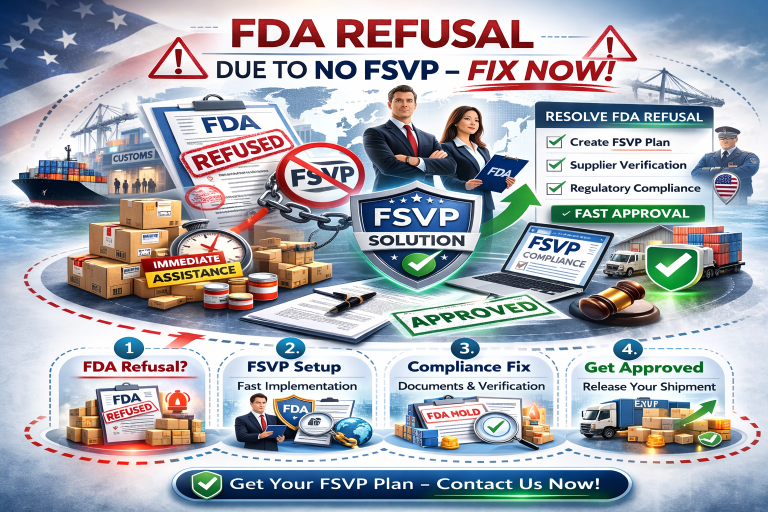
FDA Refusal Due to No FSVP — Fix It Now
Waiting won't fix it — the next shipment can be refused the same way. Here's exactly why it happens and how to correct it.
Key Takeaways
- The refused shipment usually can't be saved — it's re-exported or destroyed. Fixing the program protects future entries.
- The #1 hidden cause: confusing the customs importer of record with the FDA FSVP importer — the U.S. owner/consignee, or a designated U.S. agent.
- A DUNS number is mandatory — it's the unique facility identifier that must be transmitted at entry (21 CFR 1.509).
- Your broker isn't responsible for FSVP — the FSVP importer is. A filed entry with no program behind it still gets refused.
- Repeat refusals raise the stakes — they can lead to an Import Alert and detention without examination.
- Check for an exemption first — seafood and juice under HACCP, some canned foods, and USDA meat/poultry/egg follow different rules.
Why FDA Refused Your Shipment
"No FSVP" or "FSVP not in place" almost always traces to one of these gaps at the time of entry:
| Refusal trigger | What went wrong |
|---|---|
| No FSVP importer identified | No valid U.S. owner/consignee — or designated U.S. agent — named as the FSVP importer at entry |
| No DUNS / UFI | The required unique facility identifier wasn't transmitted to CBP with the entry |
| No hazard analysis | No documented analysis of the hazards for the imported food |
| No supplier verification | No evaluation, approval, or verification records for the foreign supplier |
| Records not produced | FSVP records couldn't be provided when FDA asked |
| Broker filed, no program behind it | The entry was filed, but no FSVP existed — FSVP is the importer's duty, not the broker's |
After a Refusal
Can't enter commerce
Refused food can't be sold or distributed in the U.S. — it must be exported or destroyed within FDA's timeframe.
Financial loss
Product value, freight, storage, and destruction/return costs add up quickly.
Higher future scrutiny
A refusal flags your entries; repeats can lead to an Import Alert and detention without examination.
How to Correct an FSVP Refusal
Identify the correct FSVP importer
The U.S. owner or consignee at entry — or a U.S. agent designated in a signed statement of consent if there's no U.S. owner/consignee. Not automatically the importer of record.
Obtain a DUNS number
FDA's recognized unique facility identifier, required at entry with the FSVP importer's name and email.
Build a compliant FSVP
A qualified individual develops it: hazard analysis, supplier evaluation and approval, and verification activities (audit, testing, or records review), with documentation.
Correct the entry & respond to FDA
Ensure future entries name the FSVP importer with the DUNS, and respond to any FDA request tied to the refusal.
Make records inspection-ready
Keep FSVP records in English and available to FDA promptly — inability to produce them is itself a failure.
Prevent recurrence
Maintain and reevaluate the FSVP as suppliers and products change, and review the wider import framework for other gaps.
Do You Even Need FSVP? Key Exemptions
FSVP applies to most human and animal food imports — but not all. If your product is exempt, the refusal may point to a different issue. Common exemptions under 21 CFR 1.501:
| Category | FSVP status |
|---|---|
| Seafood & juice under HACCP | Exempt from FSVP if the importer complies with HACCP (Part 123 seafood / Part 120 juice) — see our seafood importer guide |
| Low-acid canned foods | Exempt only for the microbiological hazards controlled under Part 113 |
| Meat, poultry & egg products | Certain products under USDA jurisdiction at import are outside FSVP |
| Transshipped / for export | Food passing through the U.S. or imported for further processing and export, not sold here |
| Research & evaluation | Exempt when labeled for research and evaluation, not for sale |
| Dietary supplements | Modified FSVP requirements apply (aligned with supplement CGMP) — not fully exempt |
Fix Your FSVP — Urgently
FDA Registration Assistance handles FSVP refusals as urgent cases: we confirm the correct FSVP importer and DUNS, build a compliant, inspection-ready FSVP program, and review your wider import framework so future shipments move without interruption.
Contact us now at info@fdaregistrationassistance.com or call +1 (928) 275-8333. Trusted by 1,000+ importers across 135+ countries, with 15+ years of FDA experience.
Frequently Asked Questions — FDA Refusal Due to No FSVP
1. What does an FDA refusal due to no FSVP mean?
FDA found no compliant Foreign Supplier Verification Program for the food at entry — no valid FSVP importer identified, no DUNS provided, or no FSVP records. Importing food without an FSVP is a prohibited act under FSMA, so FDA can refuse admission.
2. What's the difference between the FSVP importer and the importer of record?
They're not the same — and confusing them causes many refusals. Importer of record is a customs term; the FSVP importer is the U.S. owner or consignee of the food at entry (or a U.S. agent designated in a signed statement of consent if there's no U.S. owner/consignee). You can have an importer of record and still be refused for no valid FSVP importer.
3. Why did FDA refuse my shipment for no FSVP?
Usually: no FSVP importer identified at entry; no DUNS; no hazard analysis; no supplier evaluation/approval/verification records; or records that couldn't be produced. Often a broker filed the entry but no program stood behind it.
4. Can I recover a refused shipment?
Usually no — a refused shipment can't enter U.S. commerce and must be exported or destroyed within FDA's timeframe. Building the FSVP now protects your next shipment; it won't retroactively rescue the refused entry.
5. Can I create an FSVP after a refusal?
Yes — immediately — but it must be fully developed and documented before the next shipment arrives, and it won't rescue the refused entry. The goal is compliant future entries and readiness if FDA reviews your records.
6. What's included in a compliant FSVP?
Developed by a qualified individual: hazard analysis; evaluation of food risk and supplier performance; supplier approval; verification activities (onsite audit, sampling/testing, or records review); corrective actions; periodic reevaluation; and complete records. It's a program, not one document.
7. Do I need a DUNS number for FSVP?
Yes. For each line entry, the FSVP importer's name, email, and a unique facility identifier recognized by FDA — the DUNS number — must be transmitted to CBP at entry. Since mid-2022 the temporary placeholder is gone, so a missing DUNS is a direct problem.
8. Why didn't my customs broker handle FSVP?
A broker files the entry — they don't own your FSVP compliance. The regulation puts that on the FSVP importer. A broker can transmit your details at entry but can't substitute for having a program.
9. Will FDA inspect my FSVP records?
Yes. FDA can inspect your FSVP, and records must be kept in English and produced promptly on request. Being unable to produce them is itself a compliance failure.
10. Can repeat FSVP violations lead to an Import Alert?
Yes. Repeated non-compliance raises scrutiny and can contribute to Import Alert placement, which can mean detention without physical examination of future shipments.
11. Is FSVP required for all food imports?
It applies to most human and animal food unless an exemption applies — key ones include seafood and juice under HACCP, certain low-acid canned foods for microbiological hazards, and USDA meat/poultry/egg products. Check exemptions first.
12. Does seafood require FSVP?
Generally no — fish and fishery products (and juice) subject to and compliant with HACCP (Part 123 seafood, Part 120 juice) are exempt from FSVP. The verification obligation runs through the seafood HACCP rule instead. See our seafood importer guide.
13. Do dietary supplement importers need FSVP?
Yes, with modified requirements aligned to the dietary supplement CGMP rules rather than the full standard FSVP. The importer still needs a program appropriate to supplements.
14. Do Amazon food sellers need FSVP?
If the seller is the U.S. owner or consignee of imported food at entry, yes — they're the FSVP importer and need a compliant program, regardless of the marketplace.
15. Is FSVP a one-time requirement?
No. It must be maintained and reevaluated as suppliers, products, and hazards change — generally at least every three years or when new information arises. It's ongoing, not a one-time filing.
16. Who has to develop the FSVP?
A "qualified individual" with the education, training, or experience to perform the activity. This is why template programs often fail — they aren't tailored to your products and suppliers or backed by qualified analysis.
17. Can you review my existing FSVP program?
Yes. If you relied on a template, a broker, or incomplete documentation, we audit the program, find the deficiencies that led to (or could lead to) a refusal, and correct them to protect your next shipment.
18. How quickly can you build my FSVP after a refusal?
FSVP refusals are treated as urgent. We prioritize these cases and begin evaluating your importer structure and developing the program immediately, focused first on protecting your next inbound shipment.
19. How does FDA Registration Assistance fix FSVP refusals?
We review the refusal reason and your importer structure, confirm the correct FSVP importer and DUNS, build a compliant, inspection-ready FSVP, and review your wider import framework to prevent repeats — supporting importers in 135+ countries with 15+ years of experience.
20. What should I do right now if my shipment was just refused?
Act immediately. Contact FDA Registration Assistance at info@fdaregistrationassistance.com or call +1 (928) 275-8333 with your refusal notice and product/supplier details, and the correction can begin without delay.