
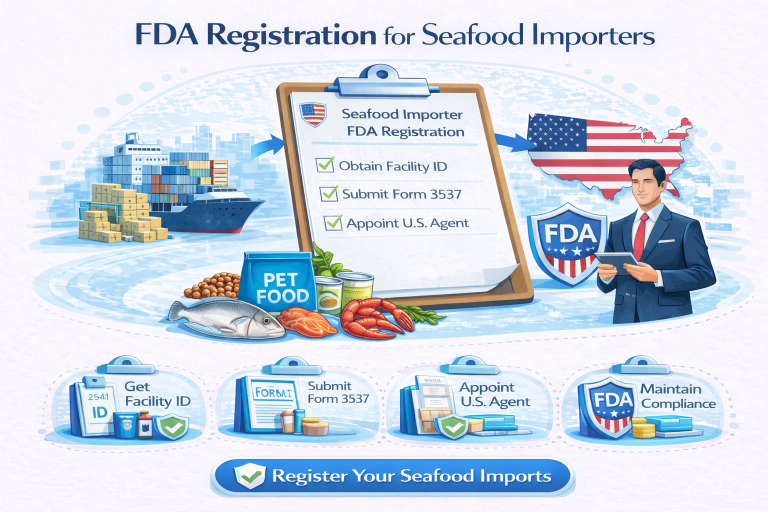
FDA Registration for Seafood Importers
Seafood is the most-detained food import there is. Getting your 123.12 verification right is what keeps your product moving.
Key Takeaways
- Seafood is exempt from FSVP (1.501(b)) — importers follow Seafood HACCP 123.12 instead.
- Two paths under 123.12: source from an equivalence-agreement country, or run written verification procedures.
- Written procedures need product specifications and affirmative steps — kept in English.
- Foreign processors must register and designate a U.S. Agent; the importer verifies this.
- U.S. importers usually don't register unless they store, process, repack, or relabel.
- Seafood dominates import detentions — histamine, Listeria, aquaculture drugs, decomposition.
Seafood HACCP Importer Verification (123.12)
Every importer of fish or fishery products must satisfy one of two paths:
Path 1 — Equivalence agreement
Source the product from a country with an active FDA memorandum of understanding (MOU) or equivalence agreement covering that fish or fishery product, and take affirmative steps to ensure it was processed under that agreement.
Path 2 — Written verification procedures
If no such agreement exists, implement written procedures with (i) product specifications and (ii) affirmative steps proving the processor follows Seafood HACCP. This is the path most importers use.
Registration: Importer vs. Foreign Processor
| Party | FDA facility registration? | Other duties |
|---|---|---|
| U.S. importer | Usually not — unless it stores, processes, repacks, or relabels | Seafood HACCP verification (123.12); prior notice |
| Foreign processor | Yes — food facility registration required | Seafood HACCP processing; designate a U.S. Agent |
| U.S. warehouse/cold storage | Yes — if it holds the seafood | Facility registration; sanitary storage |
Seafood Is the Most-Detained Food Import
Seafood carries high-risk, hard-to-detect hazards, which is why it dominates FDA import alerts and detentions:
Histamine (scombrotoxin)
In tuna, mahi, mackerel — forms with temperature abuse and can't be cooked out.
Listeria
In ready-to-eat and smoked fish — a serious pathogen concern.
Aquaculture drug residues
Unapproved veterinary drugs in some farmed species — a frequent import-alert trigger.
Decomposition
A common basis for refusal on perishable fishery products.
Pathogens & parasites
Salmonella, parasites, and related biological hazards.
Species mislabeling
Wrong market names — use FDA's Seafood List for correct naming.
Prior Notice, Labeling & Canned Seafood
- Prior notice — submitted to FDA before each shipment arrives (importer, filer, or broker).
- Labeling — food labeling rules plus a correct market name from FDA's Seafood List; species substitution is an enforcement focus.
- Canned seafood — shelf-stable tuna, salmon, and sardines are usually low-acid canned foods, adding FCE registration and a scheduled process (see our LACF page).
How to Get Seafood-Import Ready
Confirm your seafood pathway
Fish and fishery products are exempt from FSVP — you follow Seafood HACCP 123.12, not an FSVP.
Verify the foreign processor is registered
Confirm the processor holds a food facility registration and has a U.S. Agent.
Choose your verification path
Source from an equivalence-agreement country, or implement written verification procedures under 123.12(a)(2).
Document specs & affirmative steps
List product specifications and your affirmative steps; keep the records in English.
Handle prior notice & labeling
File prior notice per shipment and confirm correct market names from the Seafood List.
Stay inspection-ready
Maintain verification records, monitor import alerts, and be ready for an FDA importer inspection.
Seafood Import Compliance, Done Correctly
FDA Registration Assistance builds your Seafood HACCP importer verification program — product specifications and affirmative steps — verifies and maintains your foreign processors' registration, serves as U.S. Agent for foreign facilities, supports prior notice and labeling, and assists with detentions.
Contact us at info@fdaregistrationassistance.com or call +1 (928) 275-8333. Trusted by seafood importers and processors across 135+ countries, with 15+ years of FDA experience.
Frequently Asked Questions — Seafood Importers
1. Do seafood importers need FSVP?
Generally no. Fish and fishery products are exempt from FSVP under 21 CFR 1.501(b) when the supplier is subject to and complies with Seafood HACCP (Part 123). Importers meet 123.12 instead — a common point of confusion.
2. What is the seafood importer's actual obligation?
Under 123.12, you must either source from a country with an active FDA equivalence agreement (MOU) covering the product, or have and implement written verification procedures showing the products were processed per Seafood HACCP. One must be in place.
3. What must the written procedures include?
At minimum, product specifications ensuring the product isn't adulterated, plus affirmative steps — processor HACCP/sanitation records, a competent-authority certificate, facility inspections, the processor's HACCP plan plus a written guarantee, or periodic testing. Records kept in English.
4. Does seafood have to follow Seafood HACCP?
Yes — all fish and fishery products in U.S. commerce, domestic and imported, must be processed under Seafood HACCP (21 CFR 123), addressing histamine, pathogens, parasites, drug residues, and decomposition.
5. Do U.S. seafood importers register as a food facility?
Usually not just for importing — only if you also store, process, repack, or relabel seafood at your own facility. The foreign processor must be registered and have a U.S. Agent.
6. Do foreign processors need registration and a U.S. Agent?
Yes — any foreign facility processing seafood for the U.S. must be registered and designate a U.S. Agent. Confirming this is part of your verification.
7. Why is seafood the most-scrutinized import?
High-risk, hard-to-detect hazards — histamine in tuna/mahi/mackerel, Listeria in RTE and smoked fish, aquaculture drug residues, decomposition, pathogens, and parasites — so seafood dominates FDA detentions and import alerts.
8. What if my verification is inadequate?
Under 123.12(d), without evidence of compliant processing the product appears adulterated and can be denied entry. FDA inspects importers to review affirmative steps and issues warning letters where procedures, specifications, or steps are missing.
9. Do I submit prior notice for seafood?
Yes — prior notice must be filed for each imported food shipment before arrival, separate from your Seafood HACCP verification, typically by the importer, filer, or broker.
10. How should imported seafood be labeled?
Per food labeling rules, with an acceptable market name from FDA's Seafood List. Mislabeling or species substitution is an enforcement focus.
11. What about canned seafood?
Shelf-stable canned tuna, salmon, and sardines are typically low-acid canned foods, adding FCE registration and a scheduled process on top of Seafood HACCP — see our LACF page.
12. Does compliance make my seafood "FDA approved"?
No. FDA doesn't "approve" seafood. Meeting Seafood HACCP importer requirements and filing prior notice are compliance steps; "FDA approved" is inaccurate.
13. Can you help if my shipment was detained?
Yes — if a shipment is held or a supplier lands on an import alert, understanding DWPE and building verification and testing evidence is key to regaining entry.
14. Does this apply to shrimp?
Yes — shrimp is a fishery product under Seafood HACCP, with particular scrutiny for aquaculture drug residues. The same 123.12 verification applies; see our shrimp importers page.
15. How does FDA Registration Assistance help?
It builds your Seafood HACCP verification program, verifies and maintains foreign processor registration, serves as U.S. Agent, supports prior notice and labeling, and assists with detentions — for importers across 135+ countries.
16. How do I get started?
Contact FDA Registration Assistance at info@fdaregistrationassistance.com or call +1 (928) 275-8333 with your products and suppliers for a clear plan.