FDA Registration & U.S. Agent: One Complete Compliance Program
This page is about the whole compliance lifecycle — not just getting registered, but staying that way. For choosing a provider, see our registration company guide; for the agent role itself, our U.S. Agent page.
Key Takeaways
- Registration and U.S. Agent are inseparable for foreign facilities — one can't be valid without the other.
- Compliance is a lifecycle, not a filing: register → list → confirm agent → renew → update → stay inspection-ready.
- Fragmenting across providers creates gaps — unconfirmed agent consent, missed renewals, un-synced updates.
- Renewal schedules differ by category and run in parallel for multi-category firms.
- Registration ≠ approval — an integrated program keeps you valid, but confers no FDA "approval."
Fragmented vs. Integrated Compliance
Most compliance failures aren't dramatic — they're a handoff that nobody owned. Here's the difference:
✗ Fragmented (multiple providers)
One consultant registers you, another is your U.S. Agent, nobody owns renewals. The agent doesn't confirm FDA's consent email. An address change never gets filed. A renewal window passes unnoticed. Each provider assumes the other handled it — until a shipment is held.
✓ Integrated (one program)
Registration, U.S. Agent, listing, renewals, and updates are managed together, on one calendar, by one accountable partner. Consent verification is completed, renewals are tracked ahead of time, and updates are filed when things change — so your registration stays continuously valid.
The FDA Compliance Lifecycle
"Complete compliance" is a cycle, not a checkbox. Here's what it actually involves — and which parts recur:
Register & list Initial
Complete facility registration and any product or device listing in the correct FDA system for your category.
Designate & confirm the U.S. Agent Initial
Appoint the agent and complete FDA's consent verification — a step that must actually be finished for the registration to be fully active.
File updates when things change As needed
Ownership, address, contact, or U.S. Agent changes must be updated within FDA's timeframe — or the registration can become invalid.
Stay inspection-ready Ongoing
Keep records current and the U.S. Agent reachable, so FDA inquiries and inspection scheduling are handled promptly through your agent.
Keep imports aligned Ongoing
Keep FSVP and labeling consistent with your registration, so a valid facility doesn't still get caught by an import gap.
What the Program Covers
| Category | Core obligations | Renewal |
|---|---|---|
| Food & beverage | Registration + U.S. Agent + FSVP (importers) + labeling | Biennial (even-year Oct–Dec) |
| Dietary supplements | Registration + U.S. Agent + label/claim compliance | Biennial (as food) |
| Drugs | Establishment registration + drug listing + NDC + U.S. Agent | Annual |
| Medical devices | Registration + listing + U.S. Agent + Official Correspondent | Annual (+ FDA fee) |
| Cosmetics (MoCRA) | Facility registration + product listing + U.S. contact | Biennial (on reg date) |
Bring Registration & U.S. Agent Under One Program
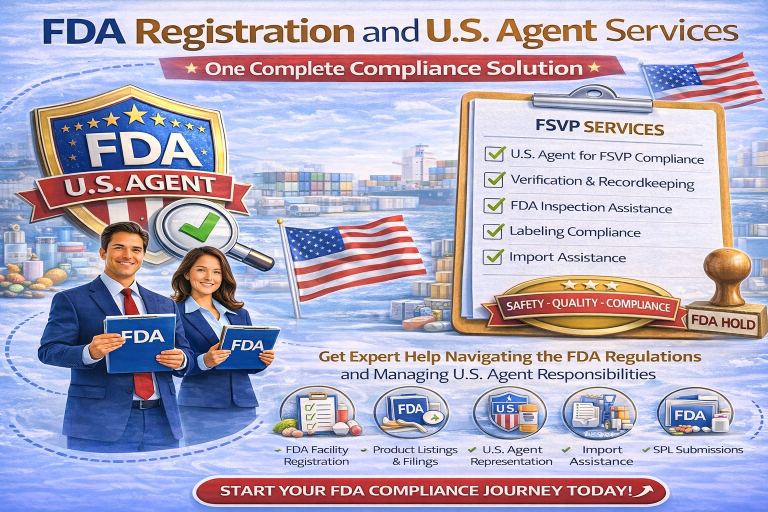
FDA Registration Assistance manages registration, U.S. Agent, listing, renewals, updates, inspection readiness, FSVP, and label compliance as one continuous program — so nothing falls between providers.
Contact us at info@fdaregistrationassistance.com or call +1 (928) 275-8333. Trusted by 1,000+ companies across 135+ countries, with 15+ years of FDA experience.
Frequently Asked Questions — Registration & U.S. Agent Compliance
1. Why are FDA registration and a U.S. Agent handled together?
For foreign facilities they're two halves of one requirement — you can't have an active registration without a designated U.S. Agent, and the agent's role exists because the facility is registered. Handling them together keeps the pieces synchronized; splitting them creates gaps like unconfirmed consent or untracked renewals.
2. What does "complete FDA compliance" actually involve?
An ongoing lifecycle: registration and listing, designating and confirming a U.S. Agent, maintaining renewals, filing updates, staying inspection-ready, and keeping FSVP and labeling aligned — not a single filing.
3. What goes wrong with different providers for each?
A U.S. Agent who never completed consent verification, a lapsed renewal nobody owned, details not updated after a change, and FDA communications that didn't reach the facility — any of which can cause import holds or an invalid registration.
4. Is registration a one-time task?
No. It must be renewed on schedule, updated when information changes, and kept aligned with your U.S. Agent and listings. Treating it as one-and-done is a common reason registrations quietly lapse.
5. How often do I renew, and does it vary by category?
Yes — food biennially (even-year Oct–Dec), cosmetics (MoCRA) biennially on your registration date, drugs and devices annually (devices with an FDA fee). Multi-category firms track several schedules at once.
6. Do I have to update between renewals?
Yes. Changes to ownership, address, contact, or U.S. Agent must be updated within FDA's timeframe (for example, food facility updates generally within 60 days, device U.S. Agent changes within 10 business days). Missing updates can invalidate the registration.
7. Does the U.S. Agent need to confirm consent?
Yes. FDA emails the agent to confirm consent; a denial or no response within 10 business days can affect registration. An integrated program ensures this is completed, not left hanging.
8. What is inspection readiness?
Keeping records, registration, and documentation current and the U.S. Agent reachable, so FDA inspections and inquiries are handled promptly. Because FDA reaches foreign facilities through the agent, an unresponsive agent undermines it.
9. Which industries does this cover?
Food and beverage, dietary supplements, drugs, medical devices, and cosmetics — the categories requiring facility registration and, in most cases, listing and a U.S. Agent for foreign facilities.
10. Can one provider manage everything across categories and facilities?
Yes — registration, U.S. Agent, listing, renewals, and updates across multiple facilities and categories, each on its own schedule. Consolidating removes the coordination gaps that cause lapses.
11. Does registration mean my product is FDA approved?
No. Registration lists your facility with FDA; it isn't approval or endorsement. A complete program keeps your registration valid, but no registration or U.S. Agent service confers FDA "approval."
12. How does FSVP fit in?
For food importers, FSVP is a separate obligation that must align with registration — a registered facility can still have shipments refused if the importer's FSVP isn't in place. An integrated program keeps them consistent.
13. How does labeling fit in?
Label compliance keeps products admissible. Even with valid registration and an agent, misbranded labeling can cause detention, so reviewing labels closes that gap before shipments are affected.
14. What happens if my registration lapses?
An expired or invalid registration can cause detention or refusal at the border and block sales. Because lapses happen quietly, continuous management is the main safeguard.
15. How do I switch to an integrated program?
Consolidate registration and U.S. Agent with one provider by updating your registration to the new agent and transferring ongoing management. Many companies do this after a lapse or near-miss.
16. Why choose FDA Registration Assistance?
It provides registration, U.S. Agent, listing, renewals, updates, inspection readiness, FSVP, and label compliance as one continuous program across every FDA category — so nothing falls between providers — for 1,000+ companies across 135+ countries.
17. How do I get started?
Contact FDA Registration Assistance at info@fdaregistrationassistance.com or call +1 (928) 275-8333. Share your category, facility location, and registration status for a plan to bring it all under one program.