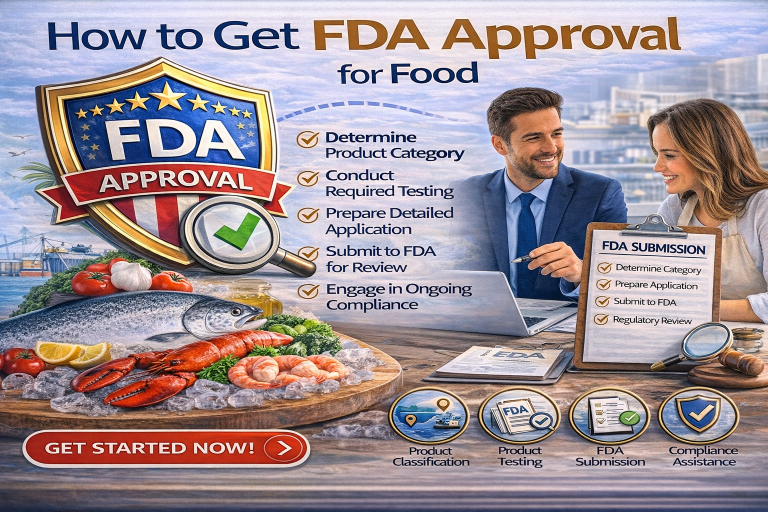
How to Get FDA Approval for Food
This guide explains exactly what FDA requires for food, what "GRAS" means and why most food ingredients don't need approval, when a food additive petition is required, how color additives work, and the complete compliance checklist for selling food in the United States.
When FDA Pre-Market Review Is Required — and When It Isn't
The term "FDA approval" means very different things depending on the product category. Here is the complete map of when pre-market FDA review applies to food:
| Product / Situation | Pre-Market FDA Approval Required? | Governing Regulation | What Is Actually Required |
|---|---|---|---|
| Conventional food products (packaged foods, beverages, snacks, condiments) | No Approval | 21 CFR Part 1, Part 101, Part 117 | Facility registration, compliant labeling, FSMA preventive controls, Prior Notice for imports |
| Food ingredients that are GRAS (salt, vinegar, most vitamins, common preservatives) | No Approval | 21 U.S.C. § 321(s) | No FDA action required. Voluntary GRAS notification to FDA is an option but not mandatory. |
| Food additives that are NOT GRAS (novel preservatives, emulsifiers, flavor enhancers) | Approval Required | 21 U.S.C. § 348 | Food Additive Petition (FAP) submitted to FDA. Use prohibited until FDA approves and issues a regulation in 21 CFR Parts 172–189. |
| Color additives (all synthetic and natural colors used in food) | Approval Required | 21 U.S.C. § 379e | Must be approved. FD&C synthetic colors (Red 40, Blue 1, Yellow 5/6) also require batch certification. Natural colors (turmeric, annatto, carmine) are approved but exempt from batch certification. |
| New Dietary Ingredients (NDI) in dietary supplements introduced after Oct 15, 1994 | Notification Required | 21 U.S.C. § 350b | 75-day advance notification to FDA. Not an approval — FDA reviews and may object. If no objection within 75 days, marketing may proceed. |
| Imported conventional food | No Approval | 21 CFR Part 1 Subpart I & L | Facility must be FDA-registered. Prior Notice required per shipment. U.S. importer must maintain FSVP for foreign supplier. Label must be FDA-compliant. |
| Dietary supplements | No Approval | DSHEA, 21 CFR Part 111 | Facility registration. Supplement Facts labeling. cGMP compliance under 21 CFR Part 111. NDI notification for new ingredients. No pre-market review for existing ingredients. |
| "Organic" claim | Not FDA — USDA | USDA National Organic Program | USDA certification by accredited certifier. Has nothing to do with FDA. FDA labeling compliance still required separately. |
GRAS — Why Most Food Ingredients Don't Need FDA Approval
The reason most food products don't require FDA approval comes down to one concept: Generally Recognized as Safe (GRAS). Under 21 U.S.C. § 321(s), a substance used in food is exempt from the food additive approval requirement if it is generally recognized — among qualified scientific experts — as safe for its intended use based on either scientific procedures or a long history of safe use before 1958.
Thousands of common food ingredients are GRAS: salt, sugar, vinegar, spices, most vitamins, most preservatives used for decades, many emulsifiers, and flavoring agents with long histories of use. These substances can be used in food without any FDA pre-market review because they are GRAS.
GRAS Self-Determination — No FDA Notification Required
A manufacturer can determine on its own — based on qualified expert scientific consensus — that a substance is GRAS for a specific use. No FDA notification is required. The manufacturer bears responsibility for the determination's accuracy. If the determination is wrong and the substance causes harm, the manufacturer is liable. FDA does not review or approve self-determined GRAS determinations before use.
Voluntary GRAS Notification to FDA
Manufacturers may voluntarily submit a GRAS notification to FDA under 21 CFR Part 570. FDA reviews and responds with either a "no objection" letter or notes that the substance does not appear to be GRAS. A "no objection" letter is not FDA approval — it is FDA's acknowledgment of the company's GRAS determination. The notification is entirely voluntary and FDA's response does not change the company's legal responsibility for safety.
If a substance is NOT GRAS and is not already an approved food additive in 21 CFR Parts 172–189, using it in food is illegal — the food is adulterated under 21 U.S.C. § 342. A Food Additive Petition must be submitted and approved by FDA before the substance can be used commercially.
Color Additives — The Exception Where FDA Approval Is Always Required
Unlike food ingredients (where GRAS exempts most from approval), all color additives require FDA approval regardless of their source or history of use. There is no GRAS exemption for color additives under 21 U.S.C. § 379e. However, there are two tiers of approved colors:
Certified Color Additives — Batch Certification Required
FD&C synthetic colors — FD&C Red No. 40, Blue No. 1, Blue No. 2, Green No. 3, Yellow No. 5, Yellow No. 6 — must be approved AND each manufactured lot must be submitted to FDA for batch certification before use. The batch certification fee is paid per pound of color manufactured. These are listed in 21 CFR Part 74. Yellow No. 5 (tartrazine) also requires specific labeling disclosure for certain products.
Exempt Color Additives — Approved but No Batch Certification
Colors derived from natural sources — annatto extract, turmeric oleoresin, beet juice, carmine (from cochineal insects), beta-carotene, paprika oleoresin — are approved for use in food but are exempt from the batch certification requirement. These are listed in 21 CFR Part 73. They must still be approved; the exemption only removes the batch-by-batch certification requirement.
How to Achieve FDA Compliance for Food — Step by Step
For conventional food products, the goal is not "getting FDA approval" — it is achieving and maintaining FDA compliance. Here are the required steps with the specific regulations that govern each:
Any facility that manufactures, processes, packs, or holds food for U.S. consumption must register with FDA. Foreign facilities must also designate a U.S. Agent. Registration renews biennially (October–December of even years). Consequence of skipping: every shipment from the facility can be refused entry at U.S. ports. FDA Registration Assistance provides the complete service.
Every substance used as a food additive must be either GRAS or an approved food additive. Novel ingredients with no history of safe use require a Food Additive Petition before commercial use. This is the step where "FDA approval" actually exists — but it applies only to non-GRAS additives, not the food product itself.
All color additives must be approved and listed in 21 CFR Parts 73 or 74. Certified colors must also have FDA batch certification for each manufactured lot. Using an unapproved color additive makes the food adulterated.
Labels must include: English statement of identity; net quantity in U.S. units; current U.S.-format Nutrition Facts panel with correct RACC serving size; complete ingredient list in descending order by weight; allergen declarations for all nine FALCPA and FASTER Act major allergens (including sesame since January 2023); and manufacturer/distributor name and address. Label errors are the #1 cause of import detention.
Most registered food facilities must implement a written food safety plan under FSMA's Preventive Controls for Human Food rule — hazard analysis, preventive controls, monitoring, corrective actions, and verification. A Preventive Controls Qualified Individual (PCQI) must develop or oversee the plan. Some facilities qualify for modified requirements or exemptions based on size or product type.
U.S. importers must maintain a Foreign Supplier Verification Program for each foreign food supplier — written hazard analysis, supplier verification activities, corrective actions, 2-year recordkeeping. FDA Registration Assistance provides complete FSVP services.
Every food shipment imported into the United States requires Prior Notice before arrival — 8 hours for ocean, 4 hours for air, 2 hours for road. The manufacturer's active FDA registration number must be included. Prior Notice inaccuracies trigger immediate shipment holds. Learn more about Prior Notice.
Five Misconceptions About FDA and Food
"I need FDA approval before I can sell my food"
Not for conventional food products. FDA requires compliance — registration, labeling, safety controls — not pre-market approval. The obligation is on you to be compliant, not on FDA to approve you before you start. FDA takes action after the fact if it finds violations.
"Organic certification is an FDA program"
No. Organic is USDA, not FDA. The USDA National Organic Program governs organic claims and certification. FDA handles food labeling and safety. A food product carrying the USDA Organic seal still needs to meet all FDA labeling requirements independently — the two are separate.
"My home country's food approval means I'm FDA-compliant"
No. Compliance with EU, China SAMR, HSA, SFA, or any other domestic food authority does not satisfy FDA requirements. FDA has its own registration, labeling, FSVP, and Prior Notice requirements that must be addressed independently regardless of domestic approvals held.
"My customs broker handles my FDA compliance"
No. Your customs broker handles CBP entry filing and duty payment. All FDA compliance obligations — FSVP, supplier registration verification, label compliance, Prior Notice accuracy — remain with you as the U.S. importer of record. See the food importer compliance guide.
Ready to Sell Food in the United States?
FDA Registration Assistance helps food manufacturers and importers achieve full FDA compliance — Food Facility Registration, U.S. Agent designation, label compliance review, FSVP, Prior Notice guidance, and ongoing compliance management. 1,000+ clients. 135+ countries. 15+ years of FDA regulatory experience.
Contact us at info@fdaregistrationassistance.com or call +1 (928) 275-8333.
Frequently Asked Questions — How to Get FDA Approval for Food
1. Does the FDA approve food products before they are sold?
No — not for most food. FDA requires compliance (facility registration, labeling, food safety controls) rather than pre-market approval. FDA may take enforcement action after a food is on the market if it finds violations. Pre-market review only applies to non-GRAS food additives, color additives, and new dietary ingredients in supplements.
2. What does FDA actually require for food instead of approval?
FDA requires: Food Facility Registration with biennial renewal; a U.S. Agent for foreign facilities; FDA-compliant labeling under 21 CFR Part 101; FSMA Preventive Controls under 21 CFR Part 117; FSVP for U.S. importers; and Prior Notice for every import shipment.
3. What is GRAS and why does it matter?
GRAS (Generally Recognized as Safe) under 21 U.S.C. § 321(s) is the exemption that explains why most food ingredients don't need FDA approval. If a substance is GRAS, it can be used in food without FDA pre-market review. If it is not GRAS, it requires a Food Additive Petition and FDA approval before any commercial use.
4. What is the difference between GRAS and an approved food additive?
A GRAS substance is recognized by qualified experts as safe — no FDA pre-market action required. An approved food additive is a non-GRAS substance that has gone through FDA's formal Food Additive Petition (FAP) process under 21 U.S.C. § 348 and received approval codified in 21 CFR Parts 172–189. This is the only "food approval" that exists in U.S. law — and it applies to additives, not to food products.
5. Does a company need FDA approval to use a food additive?
Only if the additive is not GRAS. GRAS substances can be used without FDA pre-market review. Non-GRAS food additives require a Food Additive Petition (FAP) and FDA approval before any commercial use. Using a non-GRAS, non-approved additive makes the food adulterated under 21 U.S.C. § 342.
6. What is the FDA GRAS notification program?
Manufacturers may voluntarily notify FDA of a GRAS determination under 21 CFR Part 570. FDA responds with a "no objection" letter or raises concerns. A "no objection" letter is not FDA approval — it is FDA's acknowledgment of the company's GRAS determination. The notification is voluntary; GRAS self-determination without notifying FDA is legally permissible.
7. Do color additives in food require FDA approval?
Yes — all color additives require FDA approval with no GRAS exemption. Certified colors (FD&C Red 40, Blue 1, Yellow 5, Yellow 6) also require batch certification of each manufactured lot under 21 CFR Part 74. Exempt colors from natural sources (turmeric, annatto, carmine) are approved but exempt from batch certification under 21 CFR Part 73.
8. What is a New Dietary Ingredient (NDI) notification?
Under 21 U.S.C. § 350b, a dietary supplement ingredient introduced after October 15, 1994 requires a 75-day advance notification to FDA before marketing. Not an approval — FDA reviews and may object. If no objection within 75 days, marketing may proceed. Pre-1994 dietary ingredients do not require notification.
9. Does the FDA approve organic food?
No. Organic is regulated by USDA under the National Organic Program — not FDA. A product can only carry the USDA Organic seal if certified by a USDA-accredited certifier. FDA handles labeling and safety; organic certification is entirely USDA's domain. Both frameworks must be addressed independently.
10. What FDA registration does a food company need?
Most food facilities must complete FDA Food Facility Registration under 21 CFR Part 1. Foreign facilities must also designate a U.S. Agent. Biennial renewal is required October–December of even-numbered years. Missing renewal causes automatic cancellation and blocks all U.S.-bound shipments.
11. What food labeling requirements does FDA require?
Under 21 CFR Part 101: English statement of identity; net quantity in U.S. units; Nutrition Facts panel in current FDA format with correct U.S. serving sizes; complete ingredient list in descending order; allergen declarations for all nine FALCPA and FASTER Act allergens (including sesame since January 2023); and manufacturer/distributor name and address.
12. Are food contact materials subject to FDA requirements?
Yes. Food packaging materials that may migrate into food are regulated as indirect food additives or through the food contact notification (FCN) program. Substances in packaging must be approved under 21 CFR Parts 174–179, be GRAS for the contact application, or be covered by an effective food contact notification. Novel packaging materials require regulatory review before commercial use.
13. What is FSMA and how does it apply?
FSMA's Preventive Controls for Human Food rule at 21 CFR Part 117 requires registered food facilities to implement a written food safety plan — hazard analysis, preventive controls, monitoring, corrective actions, and verification. A Preventive Controls Qualified Individual (PCQI) must develop or oversee the plan.
14. Do imported food products need FDA approval?
No. Imported food requires FDA compliance — facility registration, compliant labeling, Prior Notice, and FSVP — not FDA approval. FDA may refuse entry to non-compliant shipments, but refusal is an enforcement action, not a denial of approval.
15. What are the most common misconceptions about FDA and food?
Most common: (1) FDA "approves" food before sale — false for most food; (2) organic certification is FDA — false, it's USDA; (3) home country food safety approval means FDA compliance — false; (4) private certifications (SQF, BRC, ISO 22000) substitute for FDA compliance — false; (5) your customs broker manages FDA compliance — false, it's the importer's responsibility.
16. When is FDA pre-market review required for food?
Only three situations: (1) non-GRAS food additives — Food Additive Petition under 21 U.S.C. § 348; (2) color additives — approval under 21 U.S.C. § 379e, batch certification for certified colors; (3) new dietary ingredients in supplements introduced after October 15, 1994 — 75-day NDI notification under 21 U.S.C. § 350b.
17. What does FDA do after food is on the market if it finds a problem?
FDA can issue Warning Letters; request voluntary recalls (and order mandatory recalls for certain products); detain food at ports; issue Import Alerts causing Detention Without Physical Examination (DWPE); pursue injunctive relief through the Department of Justice; and refer serious cases for criminal prosecution.
18. Does a food company need FDA registration if it only sells domestically?
FDA Food Facility Registration is only required for facilities producing food for U.S. consumption. A facility producing food exclusively for domestic consumption in its home country with no U.S. exports does not need FDA registration. The obligation is triggered by U.S.-bound production or distribution.
19. Do dietary supplement companies need FDA approval?
No pre-market approval for most supplements under DSHEA. New dietary ingredients introduced after October 15, 1994 require a 75-day NDI notification. Supplement facilities must be FDA-registered. Products must comply with Supplement Facts labeling and cGMP requirements under 21 CFR Part 111.
20. How does FSVP relate to FDA compliance for imported food?
FSVP under 21 CFR Part 1 Subpart L is a supplier oversight program — not an approval mechanism. U.S. importers must maintain a written FSVP for each foreign food supplier, including hazard analysis, supplier verification activities, corrective actions, and 2-year recordkeeping. FSVP demonstrates the importer has verified supplier compliance — it is not FDA approval of the food.
21. Are private food safety certifications recognized by FDA?
No. SQF, BRC, ISO 22000, and similar private certifications are voluntary commercial programs — not FDA requirements. FDA compliance is required regardless of private certifications held. Private audit reports may be used as FSVP supplier verification evidence but do not substitute for FDA regulatory obligations.
22. What are the steps to achieve FDA food compliance?
Seven steps: (1) Food Facility Registration; (2) verify all ingredients are GRAS or approved additives; (3) confirm all color additives are approved under 21 CFR Parts 73 or 74; (4) achieve label compliance under 21 CFR Part 101; (5) implement FSMA Preventive Controls under 21 CFR Part 117; (6) FSVP for U.S. importers; (7) Prior Notice for every import shipment.
23. What is the Biennial Renewal for FDA Food Facility Registration?
FDA Food Facility Registration renews every two years — October 1 through December 31 of every even-numbered year. Missing the window causes automatic cancellation and blocks all U.S.-bound food shipments from that facility until re-registration is completed.
24. How does FDA Registration Assistance help food companies?
FDA Registration Assistance provides complete FDA compliance for food manufacturers and importers: Food Facility Registration with U.S. Agent designation and Biennial Renewal management; food label compliance review; FSVP development and Agent services; Prior Notice guidance; and ongoing compliance management. 1,000+ clients. 135+ countries.
25. How do I get started with FDA food compliance?
Contact FDA Registration Assistance at info@fdaregistrationassistance.com or call +1 (928) 275-8333. Provide your product formulation, facility location, target U.S. market, and any existing FDA correspondence. FDA Registration Assistance will classify your product, identify all applicable compliance requirements, and manage the process from registration through ongoing compliance.