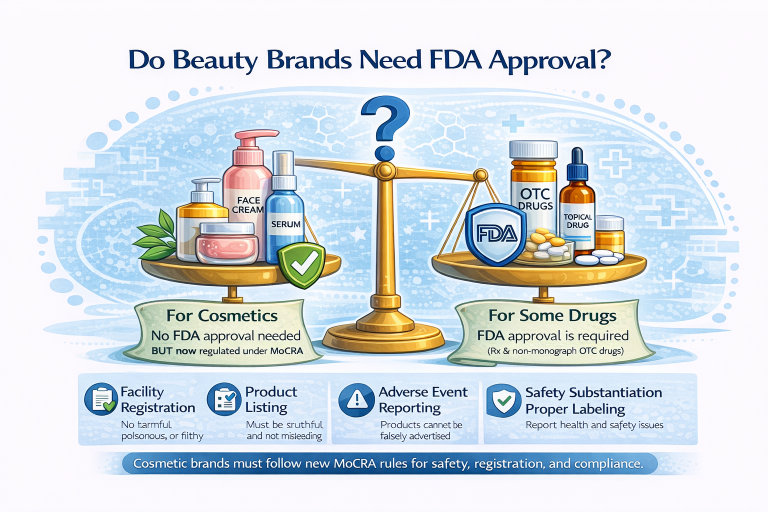
Do Beauty Brands Need FDA Approval?
Trusted by 1,000+ companies across 135+ countries, with 15+ years of FDA regulatory experience. Below: approval vs. compliance, what MoCRA actually requires, the color-additive exception, and exactly when a beauty product becomes a drug.
Approval vs. Compliance
“No FDA approval” is true — and routinely misread as “no FDA rules.” Here's the actual split.
What the FDA Does NOT Do
Pre-approve cosmetic products. Pre-approve most cosmetic ingredients. “Certify,” “endorse,” or issue an “FDA approved” status for a cosmetic.
What the FDA DOES Do
Require facility registration & product listing (MoCRA). Require safety substantiation and truthful labeling. Approve color additives. Refuse non-compliant imports, and (now) order recalls.
What MoCRA Requires of Beauty Brands
The Modernization of Cosmetics Regulation Act of 2022 is the biggest change to U.S. cosmetic oversight in generations. The core duties now in effect:
Color Additives Are the Exception
When a Beauty Product Becomes a Drug
The FDA classifies by intended use, shown largely through your claims. The same jar can be a cosmetic or a drug depending on what you say it does.
| Cosmetic claim (stays a cosmetic) | Drug claim (becomes an OTC drug) |
|---|---|
| “Moisturizes and softens skin” | “Treats eczema” / “heals a skin condition” |
| “Reduces the appearance of fine lines” | “Boosts collagen” / “regenerates skin cells” |
| “Cleanses and adds shine to hair” | “Treats dandruff” / “stops hair loss” |
| “Evens the look of skin tone” | “Treats hyperpigmentation” as a condition |
| “Adds color, scent, or glow” | “SPF / sun protection” (sunscreen is a drug) |
| “Mattifies and reduces shine” | “Antiperspirant — reduces sweat” (a drug) |
A product can be both — a sunscreen moisturizer or anti-acne cleanser must meet cosmetic and OTC drug requirements. See our OTC drug services.
You Can't Say “FDA Approved”
Get Your Beauty Brand Correctly Classified and Compliant
Send us your products and claims, and we'll classify each one (cosmetic, drug, or both), register your facility and list your products under MoCRA, set up the Responsible Person and safety records, and review your labeling — so your brand enters the U.S. market cleanly. Email info@fdaregistrationassistance.com or call +1 (928) 275-8333.
Frequently Asked Questions — Beauty Brands & FDA Approval
Do beauty brands need FDA approval?
No. The FDA does not approve cosmetics or most cosmetic ingredients before they go to market. But cosmetics are regulated: under MoCRA, brands must register facilities, list products, name a Responsible Person, substantiate safety, and report adverse events — and making a drug claim changes the category entirely.
So are cosmetics unregulated?
No, and that's the common misconception. “No pre-approval” does not mean “no rules.” Cosmetics must be safe and truthfully labeled, and since MoCRA took effect in 2023 they must also be registered and listed with the FDA.
What is MoCRA?
The Modernization of Cosmetics Regulation Act of 2022 — the most significant expansion of FDA cosmetic authority in decades. It added mandatory facility registration, product listing, a Responsible Person, safety substantiation, adverse-event reporting, and FDA recall authority. See our cosmetic regulatory services.
Do I have to register my cosmetic facility with the FDA?
Generally yes, if you manufacture or process cosmetics for the U.S. market. Facility registration is required under MoCRA and renews biennially, unless you qualify for the small-business exemption — see who must register a cosmetic facility.
Do I have to list my cosmetic products with the FDA?
Yes. Each marketed cosmetic product must be listed with the FDA, including its ingredients, and the listing is kept current. Small businesses may be exempt from listing, but not from safety or adverse-event obligations.
What is a “Responsible Person”?
The manufacturer, packer, or distributor whose name appears on the product label. Under MoCRA, the Responsible Person is accountable for safety substantiation, compliant labeling, and reporting serious adverse events.
What is the small-business exemption?
Brands with average annual U.S. cosmetic gross sales under $1 million over the prior three years are exempt from facility registration, product listing, and the forthcoming GMP rule — but not from safety substantiation or adverse-event reporting. Eye-area, injected, internal, and long-wear products don't qualify.
When does a beauty product become a drug?
When it claims to treat or prevent a condition, or to affect the structure or function of the body. “Treats acne,” “stops hair loss,” “SPF 30,” and “antiperspirant” are drug claims that pull a product into OTC drug regulation.
Is sunscreen a cosmetic or a drug?
A drug. Sunscreen — any SPF claim — is regulated as an OTC drug, requiring drug establishment registration, monograph-compliant actives, and a Drug Facts label. See OTC drug label compliance.
Are anti-aging or anti-wrinkle claims allowed on a cosmetic?
Appearance claims are fine — “reduces the look of fine lines.” But claims that the product changes the skin's structure or function are drug claims — see clinically proven skincare claims.
Is anti-dandruff shampoo a cosmetic?
No. A shampoo that simply cleanses is a cosmetic, but an anti-dandruff shampoo makes a therapeutic claim and is an OTC drug — and often both a cosmetic and a drug at once.
Are skin-lightening products cosmetics?
It depends on the claim. “Evens the look of skin tone” can be cosmetic; claiming to treat hyperpigmentation as a condition, or using certain active ingredients, can make it a drug. Some skin-lighteners have faced FDA enforcement.
Can a product be both a cosmetic and a drug?
Yes. Sunscreen moisturizers, anti-acne cleansers, and anti-dandruff conditioners are both. They must meet cosmetic requirements and OTC drug requirements at the same time.
Do color additives need FDA approval?
Yes — this is the key exception. Most color additives must be FDA-approved for their intended use (21 CFR Parts 73 and 74), and some must be batch-certified by the FDA. Using an unapproved or uncertified color makes the cosmetic adulterated.
Can I label my product “FDA approved”?
No. The FDA does not approve cosmetics, so “FDA approved” on a cosmetic is false and misleading and can itself trigger enforcement.
Can I say my product is “FDA registered”?
You can state that your facility is registered with the FDA if it genuinely is, but you must not imply FDA approval or endorsement of the product. That distinction matters in your marketing.
Do imported beauty brands have to comply with MoCRA?
Yes. Imported cosmetics face the same MoCRA requirements: the foreign facility registers, the product is listed, and a Responsible Person is named. Non-compliant, adulterated, or misbranded cosmetics can be refused at the border.
Does MoCRA require cosmetic GMP yet?
Not yet. MoCRA directs the FDA to establish cosmetic Good Manufacturing Practice regulations (the future 21 CFR Part 711), but as of mid-2026 a final rule has not been published. It is coming, so preparing now is wise.
What about fragrance allergen labeling?
Also coming, not yet in force. The FDA is expected to issue a proposed rule requiring individual disclosure of certain fragrance allergens, but it is not finalized. Many brands are already gathering allergen data from suppliers ahead of time.
What does cosmetic labeling have to include?
An ingredient declaration, product identity and net quantity, the name and place of business, any necessary warnings, and English text, under the FDA cosmetic labeling rules (21 CFR Part 701). All claims must be truthful and not misleading.
Do I need to substantiate safety?
Yes. Under MoCRA, the Responsible Person must maintain adequate substantiation that each cosmetic product is safe, and the FDA can request those records.
What are the adverse-event reporting rules?
The Responsible Person must report serious adverse events to the FDA within 15 business days and keep related records for six years (three years for small businesses).
What happens if my cosmetic isn't compliant?
A cosmetic that is adulterated or misbranded can be detained or refused at import, recalled — the FDA now has mandatory recall authority — or subject to enforcement. Non-compliance also creates liability and marketplace-removal risk.
Does a “natural” or “organic” beauty product need FDA approval?
No special FDA approval, and the FDA does not define “natural” for cosmetics. The same rules apply: be safe, truthfully labeled, registered, and listed. “Organic” claims may involve separate USDA rules.
How do I make sure my beauty brand is compliant?
Classify each product (cosmetic, drug, or both), register your facility, list your products, name a Responsible Person, and set up safety and adverse-event processes. Contact our team and we'll handle the classification, registration, listing, and labeling. Email info@fdaregistrationassistance.com or call +1 (928) 275-8333.