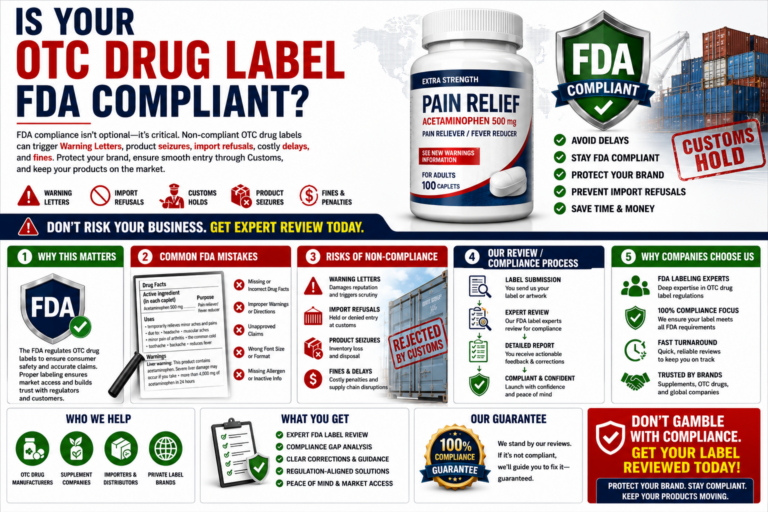
Is Your OTC Drug Label FDA Compliant?
This guide walks through the anatomy of a compliant Drug Facts panel, the required warning subheadings, the monograph-versus-NDA distinction and the OMUFA reforms, registration and listing duties, and the most common ways OTC labels fail.
Anatomy of a Compliant Drug Facts Panel
Under 21 CFR 201.66, these sections must appear in this order, with required headings and formatting. The panel cannot be broken up by marketing graphics or unrelated content.
| Order | Section | What it contains |
|---|---|---|
| Title | Drug Facts | The box is titled “Drug Facts” (or “Drug Facts (continued)”). |
| 1 | Active ingredient(s) | Each active ingredient and its amount per dosage unit. |
| 2 | Purpose | The general pharmacological category (e.g., antacid, sunscreen). |
| 3 | Uses | The indications permitted by the monograph or approved labeling. |
| 4 | Warnings | Standardized warning subheadings in order, incl. “Keep out of reach of children.” |
| 5 | Directions | Dose, frequency, age groups — consistent with the monograph. |
| 6 | Other information | Storage, required statements (e.g., certain content claims). |
| 7 | Inactive ingredients | All inactive ingredients, in the required manner. |
| 8 | Questions? (optional) | A contact phone number for questions or comments. |
The Standardized Warning Subheadings
The Warnings section is not free text. It uses set subheadings, in order, as applicable to the product:
Compliant vs. Non-Compliant OTC Labels
| Area | Compliant | Non-Compliant |
|---|---|---|
| Drug Facts panel | Required headings, order, format, and content per 201.66. | Missing sections, wrong order, marketing text inside the panel, bad formatting. |
| Active ingredient | Correct name, strength, and dosage basis. | Wrong strength, unclear concentration, or ingredient not allowed for the use. |
| Claims | Match the applicable monograph or approved labeling. | Claims reach beyond the permitted OTC category → unapproved new drug. |
| Warnings | All required warnings for the category and intended use. | Missing or incomplete warnings; unsafe directions. |
| Directions | Clear, age- and dose-specific, consistent with the monograph. | Unclear dose, unsupported frequency, off-monograph directions. |
| Marketplace readiness | Ready for retail, e-commerce, import, and distributor review. | Faces delays, rejections, listing removals, and compliance questions. |
Monograph, NDA, Registration & Tamper-Evidence
A compliant label is necessary but not sufficient. The product also needs the right pathway and the right registrations behind it.
Monograph vs. NDA
A monograph OTC drug can be marketed without an approved application if it meets the monograph's ingredients, uses, warnings, and directions. Anything outside a monograph needs an approved NDA. The CARES Act of 2020 modernized the system and added the OTC Monograph User Fee Program (OMUFA).
Registration, listing & NDC
Drug establishments register and list products under 21 CFR Part 207 via eDRLS, each product gets an NDC, and foreign establishments need a U.S. Agent — see eDRLS compliance.
Tamper-evident packaging
Most retail OTC drugs need tamper-evident packaging and a label statement describing the feature under 21 CFR 211.132.
Cosmetic / drug line
Sunscreen, anti-dandruff, acne, and antiperspirant products are OTC drugs even when marketed like cosmetics, and need a Drug Facts panel.
The Most Common Reasons OTC Labels Get Flagged
Review the label before printing, before manufacturing scale-up, before importing, and before listing online — corrections are far cheaper before packaging is locked in than after a print run, an import hold, or a marketplace removal.
Have Your OTC Label Reviewed Before You Print
We review OTC drug labels for Drug Facts formatting, active-ingredient presentation, warnings, directions, claims, statement of identity, and inactive ingredients — against 21 CFR 201.66 and the applicable monograph — so issues surface before the product is printed, imported, listed, or distributed. Trusted by 1,000+ companies across 135+ countries, with 15+ years of FDA regulatory experience. Email info@fdaregistrationassistance.com or call +1 (928) 275-8333.
Frequently Asked Questions — OTC Drug Label Compliance
What is an OTC drug label?
It is the required labeling for a nonprescription drug sold directly to consumers. It includes the statement of identity, the Drug Facts panel, the active ingredient(s), purpose, uses, warnings, directions, inactive ingredients, and company information. It is a regulated document, not just marketing — it must let consumers choose and use the product safely without a professional.
What does the FDA require on an OTC drug label?
A properly formatted Drug Facts panel, plus the statement of identity, net quantity, and manufacturer or distributor identity. The exact content depends on the active ingredient, dosage form, route of administration, and applicable OTC monograph. Format and content are set by 21 CFR 201.66 and the rest of 21 CFR Part 201.
What is the Drug Facts panel?
It is the standardized information box required on most OTC drug labels under 21 CFR 201.66. It presents safety and use information in a fixed order with required headings, minimum type sizes, bold text, bullets, and barlines, so consumers can compare products easily and use them safely.
What sections appear in the Drug Facts panel, and in what order?
Active ingredient(s), Purpose, Uses, Warnings, Directions, Other information, Inactive ingredients, and (optionally) a Questions? line. The Warnings section has its own standardized subheadings in a set order, and the panel cannot be interrupted by marketing graphics or unrelated content.
What warning subheadings are required?
Depending on the product, they include “Do not use,” “Ask a doctor before use if,” “Ask a doctor or pharmacist before use if,” “When using this product,” “Stop use and ask a doctor if,” “If pregnant or breast-feeding,” and the mandatory “Keep out of reach of children” with the accidental-overdose statement.
Is “Keep out of reach of children” mandatory?
Yes. Essentially every OTC drug label must carry the “Keep out of reach of children” warning, and oral products must include accidental-overdose / seek-help language. It is a required element under 21 CFR 201.66, not optional.
Does every OTC drug need a Drug Facts panel?
Most do, unless a specific exemption or modified-labeling rule applies. Do not assume an exemption because the package is small, imported, cosmetic-like, or sold online. Small packages have some modified options, but the product still must meet the applicable requirements.
What is an OTC monograph?
It is a regulatory standard that sets the conditions under which certain OTC drugs may be marketed without an approved new drug application — permitted active ingredients, strengths, indications, warnings, and directions. If a product does not meet the applicable monograph, it cannot be marketed as a monograph OTC drug.
What changed with OTC monograph reform?
The CARES Act of 2020 modernized the OTC monograph system, replacing slow rulemaking with administrative orders and creating the OTC Monograph User Fee Program (OMUFA). Monograph drug facilities now register and may owe OMUFA facility fees, and monographs are updated by order rather than by full rulemaking.
Can an OTC drug be sold without FDA approval?
Some can, if they fully comply with an applicable OTC monograph and all other requirements. That does not mean the product is unregulated — it must still meet ingredient, labeling, manufacturing (cGMP), registration, listing, and safety requirements. An OTC drug not covered by a monograph needs an approved NDA.
Do OTC drugs need establishment registration and listing?
Yes. Drug establishments must register and list their products with the FDA under 21 CFR Part 207 through the electronic system (eDRLS), and each product receives an NDC — see eDRLS compliance for drug companies. Foreign establishments must designate a U.S. Agent.
Do OTC drugs need tamper-evident packaging?
Most OTC drugs sold at retail require tamper-evident packaging and a statement on the label alerting consumers to that feature, under 21 CFR 211.132. Missing tamper-evident features or the required statement is a labeling and cGMP problem.
What's the difference between an OTC drug and a cosmetic?
A cosmetic is intended to cleanse or beautify; an OTC drug is intended to diagnose, cure, mitigate, treat, or prevent disease, or affect the body's structure or function. A product can be both — see our cosmetics & MoCRA services — in which case it must also meet OTC drug labeling.
Can a product be both a cosmetic and an OTC drug?
Yes. A moisturizing sunscreen is a cosmetic because it moisturizes and an OTC drug because it helps prevent sunburn. Such products must carry both cosmetic labeling and a Drug Facts panel — related: FDA requirements for clinically proven skincare.
What makes an OTC drug label non-compliant?
An incorrect Drug Facts format, missing or out-of-order sections, missing warnings, unsupported claims, improper directions, wrong active-ingredient information, an inaccurate statement of identity, or language that does not match the applicable OTC monograph.
Can marketing claims make a label non-compliant?
Yes — claims are a leading cause. Claims to treat, prevent, cure, or mitigate a disease must be authorized for the product's category. If the claims exceed what the applicable monograph allows, the FDA may treat the product as an unapproved new drug — see how efficacy claims are judged.
What is misbranding for an OTC drug?
Under the Federal Food, Drug, and Cosmetic Act, a drug is misbranded if its labeling is false or misleading, omits required information, or fails to meet the required format. Absent warnings, inadequate directions, or a non-conforming Drug Facts panel can each cause misbranding.
What happens if an OTC drug is misbranded?
The FDA can issue warning letters, detain or refuse imports, seize product, seek an injunction, or pursue a recall, depending on the seriousness. Commercial fallout includes retailer rejection, marketplace removal, distributor delays, and relabeling costs.
Do imported OTC drugs need FDA-compliant labels?
Yes. Imported OTC drugs must meet the same labeling requirements as domestic ones, and the foreign establishment must be registered with a U.S. Agent. Non-compliant labels can be detained or refused at the port — see import refusal & detention help.
Can Amazon remove an OTC drug listing over labeling?
Yes. Marketplaces remove or restrict OTC listings when the Drug Facts panel is missing, claims appear unauthorized, the product category is unclear, or compliance documentation is inadequate. Listing copy that claims more than the physical label is a common trigger.
Can I copy a competitor's OTC label?
It is risky. The competitor may not be compliant, may use a different active ingredient or dosage form, or may rely on different monograph conditions. Your label must be built from your exact formula, claims, dosage form, and product category.
Do private-label OTC products need a label review?
Yes. The brand owner, distributor, and importer can each face consequences. Even when an overseas manufacturer supplies the artwork, the U.S. label should be confirmed against FDA requirements before launch rather than assumed correct.
Does the label have to match the formula?
Yes. The active and inactive ingredients, strength, dosage form, and intended use on the label must match the actual formulation. A label that does not match the formula can be misleading, unsafe, or inconsistent with the applicable monograph.
When should I review an OTC drug label?
Before printing, before manufacturing scale-up, before importing, before listing on Amazon or other marketplaces, and before sending samples to retailers — and again whenever the formula, supplier, claims, package size, or monograph requirements change. A pre-print review is the cheapest point to fix problems.
How can FDA Registration Assistance help with OTC drug labels?
We review the Drug Facts format, active-ingredient presentation, warnings, directions, claims, statement of identity, and inactive ingredients against the applicable monograph and 21 CFR 201.66, before the product is printed, imported, listed, or distributed. See our drug labeling services or contact our team.