FDA Registration for Canes and Crutches
Why canes and crutches are exempt Class I devices, what you still have to do, and the safety labeling that matters for a load-bearing aid.
Key Takeaways
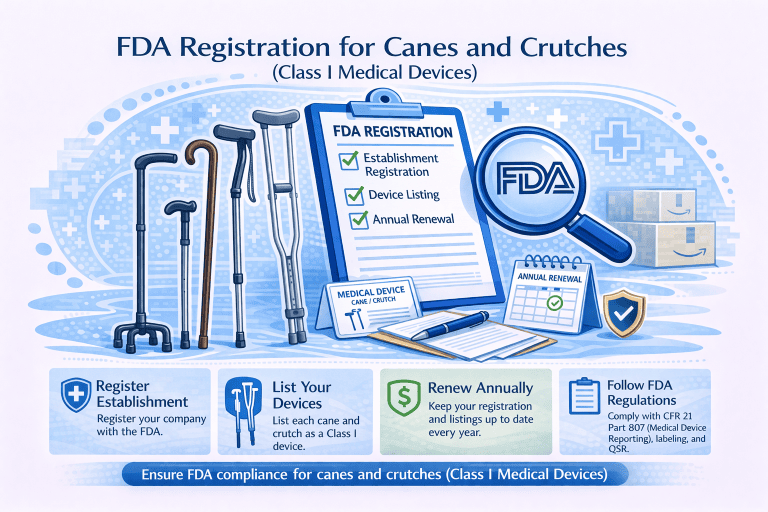
- Canes, crutches, walkers = Class I — ambulatory assist devices (21 CFR Part 890).
- Generally 510(k)-exempt — including tips & pads (890.3790).
- Exempt ≠ requirement-free — still register, list, and meet general controls.
- Records & complaint files still apply — even under the GMP exemption.
- Load-bearing = safety labeling — weight capacity, height, proper use.
- Exempt/registered ≠ "FDA approved"; foreign makers need a U.S. Agent.
Ambulatory Assist Devices Are Class I
| Device | Regulation | Class / pathway |
|---|---|---|
| Cane | 21 CFR 890.3075 | Class I, 510(k)-exempt |
| Crutch | 21 CFR 890.3150 | Class I, 510(k)-exempt |
| Walker (mechanical) | 21 CFR Part 890 | Class I, generally 510(k)-exempt |
| Cane / crutch / walker tips & pads | 21 CFR 890.3790 | Class I accessory, 510(k)-exempt |
Exempt Doesn't Mean Unregulated
Because canes and crutches don't need a 510(k), it's easy to assume there's nothing to do. There is. FDA's own guidance is explicit that exempt manufacturers must still register and list. An exempt Class I cane or crutch requires:
- FDA establishment registration — 21 CFR Part 807, via FURLS/DRLM (annual)
- Device listing — list the device under its classification/product code
- Compliant labeling — 21 CFR Part 801
- Medical Device Reporting — 21 CFR Part 803
- Records & complaint files — the GMP exemption for Class I does not cover 21 CFR 820.180 (records) or 820.198 (complaint files), which still apply
Safety Labeling Matters
Canes, crutches, and walkers carry a person's weight — a failure can cause a fall. Even though these are simple, exempt devices, labeling is a general control and is especially important here:
- Weight capacity — the maximum user weight the device supports
- Height adjustment — the range and how to set it correctly
- Proper use & inspection — how to use it, and checking tips/pads for wear
- Warnings — don't exceed the weight limit; replace worn tips
- No "FDA approved" claims — the device is registered/listed, not approved
Simplest End of the Mobility Spectrum
Canes, crutches, and standard walkers are at the simplest end of the mobility-device range. As devices add power, electronics, or higher-risk functions, the class and requirements climb:
- Cane / crutch / standard walker — Class I, usually 510(k)-exempt
- Manual wheelchair — Class I (often exempt), but confirm the product code
- Powered wheelchair / scooter — Class II, needs a 510(k)
Common Cane & Crutch Mistakes
- Assuming "510(k)-exempt" means "no FDA obligations" — you still register, list, and keep records/complaint files
- Omitting weight capacity or proper-use labeling
- Calling an exempt device "FDA approved/cleared"
- Overlooking that a special-feature or powered device may not be exempt
- Missing UDI where applicable
- Missing the U.S. Agent (foreign manufacturers)
Mobility Aids & Device Compliance
Get Your Canes & Crutches Compliant
FDA Registration Assistance confirms the classification (Class I ambulatory assist device — cane 890.3075, crutch 890.3150, walker, or tips/pads 890.3790) and whether the 510(k) exemption applies, then handles establishment registration and device listing, reviews labeling (weight capacity, proper use, no "FDA approved" claims), and provides U.S. Agent service for foreign makers.
Contact us at info@fdaregistrationassistance.com or call +1 (928) 275-8333 for a quote. An independent compliance firm serving 1,000+ companies across 135+ countries, with 15+ years of experience.
Frequently Asked Questions — Canes & Crutches
1. Are canes and crutches FDA medical devices?
Yes. Canes, crutches, and walkers are ambulatory assist devices - Class I medical devices under FDA's physical medicine device regulations (21 CFR Part 890), for example a cane (890.3075) and a crutch (890.3150). They're intended for a medical purpose (helping a person with impaired mobility ambulate), which makes them devices. Most are Class I and 510(k)-exempt, but "exempt" doesn't mean unregulated - registration, listing, and general controls still apply.
2. Do canes and crutches need a 510(k)?
Usually not. Canes, crutches, and walkers are Class I devices that FDA has generally exempted from 510(k) premarket notification (subject to the limitations in 21 CFR 890.9). So for a standard cane, crutch, or walker you typically don't file a 510(k). The exemption has limits, and a device with unusual technology or claims should be checked, but the ordinary ambulatory assist devices are exempt from premarket notification.
3. If they're exempt, is there nothing to do?
No - 510(k)-exempt is not requirement-free. Even an exempt Class I cane or crutch requires FDA establishment registration and device listing (21 CFR Part 807), plus general controls: compliant labeling (21 CFR Part 801), Medical Device Reporting (21 CFR Part 803), the applicable quality system requirements, and the prohibitions against misbranding/adulteration. FDA's own guidance is explicit: exempt manufacturers still must register their establishment and list the device.
4. What quality system requirements apply to canes and crutches?
Most Class I ambulatory assist devices are exempt from most of the GMP/quality system regulation - but not all of it. The exemption specifically does not cover the records requirements (21 CFR 820.180) and the complaint-file requirements (21 CFR 820.198), which still apply. So even an exempt cane or crutch maker must maintain the required device records and a complaint-handling file. (A sterile device, or one that loses the exemption, would face the full quality system.)
5. What class are cane, crutch, and walker tips and pads?
Cane, crutch, and walker tips and pads (21 CFR 890.3790) - the rubber or rubber-substitute accessories applied to the ground end to prevent skidding, or to the body-contact area for comfort - are Class I accessories and are 510(k)-exempt (and exempt from most of the quality system except records and complaint files). So replacement tips and grips are themselves regulated Class I accessories, following the same light-touch framework as the canes and crutches they serve.
6. Why does safety labeling matter for a cane or crutch?
Because these are load-bearing mobility aids, and a failure can cause a fall or injury. Labeling should clearly state the intended use, the weight capacity (maximum user weight), height adjustment range and how to set it, proper-use instructions, and any warnings (e.g., check tips for wear, don't exceed weight limit). Truthful, adequate labeling is a general control that applies even to exempt Class I devices - and it's especially important for a device someone relies on to stand and walk.
7. Are walkers and rollators treated the same as canes and crutches?
Standard mechanical walkers are Class I ambulatory assist devices, generally 510(k)-exempt, following the same framework (register, list, general controls, records/complaint files). A rollator (a wheeled walker with a seat/brakes) is still a mechanical ambulatory aid, but added features - wheels, hand brakes, a seat - mean you should confirm the specific classification and any labeling/testing considerations for those features. The basic exemption framework is the same, but confirm the details for wheeled/braked models.
8. How is this different from wheelchair compliance?
They're related mobility aids but split by power/complexity. Canes, crutches, and standard walkers are simple Class I devices (usually 510(k)-exempt). A manual wheelchair is also Class I, but a powered (battery) wheelchair or scooter is Class II and needs a 510(k). So canes/crutches are at the simplest end of the mobility-device spectrum; as devices add power, electronics, or higher-risk functions, the class and requirements go up. See our wheelchair guide for the powered side.
9. Do foreign cane and crutch manufacturers need to register?
Yes. A foreign maker of canes, crutches, or walkers must complete FDA establishment registration and device listing, comply with general controls (including the records and complaint-file requirements), and appoint a U.S. Agent - even though these devices are 510(k)-exempt. Many mobility aids are imported, so this is common; each foreign establishment registers for its role and needs a valid U.S. Agent before it can complete registration and import.
10. Is a cane or crutch "FDA approved"?
No. An exempt Class I device isn't "approved" or "cleared" - FDA doesn't approve or clear 510(k)-exempt devices. So a cane, crutch, or walker should not be marketed as "FDA approved" or "FDA cleared." The accurate statement is that your establishment is registered and the device is listed (and complies with general controls). Calling an exempt mobility aid "FDA approved" is misleading.
11. What about a cane or crutch with special features?
Added features can change the analysis. A quad cane, forearm (Lofstrand) crutch, or seat cane generally stays within the Class I ambulatory-assist framework. But a device that adds, say, powered functions, sensors/electronics, or claims beyond simple mobility support could fall under a different classification or lose the exemption. Assess any non-standard feature or claim against the specific classification rather than assuming the basic exemption applies.
12. Does an exemption ever not apply?
Yes. The Class I exemptions are subject to the limitations in 21 CFR 890.9 - broadly, an exemption may not apply if the device has a new intended use, or operates on a different fundamental technology, or otherwise raises different questions of safety/effectiveness than the classified device. A "reserved" device is also not exempt. So confirm the exemption for your specific product and claims rather than assuming every cane or crutch is automatically exempt.
13. What labeling do canes and crutches need?
Device labeling under 21 CFR Part 801: the intended use, the manufacturer's name and address, adequate directions for use (including height adjustment and proper positioning), the weight capacity, any warnings, and UDI where applicable (21 CFR Part 830). For a load-bearing device, weight capacity and proper-use/inspection instructions are particularly important. Labeling claims must be truthful and must not imply FDA approval.
14. What are the most common cane and crutch mistakes?
Assuming "510(k)-exempt" means "no FDA obligations" (you still register, list, and keep records/complaint files); omitting weight capacity or proper-use labeling; calling an exempt device "FDA approved/cleared"; missing UDI; overlooking that a special-feature or powered device may not be exempt; and (for foreign makers) missing the U.S. Agent. Most trace back to underestimating what remains required even when a 510(k) isn't.
15. Are orthopedic/hospital canes different from retail canes?
The regulatory treatment follows intended use, not the sales channel. A cane sold for a medical purpose (to aid ambulation for someone with impaired mobility) is a Class I device whether it's sold through a medical supplier or a retail store. A purely decorative walking stick with no medical intended use is different. If it's marketed or intended as a mobility aid for a medical need, it's a device and follows this framework.
16. How does FDA Registration Assistance help cane and crutch companies?
We confirm the classification (Class I ambulatory assist device - cane 890.3075, crutch 890.3150, walker, or tips/pads 890.3790) and whether the 510(k) exemption applies, then handle FDA establishment registration and device listing, review labeling (weight capacity, proper use, no "FDA approved" claims), and provide U.S. Agent service for foreign makers - so your mobility aids are registered and market-ready. We're an independent compliance firm serving 1,000+ companies across 135+ countries with 15+ years of experience. Contact info@fdaregistrationassistance.com or +1 (928) 275-8333.