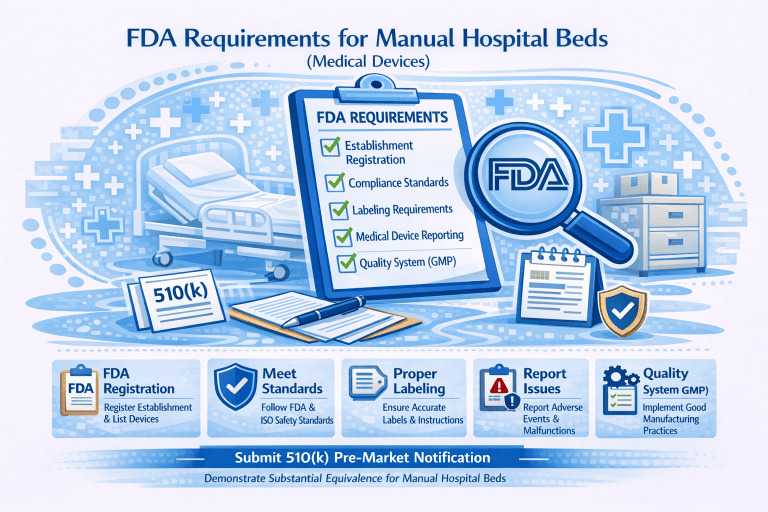
FDA Requirements for Manual Hospital Beds
Manual (Class I) vs AC-powered (Class II), what you must do even when exempt, and the bed-rail entrapment guidance every bed maker needs.
Key Takeaways
- Manual hospital bed = Class I — 21 CFR 880.5120; generally 510(k)-exempt.
- AC-powered hospital bed = Class II — 21 CFR 880.5100 (product code FNL), special controls.
- Both include movable, latchable side rails.
- Entrapment is the defining hazard — FDA/HBSW dimensional guidance, 7 zones (1–4 ≈ 80%).
- Adult portable bed rails — separate FDA/CPSC safety attention.
- Exempt ≠ requirement-free — register, list, records/complaints, MDR; not "FDA approved."
Manual (Class I) vs AC-Powered (Class II)
| Bed type | Regulation | Class / pathway |
|---|---|---|
| Manual adjustable hospital bed (attendant-operated) | 21 CFR 880.5120 | Class I, 510(k)-exempt |
| AC-powered adjustable hospital bed (patient motor + remote) | 21 CFR 880.5100 (FNL) | Class II, special controls |
It's the mechanism that drives the class: a manual bed is adjusted by an attendant; an AC-powered bed adds a built-in electric motor and patient remote — more that can go wrong, so it's Class II with special controls. Both classifications describe a bed that includes movable and latchable side rails.
Bed-Rail Entrapment
Entrapment — a patient caught or trapped in the spaces in or around the bed rails, mattress, or frame — is a serious, sometimes fatal hazard, especially for frail or cognitively impaired patients. It's the single most important safety consideration for a hospital bed.
FDA and the Hospital Bed Safety Workgroup issued Hospital Bed System Dimensional and Assessment Guidance to Reduce Entrapment, which identifies seven potential entrapment zones and evidence-based dimensional criteria (gap measurements) plus test tools/methods to check a bed system. Actual entrapments have been reported in six of the zones, and Zones 1–4 account for roughly 80% of reported events:
- Within the rail
- Under the rail, between the rail and the mattress
- Between the rail and the mattress
- Between rail supports (or a split rail)
- Between the rail and the headboard/footboard
- Between the end of the rail and the side edge of the head/foot board
- Between the head/foot board and the mattress end
Registration, Listing & General Controls
A 510(k)-exempt manual hospital bed is not free of FDA obligations:
- Establishment registration & device listing — 21 CFR Part 807, via FURLS/DRLM
- Compliant labeling — 21 CFR Part 801 (weight capacity, side-rail use, entrapment warnings)
- Medical Device Reporting — 21 CFR Part 803 (side-rail events are a significant MDR area)
- Records & complaint files — 21 CFR 820.180 & 820.198, which the Class I GMP exemption does not cover
- AC-powered beds — add electrical safety and the Class II special controls
- U.S. Agent — for foreign establishments
Same Pattern as Other Durable Medical Equipment
Hospital beds follow the familiar DME pattern — the manual version is lower class, the powered version higher:
- Class I (manual/simple) — manual hospital bed, manual wheelchair, canes/crutches/walkers
- Class II (powered/special controls) — AC-powered hospital bed, powered wheelchair, scooter
Common Hospital Bed Mistakes
- Treating an exempt manual bed as having no FDA obligations — register, list, records, complaints, MDR still apply
- Ignoring the entrapment dimensional criteria for side rails
- Treating an AC-powered bed like a manual one — it's Class II with special controls
- Weak labeling/warnings (weight capacity, side-rail use, entrapment)
- Calling a bed "FDA approved"; missing UDI
- Missing the U.S. Agent (foreign manufacturers)
Hospital Beds & Device Compliance
Get Your Hospital Bed Compliant
FDA Registration Assistance confirms the classification (manual Class I under 880.5120, or AC-powered Class II under 880.5100) and 510(k)/exemption status, flags the entrapment dimensional guidance and side-rail/special-control considerations, and handles establishment registration and device listing, labeling review, and U.S. Agent service for foreign makers.
Contact us at info@fdaregistrationassistance.com or call +1 (928) 275-8333 for a quote. An independent compliance firm serving 1,000+ companies across 135+ countries, with 15+ years of experience.
Frequently Asked Questions — Manual Hospital Beds
1. Is a manual hospital bed an FDA medical device?
Yes. A manual adjustable hospital bed - a bed with a manual mechanism operated by an attendant to adjust height and surface contour, including movable and latchable side rails - is a Class I medical device under 21 CFR 880.5120. It's intended for a medical purpose, which makes it a device. It's generally 510(k)-exempt, but "exempt" doesn't mean unregulated: establishment registration, device listing, and general controls still apply.
2. What's the difference between a manual and an AC-powered hospital bed?
It's the mechanism and the class. A manual adjustable hospital bed (21 CFR 880.5120) is adjusted by an attendant's manual mechanism and is Class I. An AC-powered adjustable hospital bed (21 CFR 880.5100, product code FNL) has a built-in electric motor and patient-operated remote controls, and is Class II (special controls). Both include movable, latchable side rails. As with other durable medical equipment, adding power/electronics raises the class.
3. Does a manual hospital bed need a 510(k)?
Generally no. A manual adjustable hospital bed is a Class I device that FDA has exempted from 510(k) premarket notification, subject to the limitations in 21 CFR 880.9. So a standard manual hospital bed typically doesn't require a 510(k). The exemption has limits (a new intended use or different technology can remove it), but the ordinary manual bed is exempt from premarket notification - though registration, listing, and general controls still apply.
4. Does an AC-powered hospital bed need a 510(k)?
The AC-powered adjustable hospital bed is Class II with special controls (21 CFR 880.5100, product code FNL). Under the current regulation it is exempt from premarket notification subject to the 880.9 limitations, but it carries special controls (including the entrapment dimensional guidance), and a bed with new technological characteristics or a new intended use may not qualify for the exemption and could require a 510(k). Confirm the exemption and applicable special controls for your specific powered bed.
5. What is hospital bed entrapment, and why does it matter?
Entrapment is when a patient is caught, trapped, or strangled in the spaces in or around the bed rails, mattress, or bed frame - a serious, sometimes fatal hazard, especially for frail or cognitively impaired patients. It's the defining safety issue for hospital beds. FDA and the Hospital Bed Safety Workgroup (HBSW) developed guidance identifying entrapment zones and dimensional criteria to reduce the risk, and side-rail-related events are a significant source of adverse-event reports.
6. What is the FDA entrapment guidance?
FDA released "Hospital Bed System Dimensional and Assessment Guidance to Reduce Entrapment," developed with the Hospital Bed Safety Workgroup. It identifies seven potential entrapment zones (with actual entrapments reported in six of them, and Zones 1-4 accounting for roughly 80% of reported events), and provides evidence-based dimensional criteria and test tools/methods for measuring the gaps in a bed system. There's also a Bed Safety Entrapment Kit and clinical guidance on assessing and using bed rails.
7. What are the seven entrapment zones?
Broadly, they're the gap locations where a patient can become entrapped: within the rail; under the rail (between the rail and the mattress); between the rail and the mattress; between rail supports (or between a split rail); between the rail and the headboard/footboard; between the end of the rail and the side edge of the head/foot board; and between the head/foot board and the mattress end. Zones 1-4 cause about 80% of reported entrapments, which is why the dimensional criteria focus heavily on those gaps.
8. Are bed rails (side rails) regulated separately?
Side rails are part of the hospital bed device (both manual and AC-powered beds include movable, latchable side rails), and their dimensions are central to the entrapment guidance. Separately, adult portable bed rails (aftermarket rails added to a bed) have drawn specific FDA and CPSC attention due to entrapment deaths, including a joint effort toward voluntary safety standards. So whether integrated or portable, bed rails are a focus of hospital bed safety.
9. Is a 510(k)-exempt hospital bed free of FDA requirements?
No. Even an exempt Class I manual hospital bed requires FDA establishment registration and device listing (21 CFR Part 807) and general controls: labeling (21 CFR Part 801), Medical Device Reporting (21 CFR Part 803), and the records (21 CFR 820.180) and complaint-file (21 CFR 820.198) requirements, which the Class I GMP exemption does not cover. "Exempt from 510(k)" is not "exempt from FDA" - registration, listing, records, complaints, and MDR still apply.
10. What safety/quality should a hospital bed maker address?
Design the bed and its side rails to meet the entrapment dimensional criteria; use the HBSW test tools/methods to verify gaps; provide clear labeling and instructions (including weight capacity, side-rail use, and entrapment warnings); maintain records and a complaint file; and monitor and report adverse events (MDR). For an AC-powered bed, add the electrical-safety and special-control considerations. Entrapment mitigation should be built into the design, not treated as an afterthought.
11. Do foreign hospital bed manufacturers need to register?
Yes. A foreign maker of manual or AC-powered hospital beds must complete FDA establishment registration and device listing, comply with general controls (and Class II special controls for powered beds), address the entrapment guidance, and appoint a U.S. Agent - even for an exempt Class I manual bed. Many beds are imported, so this is common; each foreign establishment registers for its role and needs a valid U.S. Agent before it can complete registration and import.
12. Is a hospital bed "FDA approved"?
No. A manual hospital bed (Class I, exempt) is registered/listed, not "approved" or "cleared"; an AC-powered bed is a Class II device (with special controls, often exempt) - so neither is "FDA approved" in the PMA sense. Only high-risk Class III PMA devices are "FDA approved." Describe a hospital bed accurately: registered and listed, and compliant with the applicable class requirements - not "FDA approved."
13. What about pediatric or specialty beds?
Pediatric hospital beds, cribs, and specialty beds (e.g., low beds, bariatric beds, or beds with specific therapeutic functions) can have their own classifications, dimensional/safety requirements, and sometimes a higher class - for example pediatric medical cribs have specific side-rail spacing and mattress-fit requirements. Don't assume a specialty or pediatric bed follows the standard adult manual/AC-powered framework; confirm the specific classification and safety criteria for that product.
14. How does this compare to wheelchairs and other mobility equipment?
Hospital beds follow the same durable-medical-equipment pattern as mobility aids: the manual version is lower class (Class I) and the powered version is higher (Class II). Canes, crutches, and manual wheelchairs are Class I; powered wheelchairs, scooters, and AC-powered beds are Class II. So a manual hospital bed sits alongside manual wheelchairs and canes at the simpler end, while powered beds join powered wheelchairs at the special-controls end.
15. What are the most common hospital bed compliance mistakes?
Treating an exempt manual bed as having no FDA obligations (registration, listing, records, complaints, and MDR still apply); ignoring the entrapment dimensional criteria for side rails; treating an AC-powered bed like a manual one (it's Class II with special controls); weak labeling/warnings; calling a bed "FDA approved"; missing UDI; and (for foreign makers) missing the U.S. Agent. The biggest safety miss is not designing to the entrapment guidance.
16. How does FDA Registration Assistance help hospital bed companies?
We confirm the classification (manual Class I under 880.5120, or AC-powered Class II under 880.5100) and 510(k)/exemption status, flag the entrapment dimensional guidance and side-rail/special-control considerations, and handle FDA establishment registration and device listing, labeling review, and U.S. Agent service for foreign makers - so your bed is registered, market-ready, and designed with the entrapment guidance in mind. We're an independent compliance firm serving 1,000+ companies across 135+ countries with 15+ years of experience. Contact info@fdaregistrationassistance.com or +1 (928) 275-8333.