
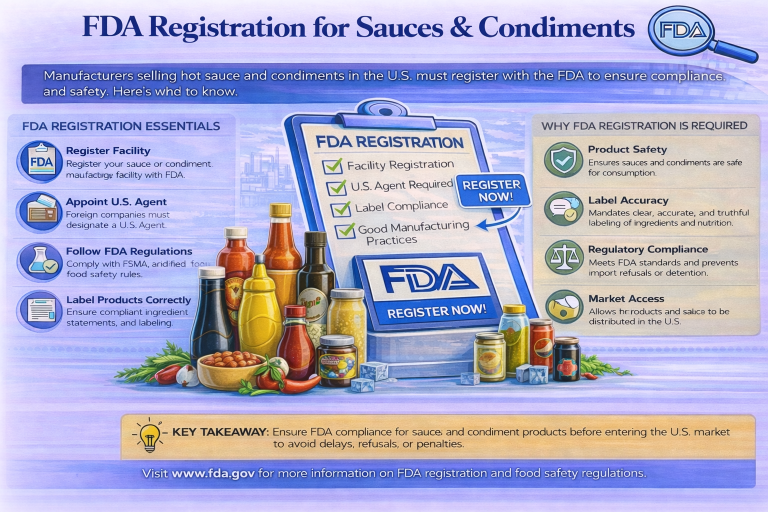
FDA Registration for Sauces & Condiments
Ketchup, mustard, BBQ, mayo, dressings, soy sauce, fish sauce — same shelf, wildly different rules. Classify first, file second.
Key Takeaways
- A sauce can be one of five things — classification decides the rules.
- Acidified (ketchup, mustard, BBQ, most hot sauce/salsa) → FCE + scheduled process.
- Low-acid canned (some gravies, cheese sauces) → the stricter LACF rules.
- Mayonnaise & salad dressing are standardized — legal recipes (21 CFR Part 169).
- Condiments hide allergens — soy, wheat, fish, egg, sesame, milk.
- Refrigerated sauces are excluded from the acidified rules; registration ≠ approval.
The Five Buckets
| Bucket | Examples | What it triggers |
|---|---|---|
| Acidified food | Ketchup, mustard, BBQ, relish, salsa, most hot sauce | FCE + scheduled process (Part 114) |
| Low-acid canned | Some gravies, cheese/Alfredo sauces | LACF filings (Part 113) |
| Acid food | Vinegar-forward sauces (naturally ≤ 4.6) | Generally exempt from Part 114 |
| Refrigerated | Fresh dressings, refrigerated salsas | Excluded from acidified rules |
| Standardized dressing | Mayonnaise, salad dressing | Must meet a standard of identity |
Standardized Dressings — the Name Is Regulated
Some condiment names aren't just marketing — they're defined by law. If the name is standardized, the product must match the standard of identity or use a different name:
Mayonnaise 169.140
- Emulsified semisolid
- ≥ 65% vegetable oil
- An acidifying ingredient (vinegar/lemon)
- An egg-yolk ingredient
Salad dressing 169.150
- Emulsified semisolid
- ≥ 30% vegetable oil
- An acidifying ingredient + egg yolk
- A starchy paste
Allergens in Condiments
Condiments are a classic source of undeclared allergens, because the allergen is often an ingredient of an ingredient:
Soy & wheat
Soy sauce and many Asian sauces typically contain soy and wheat.
Fish
Fish sauce and Worcestershire contain fish (anchovy) — easy to miss.
Sesame, egg, milk
Tahini/dressings (sesame); mayo (egg); cheese & cream sauces (milk).
From Recipe to Compliant
Classify the product
A process authority determines the bucket from your formula and finished pH.
Meet any standard of identity
"Mayonnaise" or "salad dressing"? Match the Part 169 standard, or use another name.
Register the facility
The maker/packer/holder registers; foreign facilities add a U.S. Agent.
File acidified/LACF paperwork if needed
FCE registration and a scheduled process, via a process authority.
Get allergen labeling right
Declare soy, wheat, egg, fish, sesame, milk; control cross-contact.
Handle imports & keep current
Prior notice + FSVP; renew every two years; re-file on change.
Get Your Sauce or Condiment to Market
FDA Registration Assistance helps classify the product, registers the facility, serves as U.S. Agent, handles acidified and LACF filings with your process authority, and reviews labeling — standard-of-identity names and allergen declarations included.
Contact us at info@fdaregistrationassistance.com or call +1 (928) 275-8333. Trusted by companies across 135+ countries, with 15+ years of experience.
Frequently Asked Questions
1. Do sauces and condiments need FDA registration?
The facility that makes, packs, or holds them registers, and foreign facilities need a U.S. Agent. But registration is just the start — what else applies depends on the type of sauce, because "sauce" isn't one category. Registration isn't approval.
2. Why does the type of sauce matter so much?
Because sauces span nearly every food-safety bucket — acidified, low-acid canned, acid food, refrigerated, or standardized dressing — each with different requirements. Classification is the first and most important step.
3. Which sauces are acidified foods?
Shelf-stable products made from low-acid ingredients brought to pH ≤ 4.6 with added acid — ketchup, mustard, BBQ, relish, most jarred salsa and hot sauce (Part 114). These need FCE registration and a scheduled process; see our hot sauce & salsa page.
4. What about low-acid sauces?
A shelf-stable sauce with pH above 4.6 — some gravies, cheese or Alfredo sauces, certain simmer sauces — can fall under the low-acid canned food rules (Part 113), which are even more demanding. A process authority determines where a formula lands.
5. Is mayonnaise a standardized food?
Yes — mayonnaise has a standard of identity (21 CFR 169.140): emulsified semisolid, at least 65% vegetable oil, an acidifying ingredient, and egg yolk. If your product doesn't meet it, you can't call it "mayonnaise."
6. Is salad dressing standardized too?
Yes — "salad dressing" has its own standard (21 CFR 169.150): emulsified semisolid, at least 30% vegetable oil, an acidifying ingredient, egg yolk, and a starchy paste. The name has to match what's in the jar.
7. What happened to the French dressing standard?
FDA revoked the standard of identity for French dressing in 2022, in response to an industry petition. So "French dressing" is no longer standardized — a good example that standards do change.
8. What allergens hide in condiments?
More than expected — soy sauce (soy + wheat), fish sauce and Worcestershire (fish/anchovy), tahini and dressings (sesame), mayo and creamy dressings (egg), cheese and cream sauces (milk). Each major allergen present must be declared and cross-contact controlled.
9. Do I need FCE and scheduled process filings?
Only if your product is acidified or low-acid canned. If it's an exempt acid food or a refrigerated sauce, the filings may not apply — which is exactly why classification comes first.
10. Does refrigeration change things?
Yes — foods stored, distributed, and sold under refrigeration are excluded from the acidified rule, so a refrigerated sauce or dressing generally isn't acidified, though it still must be made safely. The acidified rules target shelf-stable products.
11. Do importers need FSVP and prior notice?
Yes — a registered foreign facility with a U.S. Agent, prior notice per shipment, and an importer FSVP. If acidified or low-acid, the foreign processor also needs FCE registration and a scheduled process on file.
12. Is "FDA registered" the same as "FDA approved"?
No — registration and process filings tell FDA the facility and process exist; they aren't approval of the product. "FDA approved" based on registration is inaccurate.
13. Why do sauce shipments get held?
Missing acidified/low-acid filings when required, undeclared allergens, and mislabeling — including using a standardized name like "mayonnaise" for a product that doesn't meet the standard. Correct classification up front prevents most of these.
14. How does FDA Registration Assistance help?
It helps classify the product, registers the facility, serves as U.S. Agent, handles acidified/LACF filings with your process authority, and reviews labeling — standard-of-identity names and allergen declarations included, for companies across 135+ countries. Contact info@fdaregistrationassistance.com or +1 (928) 275-8333.
