
FSVP for Importers: What FDA's Rule Actually Requires
Understand importer responsibility, supplier verification, and recordkeeping before scoping the FSVP support your business needs.
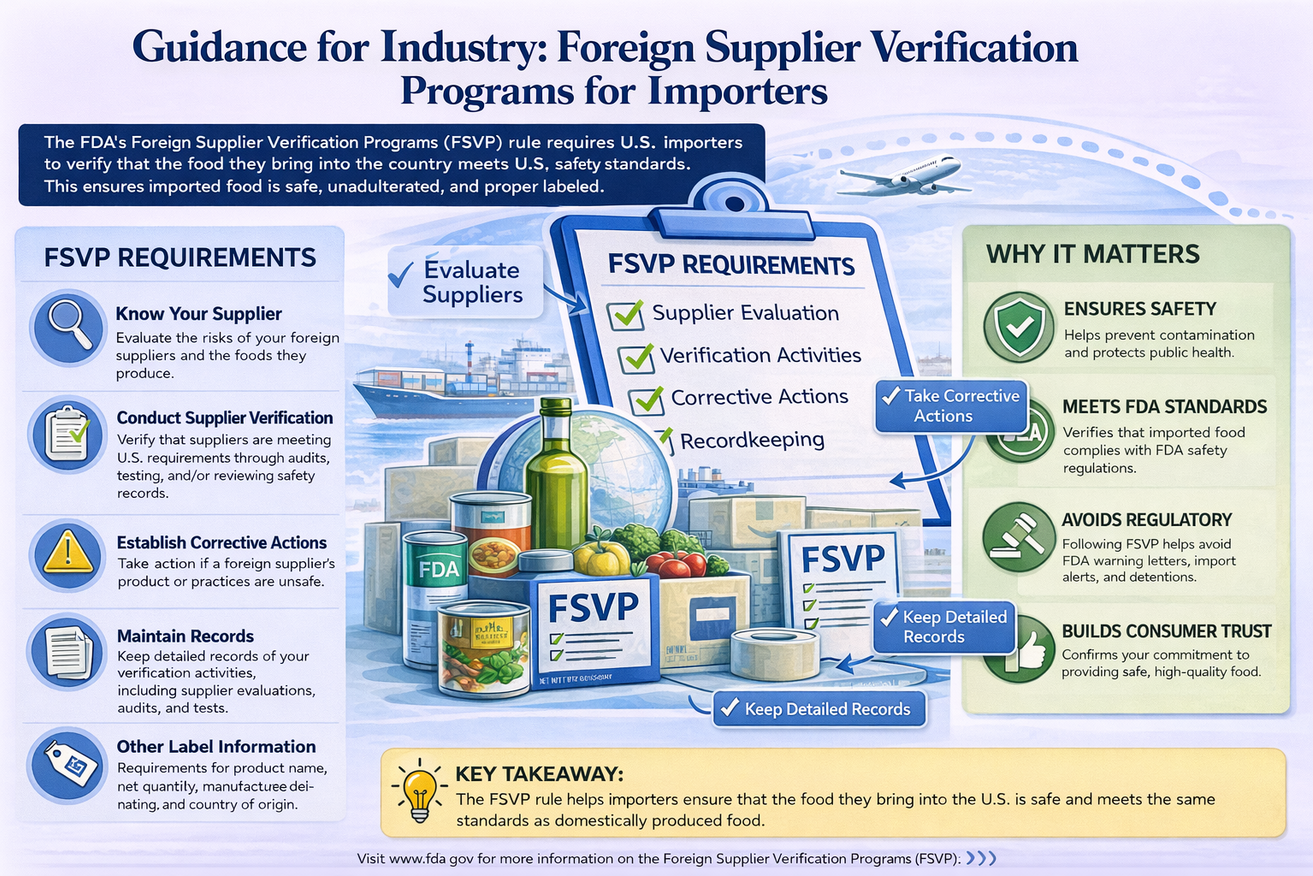
FSVP isn't a certificate you buy — it's a program you own. Knowing who "you" are in FDA's eyes is where it starts.
Need an FSVP scoped to your actual foods and suppliers? Start by identifying the responsible importer and applicable requirements. Then discuss the program, verification, and recordkeeping work your business needs.
Request My FSVP Project QuoteKey Takeaways
- FSVP is the importer's job — 21 CFR Part 1, Subpart L, under FSMA.
- The FSVP importer is the U.S. owner or consignee at entry — not always the importer of record.
- There's no "FSVP Agent" that absorbs your liability — help can be hired; responsibility can't be moved.
- Not every food — seafood and juice under HACCP follow 123.12 / 120.14 instead.
- Core components — qualified individual, hazard analysis, supplier evaluation, verification, corrective actions, records.
- Identify at entry with name, email, and DUNS (1.509).
What a Compliant FSVP Contains
| Component | What it means | Cite |
|---|---|---|
| Qualified individual | Someone with the education, training, or experience to develop and apply the FSVP | 1.503 |
| Hazard analysis | Identify known or reasonably foreseeable hazards for each food | 1.504 |
| Supplier evaluation & approval | Assess the supplier and the risk; approve suppliers; set verification | 1.505 |
| Verification activities | Audits, sampling/testing, or records review, matched to the risk | 1.506 |
| Corrective actions | Act when a supplier isn't controlling a hazard | 1.508 |
| Identify at entry | Name, email, and DUNS transmitted to CBP at each entry | 1.509 |
| Records | Signed, dated, legible; available promptly to FDA on request | 1.510 |
Where FSVP Doesn't Apply
FSVP covers most imported food — but several categories are carved out (21 CFR 1.501), and treating them as standard FSVP is a real error:
Follow a different rule
- Seafood under HACCP → importer rules at 123.12
- Juice under HACCP → importer rules at 120.14
- Meat, poultry, egg → USDA, not FDA
Modified requirements
- Dietary supplements → modified FSVP (1.511)
- Very small importers → lighter obligations
- Research/personal use, transshipment, and certain re-imports
The "FSVP Agent" Myth
Some providers market an "FSVP Agent" as if hiring one moves the legal responsibility off your shoulders. It doesn't. Here's the honest picture:
What's real
- A foreign owner with no U.S. owner/consignee designates a U.S. agent or representative — who then becomes the FSVP importer
- You can hire a firm or qualified individual to build and maintain your program
What's a myth
- That an "FSVP Agent" absorbs your liability
- That a supplier's certificate replaces your own program
- That the responsibility can be moved off the importer at all
Building Your FSVP
Confirm you're the FSVP importer
Identify the U.S. owner or consignee at entry — or the designated U.S. agent if there's none.
Check for exemptions
Rule out seafood/juice under HACCP and USDA foods before building a standard program.
Assign a qualified individual
Someone with the right education, training, or experience develops and applies the FSVP.
Analyze hazards & evaluate the supplier
Run a hazard analysis per food and evaluate the supplier to approve them and set verification.
Verify & correct
Perform verification (audits/testing) and take corrective actions when needed.
Identify at entry & keep records
Provide name, email, and DUNS at entry; keep signed, dated records ready for FDA.
FSVP Done Right — and Kept Current
FDA Registration Assistance develops and maintains FSVPs — qualified individual, hazard analysis, supplier evaluation and verification, corrective actions, and records — and supports importers through FDA's FSVP inspections, while keeping the responsibility clearly where it belongs: with you, the importer.
Contact us at info@fdaregistrationassistance.com or call +1 (928) 275-8333. Trusted by importers across 135+ countries, with 15+ years of experience.
Frequently Asked Questions
1. What is FSVP?
Foreign Supplier Verification Programs — an FDA rule under FSMA (21 CFR Part 1, Subpart L) requiring the U.S. importer to verify that foreign suppliers produce food meeting U.S. safety standards. It applies to most imported food unless exempt.
2. Who is the "FSVP importer"?
The U.S. owner or consignee at the time of entry — the party that owns, has bought, or has agreed in writing to buy the food. With no U.S. owner/consignee, the foreign owner designates a U.S. agent or representative. This may differ from the customs "importer of record."
3. Is there such a thing as an "FSVP Agent"?
Not as a way to transfer liability. A foreign owner with no U.S. owner/consignee can designate a U.S. agent who then becomes the FSVP importer and bears the responsibility. You can hire help to build and maintain the program, but the legal responsibility stays with the importer.
4. Does FSVP apply to every imported food?
No. Seafood and juice under HACCP follow 21 CFR 123.12 and 120.14 instead; meat, poultry, and egg fall under USDA; and dietary supplements and very small importers have modified requirements. "Applies to all food" overstates it.
5. Do seafood importers follow FSVP?
No — seafood is exempt from standard FSVP; importers follow Seafood HACCP importer rules at 21 CFR 123.12. A common, costly mix-up — see our seafood importer page.
6. What are the main FSVP requirements?
Qualified individual (1.503), hazard analysis (1.504), supplier evaluation/approval (1.505), verification (1.506), corrective actions (1.508), identification at entry (1.509), and records (1.510) — together your written Subpart L program.
7. How is the importer identified at entry?
The FSVP importer's name, email, and DUNS number are transmitted to CBP at each line entry (21 CFR 1.509). A missing or mismatched DUNS is a frequent cause of entry problems.
8. What records does FSVP require?
Hazard analyses, supplier evaluations/approvals, verification activities and results, and corrective actions — signed, dated, legible, and available promptly to FDA on request (21 CFR 1.510). FSVP inspections are often done remotely.
9. Can my supplier's certifications satisfy FSVP?
Usually not on their own. An audit or certificate can be part of verification, but FSVP requires your own hazard-based program tailored to your products and suppliers. Relying solely on a certificate is a common shortfall.
10. What if I don't have an FSVP?
Food can be held or refused and you can be flagged for follow-up — FSVP is heavily enforced. If a shipment is already affected, see fixing an FDA refusal for no FSVP.
11. Is FSVP a one-time task?
No — it's ongoing. You keep verification current and update records, and reanalysis is generally required at least every three years or when something relevant changes.
12. Do very small importers have to comply?
Yes, with modified requirements. A very small importer (broadly, under $1 million/year in applicable food sales) meets a lighter set of obligations but still needs a program and records.
13. Can I switch FSVP providers?
Yes — but since you own the records and responsibility, a clean handoff matters. See replacing an FSVP provider.
14. How does FDA Registration Assistance help?
It develops and maintains FSVPs — qualified individual, hazard analysis, supplier verification, corrective actions, records — and supports FDA FSVP inspections, keeping responsibility with the importer, for companies across 135+ countries. Contact info@fdaregistrationassistance.com or +1 (928) 275-8333.
Move from an FSVP overview to a product-and-supplier project
A general guide cannot determine every hazard, supplier issue, or applicable modification for your imports. Our team can discuss FSVP development and maintenance support against the foods, suppliers, and records in your actual supply chain.
- Identify the FSVP importer arrangement and the foods and suppliers in scope.
- Discuss hazard analysis, supplier evaluation, verification, and records support where applicable.
- Agree on the project scope and information needed without presenting a purchased certificate as a substitute for the program.
See our related service and review scope.
Request My FSVP Project QuoteFDA Registration Assistance is a private consulting firm, not FDA. Professional assistance is not government approval or a guarantee of a regulatory outcome.
Request FSVP Program Scope & Pricing
Tell us your food types, supplier countries, number of suppliers and products, importer arrangement, and planned import date. Indicate whether you need a new program, review of existing records, or help with an FDA request. Our team can discuss the appropriate scope and pricing.
Submitting this inquiry does not purchase a service or authorize paid work. Our team can discuss the scope and required materials before you commission the review. Fields marked with an asterisk are required.