
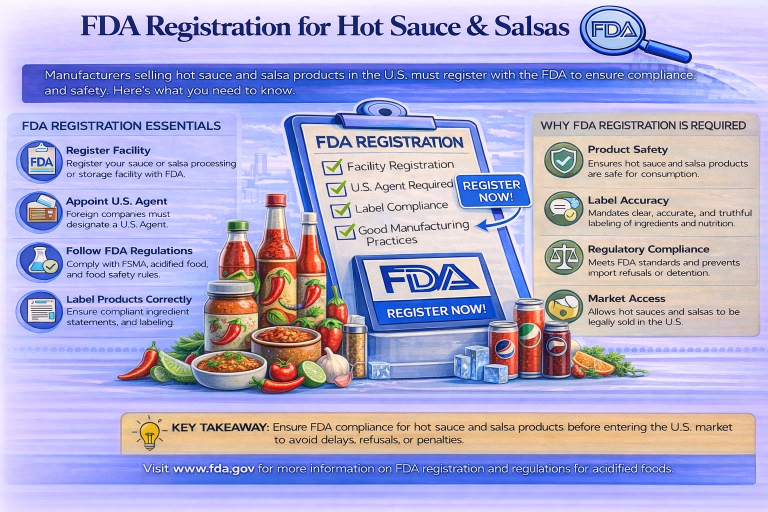
FDA Registration for Hot Sauce & Salsa
The single most important step happens before any filing: figuring out which of three buckets your sauce falls into.
Key Takeaways
- Most jarred salsa & hot sauce = acidified foods (21 CFR Part 114).
- Two FDA filings: FCE registration (Form 2541) + scheduled process (Form 2541e).
- A process authority must establish and validate your scheduled process.
- Better Process Control School training is required (21 CFR 114.10).
- pH ≤ 4.6 is the control that prevents botulism in sealed jars.
- Exemptions: vinegar-forward "acid foods," fermented sauces, and refrigerated products.
Three Buckets — and Only One Is Heavily Regulated
Acid food
Naturally at pH ≤ 4.6 (114.3(a)). A vinegar-forward sauce with only small amounts of low-acid ingredients can qualify — and falls outside Part 114.
Acidified food
Low-acid food + added acid → pH ≤ 4.6 (114.3(b)). Most jarred salsa & hot sauce. This is the bucket that triggers FCE + scheduled process.
Low-acid food
pH above 4.6 in a sealed container — the LACF rules (Part 113). Rare for sauces, but possible.
What the Acidified Bucket Requires
| Requirement | What it is | Reference |
|---|---|---|
| FCE registration | Register the establishment as a Food Canning Establishment | Form FDA 2541 |
| Scheduled process | File the process for each product & container size | Form FDA 2541e |
| Process authority | Expert establishes/validates the scheduled process | Letter on file |
| Trained supervision | Better Process Control School (acidified track) | 21 CFR 114.10 |
| Facility registration | Standard food facility registration + U.S. Agent (foreign) | Part 1, Subpart H |
| Preventive controls | CGMP / preventive controls framework | Parts 108 & 117 |
Better Process Control School
This is the requirement first-time makers almost never see coming: for acidified foods, processing must be supervised by someone who has completed a Better Process Control School (BPCS) acidified-foods course (21 CFR 114.10).
What counts
- A BPCS acidified-foods course (multi-day)
- Run by university food-science programs
- Supervision by a course graduate
What doesn't
- General food-handler cards
- ServSafe or intro HACCP courses
- "We've made it for years" experience alone
From Kitchen to Compliant
Classify the product
A process authority determines acid vs. acidified vs. low-acid from your formula and finished pH.
Register the facility
Standard food facility registration; foreign facilities add a U.S. Agent.
File the FCE registration
Register as a Food Canning Establishment (Form 2541) if acidified.
File the scheduled process
Form 2541e for each product and container, backed by the process authority's letter.
Get BPCS training
A Better Process Control School graduate supervises processing (114.10).
Labeling & imports
Compliant label; for imports add prior notice and FSVP.
Get Your Hot Sauce or Salsa to Market
FDA Registration Assistance registers your facility, serves as U.S. Agent, and handles the acidified-food filings — FCE registration and the scheduled process — alongside your process authority, plus label review and import support.
Contact us at info@fdaregistrationassistance.com or call +1 (928) 275-8333. Trusted by companies across 135+ countries, with 15+ years of experience.
Frequently Asked Questions
1. Do hot sauce and salsa need FDA registration?
The facility that makes, packs, or holds them registers, and foreign facilities need a U.S. Agent. But for most shelf-stable jarred products, registration is just the start — they're usually acidified foods, which add filings. Registration isn't approval.
2. Are hot sauce and salsa acidified foods?
Usually — an acidified food (21 CFR Part 114) is a low-acid food (peppers, onions, tomatoes) with acid like vinegar added to bring the finished pH to 4.6 or below, shelf-stable. Most jarred salsas and many hot sauces fit. Not all do, so classification matters.
3. Acid food vs. acidified food — what's the difference?
An acid food is naturally at pH ≤ 4.6 (114.3(a)); an acidified food is a low-acid food made safe with added acid (114.3(b)). Acidified foods need FCE registration and a scheduled process; acid foods generally don't. A vinegar-forward hot sauce can qualify as an acid food.
4. What filings do acidified products need?
Two: register as a Food Canning Establishment (Form 2541) and file a scheduled process for each product and container size (Form 2541e), backed by a process authority's letter. Both go through FDA Industry Systems, and retailers often ask for them.
5. What is a process authority?
A qualified expert who establishes and validates your scheduled process — pH, acidification, any thermal step — and issues a letter of critical factors. FDA's scheduled process filing is built on it, so you generally can't file without one.
6. Do I need Better Process Control School?
Yes for acidified foods — under 21 CFR 114.10, processing must be supervised by a BPCS acidified-foods graduate. It's a multi-day university course; general food-handler certifications don't count. It surprises many first-time makers.
7. Why does pH 4.6 matter so much?
In a sealed, low-oxygen jar, Clostridium botulinum is the danger. Keeping the finished equilibrium pH at or below 4.6 through validated formulation and processing is the core control that prevents botulism — the reason for the strict rules.
8. Is a fermented hot sauce an acidified food?
Not necessarily — a sauce made acidic purely through traditional fermentation (not added acid) may fall outside the rule, but a process authority should confirm it, since formulation details matter. Fermentation plus added vinegar can change the answer.
9. What about refrigerated salsa?
Foods stored, distributed, and sold under refrigeration are excluded from the acidified rule, so a fresh refrigerated salsa generally isn't an acidified food — though it still must be made safely. The acidified rules target shelf-stable jarred products.
10. Do I still need a preventive controls plan?
Acidified facilities are also subject to preventive controls (Part 117) and emergency permit control (Part 108). In practice the validated scheduled process is the heart of your controls, but the CGMP/PC framework still applies.
11. Do importers need FSVP and prior notice?
Yes — imported sauces need a registered foreign facility with a U.S. Agent, prior notice per shipment, and an importer FSVP. If acidified, the foreign processor also needs FCE registration and a scheduled process on file.
12. Is "FDA registered" the same as "FDA approved"?
No — registration and process filings tell FDA the facility and process exist; they aren't approval of the product. "FDA approved" based on registration is inaccurate.
13. What if I skip the acidified filings?
An acidified food sold without the required FCE registration and scheduled process can be treated as adulterated — leading to detention or refusal at import, holds, or enforcement. Missing filings is a top reason these products get flagged.
14. How does FDA Registration Assistance help?
It registers the facility, serves as U.S. Agent, and handles the acidified-food filings (Form 2541 and 2541e) alongside your process authority, plus label review and import support, for companies across 135+ countries. Contact info@fdaregistrationassistance.com or +1 (928) 275-8333.