
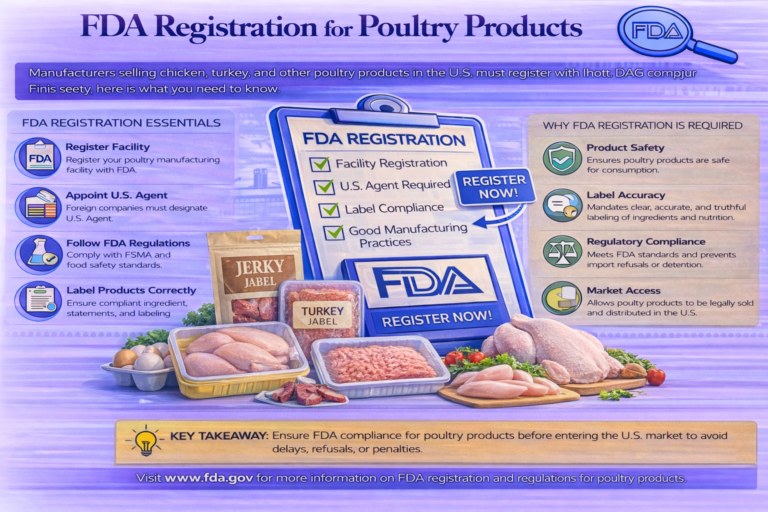
FDA Registration for Poultry Products
Chicken and turkey are USDA. Game birds are FDA. The line runs between domesticated and wild — not between "bird" and "not a bird."
Key Takeaways
- PPIA covers "any domesticated bird" — chicken, turkey, duck, goose, guinea, ratites, squab → USDA.
- Game birds are FDA — wild turkey, wild ducks/geese, grouse, pheasant, quail.
- Even farm-raised pheasant & quail are FDA — they aren't "poultry" under the Act.
- USDA poultry = mandatory continuous, bird-by-bird inspection + FSIS label approval.
- Salmonella & Campylobacter are the defining poultry pathogens.
- Shell eggs = FDA; egg products = USDA (Egg Products Inspection Act).
Which Birds Go Where?
USDA / FSIS
"Poultry" under the Act (9 CFR 381.1) — any domesticated bird:
- Chickens, turkeys, ducks, geese, guineas
- Ratites — ostrich, emu, rhea (added 2001)
- Squab — young pigeons, ~1–30 days
FDA
"Non-amenable" game birds — outside the Act's definition:
- Wild birds — wild turkey, wild ducks and geese, grouse
- Pheasant & quail — even farm-raised
- Other waterfowl not named in the Act
Mandatory vs Voluntary Inspection
USDA poultry: mandatory
Amenable poultry gets continuous, daily, bird-by-bird FSIS inspection — before and after slaughter — plus HACCP and FSIS label pre-approval. No bird is processed for human food without an inspector present, and USDA covers that inspection cost.
FDA game birds: voluntary option
Game birds are FDA-regulated. USDA can inspect them voluntarily (fee-for-service, under the Agricultural Marketing Act), and they may carry a voluntary mark — but the producer pays, and FDA keeps regulatory jurisdiction in interstate commerce.
Shell Eggs vs Egg Products
| Product | Agency | Why |
|---|---|---|
| Shell eggs | FDA | Shell-egg production, transport, storage; plants that wash, sort, and pack |
| Egg products (liquid, frozen, dried) | USDA / FSIS | Egg-breaking and pasteurizing plants, under the Egg Products Inspection Act |
The FDA Path for Game Birds
If your product is a non-amenable game bird (pheasant, quail, wild waterfowl), you're on the standard FDA food path — the same one we handle for other FDA foods:
- Register the facility — foreign facilities add a U.S. Agent.
- Preventive controls — a Part 117 hazard analysis centered on Salmonella and Campylobacter.
- Labeling — FDA food labeling, no pre-approval; declare allergens from added ingredients (marinades, coatings, sauces).
- Imports — prior notice + an importer FSVP; see the food importer guide.
From Bird to Compliant
Domesticated or wild?
Domesticated poultry (chicken, turkey, duck…) → USDA; game birds (pheasant, quail, wild) → FDA.
Check combination products
2%+ cooked (or >3% raw) poultry → USDA; below → FDA.
If FDA-regulated, register
The facility registers with FDA; foreign facilities add a U.S. Agent.
Control Salmonella & Campylobacter
Part 117 hazard analysis for the poultry pathogens.
Label & handle imports
FDA labeling (no pre-approval); prior notice + FSVP for imports.
Keep it current
Renew every two years; re-check jurisdiction if the formula changes.
Get Your Poultry Product on the Right Track
FDA Registration Assistance starts by determining whether your bird is FDA (game) or USDA (domesticated poultry). For FDA-regulated game birds, we register the facility, serve as U.S. Agent, build the FSVP, review labeling, and handle prior notice. For USDA poultry, we help you understand the FSIS path so you don't file the wrong thing.
Contact us at info@fdaregistrationassistance.com or call +1 (928) 275-8333. Food Facility Registration is available starting at $858. Trusted by companies across 135+ countries, with 15+ years of experience.
Frequently Asked Questions
1. Do poultry products need FDA registration?
Usually not. Most poultry — chicken, turkey, duck, goose — is USDA/FSIS under the Poultry Products Inspection Act, with mandatory continuous inspection, not FDA registration. FDA registration applies to game birds the Act doesn't cover, and to some low-poultry combination products. First, settle which agency you're under.
2. What is the test for poultry — FDA or USDA?
Domesticated vs wild. The Act (9 CFR 381.1) defines poultry as "any domesticated bird," listing chickens, turkeys, ducks, geese, guineas, ratites, and squab — those are USDA. Birds outside that definition (game birds) are FDA. For red meat the test is a species list; for poultry it's domesticated vs wild.
3. Which birds does USDA regulate?
The "amenable" domesticated birds named in the Act: chickens, turkeys, ducks, geese, guineas, ratites (ostrich, emu, rhea — added 2001), and squab (young pigeons ~1–30 days). These get mandatory, continuous, bird-by-bird FSIS inspection and are exempt from the FD&C Act to the extent the Act covers them.
4. Which birds does FDA regulate?
Game birds outside the Act — wild turkey, wild ducks and geese, grouse, and, notably, pheasant and quail. These are "non-amenable" and FDA-regulated, following the FDA food path (registration, preventive controls, labeling, FSVP for imports).
5. Are farm-raised pheasant and quail USDA or FDA?
FDA. Even commercially farm-raised pheasant and quail are "non-amenable" and not "poultry" under the Act, so they're FDA-regulated — not USDA — despite being domesticated in practice. USDA can inspect them voluntarily, but the regulatory authority is FDA.
6. Can USDA inspect FDA-regulated game birds?
Yes, voluntarily — USDA/FSIS offers fee-for-service inspection for game birds and migratory waterfowl under the Agricultural Marketing Act. But the producer pays, and FDA keeps regulatory jurisdiction in interstate commerce, even if the product bears a voluntary USDA mark. Amenable poultry, by contrast, gets mandatory inspection at USDA's cost.
7. What does USDA poultry inspection involve?
Continuous, daily, bird-by-bird inspection — before and after slaughter — by FSIS, plus HACCP and FSIS label pre-approval. No amenable bird may be processed for human food without an inspector present. It's far more hands-on than FDA's facility registration model.
8. How are Salmonella and Campylobacter handled?
They're the defining poultry pathogens. For USDA poultry, FSIS sets pathogen-reduction performance standards enforced through inspection. For FDA-regulated game birds, the same hazards are addressed through the facility's Part 117 hazard analysis. Either way, they're the central concern.
9. Where do eggs fit in?
Eggs split by processing. FDA regulates shell eggs (and plants that wash, sort, and pack them). USDA regulates processed egg products — liquid, frozen, dried — under the Egg Products Inspection Act. A shell-egg packer is FDA; an egg-breaking and pasteurizing plant is USDA.
10. My product is chicken or turkey — can you FDA-register it?
Chicken and turkey are USDA-regulated, so FDA registration isn't the right path — the product needs USDA/FSIS inspection and, for imports, FSIS import eligibility. We help you confirm jurisdiction and understand the FSIS path, but USDA establishment approval and inspection are USDA processes, not FDA registration.
11. Do FDA-regulated game birds need a U.S. Agent and FSVP?
Yes — for FDA-regulated game birds, a foreign facility needs a U.S. Agent, each import needs prior notice, and the importer maintains an FSVP — the same FDA import requirements as other FDA foods.
12. Is "FDA registered" the same as "FDA approved"?
No — registration tells FDA a facility exists and what it does; it isn't approval. And for USDA-regulated poultry, "FDA registered" isn't even the right framework. Neither agency "approves" a poultry product just because a facility is registered or inspected.
13. What's the biggest mistake poultry businesses make?
Getting the FDA-vs-USDA determination wrong — either trying to FDA-register chicken or turkey (which is USDA), or running an FDA-regulated game-bird product without the registration and FSVP it needs. Settling domesticated-vs-wild first prevents detentions and wasted filings.
14. How does FDA Registration Assistance help?
We start by determining whether your bird is FDA (game) or USDA (domesticated poultry). For FDA-regulated game birds, we register the facility, serve as U.S. Agent, build the FSVP, review labeling, and handle prior notice. For USDA poultry, we help you understand the FSIS path. Starting at $858, for companies across 135+ countries. Contact info@fdaregistrationassistance.com or +1 (928) 275-8333.
