FDA Registration for Food Importers: The Full Picture
The good news: once you see the four pieces clearly, importing compliantly is a checklist — not a mystery.
Key Takeaways
- No standalone "importer registration" — it's a bundle of obligations.
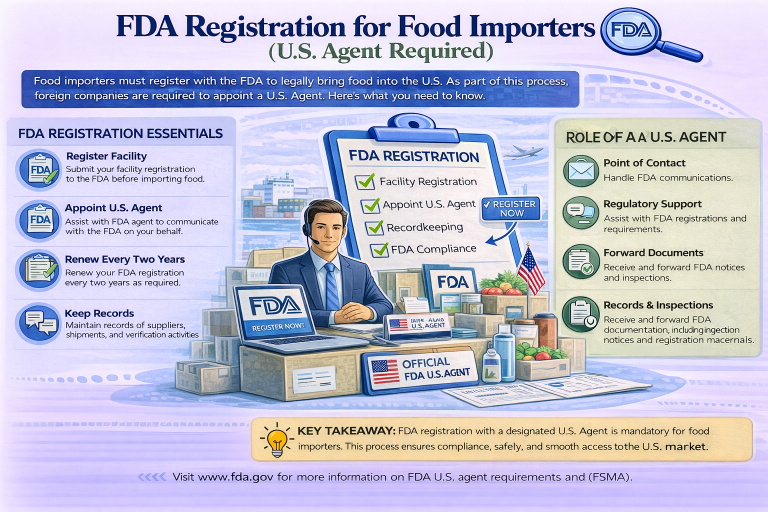
- The foreign facility registers (with a U.S. Agent) — you can't import from an unregistered one.
- You register a facility only if you also hold or store the food.
- Prior notice is filed for every shipment; FSVP is your ongoing responsibility.
- Seafood/juice follow HACCP (123.12 / 120.14), not standard FSVP.
- Registration ≠ approval — and the responsibility sits with you, not your supplier.
The Four FDA Pieces for an Importer
Foreign facility registration
The producer/holder abroad must be registered and have a U.S. Agent. Confirm this before you buy.
Prior notice
Advance notice to FDA before each shipment reaches the U.S. port. Every shipment, every time.
FSVP
Your program to verify each supplier and food — see the FSVP guide. Seafood/juice follow HACCP instead.
Your own registration
Only if you hold or store the food yourself (e.g. a warehouse). Pure importers usually skip this.
Do You Register a Facility, or Not?
This is the question that decides whether piece #4 applies to you:
You hold the food → you register
If you operate a warehouse or otherwise store the imported food, that's "holding food" — your facility registers with FDA and renews biennially, just like any other food facility.
You never hold it → you usually don't
If you take ownership on paper and the product ships straight to your customer without you holding it, you generally don't register a facility — but prior notice and FSVP still apply to you.
The Buck Stops with the Importer
| Obligation | Whose job | When |
|---|---|---|
| Facility registration (abroad) | Foreign facility (you verify it) | Before importing; renew biennially |
| U.S. Agent | Foreign facility appoints | Part of the facility's registration |
| Prior notice | Importer / filer | Before each shipment arrives |
| FSVP | Importer (U.S. owner/consignee at entry) | Ongoing program |
| Labeling | Importer ensures compliance | Before entry |
The Importer's Path to Compliance
Confirm the foreign facility is registered
Verify registration and a valid U.S. Agent — you can't lawfully import from an unregistered facility.
Decide if you register too
Do you hold or store the food? If yes, your facility registers as well.
Set up your FSVP
Build a program per supplier and food — seafood/juice follow HACCP instead.
File prior notice
Submit FDA prior notice before each shipment reaches the U.S. port.
Check labeling
Confirm the label meets U.S. requirements before entry.
Keep everything current
Renew registration biennially, keep FSVP records ready, file prior notice every time.
Import Food Without the Border Surprises
FDA Registration Assistance handles the importer's full FDA picture — confirming and completing foreign facility registration, serving as U.S. Agent, building and maintaining your FSVP, filing prior notice, and reviewing labels — so nothing surfaces at the port.
Contact us at info@fdaregistrationassistance.com or call +1 (928) 275-8333. Trusted by importers across 135+ countries, with 15+ years of experience.
Frequently Asked Questions
1. Do food importers need "FDA registration"?
Not as a single "importer registration" — there's no such thing. It's a bundle: the foreign facility must be registered (with a U.S. Agent), you file prior notice per shipment, you maintain an FSVP, and you register your own facility only if you hold the food. Labeling must comply too.
2. So do I register a facility as an importer?
Only if you manufacture, process, pack, or hold food. An importer with a warehouse registers that facility; a pure importer that never physically holds the food generally doesn't — but still handles prior notice and FSVP.
3. Does the foreign facility have to be registered?
Yes — the facility abroad must be registered with FDA and have a U.S. Agent. You can't lawfully import from an unregistered facility, and FDA checks at entry. Confirm this first with any new supplier.
4. Is "FDA registration" the same as FDA approval?
No — registration tells FDA a facility exists and what it does; it isn't approval or certification of the facility or the food. "FDA approved" based on registration is inaccurate.
5. What is prior notice?
Advance notification to FDA that a food shipment is arriving, submitted before it reaches the U.S. port — required for each shipment, separately from registration and FSVP. Missing or late prior notice is a common cause of port holds.
6. What is FSVP and is it my job?
The Foreign Supplier Verification Program requires the U.S. importer to verify suppliers meet U.S. safety standards. Yes — it's the importer's legal responsibility. See our FSVP guide.
7. Do seafood importers follow the same rules?
Mostly, but not on FSVP — seafood is exempt and follows Seafood HACCP importer rules at 21 CFR 123.12 (juice at 120.14). The facility still registers and prior notice still applies. See our seafood importer page.
8. Who's legally responsible — me or my supplier?
You, the importer, carry the U.S.-side responsibility. Assuming the supplier handles everything is a common, costly mistake. Suppliers provide documents; FSVP, prior notice, and confirming registration fall on you.
9. Do I need a U.S. Agent?
The foreign facility does — as FDA's contact. A U.S.-based importer personally doesn't, but the facility you buy from must have one, or its registration isn't valid.
10. What happens if something is missing?
Shipments can be held, detained, or refused, and you can be flagged for follow-up. Gaps surface at the border. If a shipment is already affected, see fixing an FDA refusal for no FSVP.
11. Is this a one-time setup?
No — facility registration renews every two years, FSVP is ongoing, and prior notice is filed for every shipment. Compliant importing is continuous.
12. Does labeling matter for imports?
Yes — imported food must meet U.S. labeling rules, and labeling issues are a frequent reason food is held. A label compliant in the origin country isn't automatically compliant here.
13. How fast can I get set up?
Registration and prior notice can move quickly, but a DUNS number (needed for registration) can take time, and a proper FSVP takes real work. Start well before your first shipment.
14. How does FDA Registration Assistance help importers?
It handles the importer's full FDA picture — foreign facility registration, U.S. Agent, FSVP, prior notice, and label review — in one place, for importers across 135+ countries. Contact info@fdaregistrationassistance.com or +1 (928) 275-8333.