
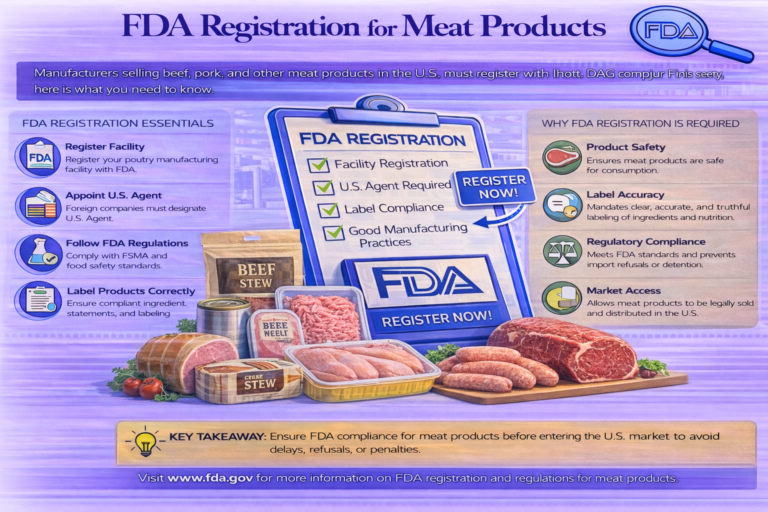
FDA Registration for Meat Products
Get the agency wrong and everything downstream is wrong — inspection, labeling, imports. Get it right and the path is clear.
Key Takeaways
- Most meat & poultry is USDA/FSIS, not FDA — beef, pork, lamb, chicken, turkey.
- FDA regulates "non-amenable" game — bison, venison, elk, rabbit, quail, pheasant.
- USDA = grant of inspection, daily inspection, HACCP, FSIS label pre-approval.
- FDA = facility registration, Part 117, no label pre-approval, prior notice + FSVP.
- Combination products flip at >3% raw / ≥2% cooked meat or poultry.
- "FDA registered" ≠ approved — and for USDA meat, it's not even the right framework.
Which Agency Regulates Your Meat?
USDA / FSIS
"Amenable species" — exempt from the FD&C Act to the extent USDA's laws cover them:
- Red meat: cattle, sheep, swine, goats, horses (Federal Meat Inspection Act)
- Poultry: chicken, turkey, duck, goose, guinea, ratites (ostrich/emu), squab (Poultry Products Inspection Act)
- Also: catfish and processed egg products
FDA
"Non-amenable" game species — the meats USDA's laws don't cover:
- Red game: antelope, bison, deer (venison), elk, reindeer, moose, rabbit, water buffalo
- Reptiles: non-aquatic reptiles such as alligator
- Game birds: grouse, pheasant, quail, wild turkey, wild ducks and geese
Combination Products: the % Threshold
For multi-ingredient foods — soups, sauces, frozen meals, sandwiches — jurisdiction turns on how much meat or poultry is in the product:
| Meat / poultry content | Agency | Example |
|---|---|---|
| More than 3% raw, or 2%+ cooked | USDA / FSIS | Pepperoni pizza; meat lasagna; chicken soup at 2%+ cooked |
| Below those thresholds | FDA | Vegetable soup with a trace of cooked beef; flavored broths |
What Each Agency Requires
| USDA / FSIS | FDA | |
|---|---|---|
| Core mechanism | Grant of inspection + continuous (often daily) inspection | Facility registration + preventive controls |
| Food-safety system | HACCP (mandatory) | Hazard analysis under Part 117 |
| Labels | FSIS pre-approval (unless generically approved); inspection legend | No pre-approval; FDA food labeling rules |
| Imports | Country + establishment must be found equivalent by FSIS | Prior notice + importer FSVP |
The FDA Path for Game Meats
If your product is a non-amenable species (bison, venison, elk, rabbit, game birds), you're on the standard FDA food path — the same one we handle for other FDA foods:
- Register the facility — foreign facilities add a U.S. Agent.
- Preventive controls — a hazard analysis under Part 117 (pathogens especially).
- Labeling — FDA food labeling, no pre-approval; declare allergens from added ingredients.
- Imports — prior notice + an importer FSVP; see the food importer guide.
From Product to Compliant
Determine the agency
USDA (beef, pork, chicken…) or FDA (bison, venison, rabbit, game)? This decides everything.
Check the combination threshold
Over 3% raw / 2%+ cooked meat → USDA; below → FDA.
If FDA-regulated, register
The facility registers with FDA; foreign facilities add a U.S. Agent.
Meet preventive controls
Part 117 hazard analysis for pathogens and other hazards.
Label & handle imports
FDA labeling (no pre-approval); prior notice + FSVP for imports.
Keep it current
Renew every two years; re-check jurisdiction if the formula changes.
Get Your Meat Product on the Right Track
FDA Registration Assistance starts by determining whether your product is FDA or USDA. For FDA-regulated (non-amenable) meats, we register the facility, serve as U.S. Agent, build the FSVP, review labeling, and handle prior notice. For USDA products, we help you understand the FSIS path so you don't file the wrong thing.
Contact us at info@fdaregistrationassistance.com or call +1 (928) 275-8333. Food Facility Registration is available starting at $858. Trusted by companies across 135+ countries, with 15+ years of experience.
Frequently Asked Questions
1. Do meat products need FDA registration?
Usually not. Most meat and poultry — beef, pork, lamb, goat, chicken, turkey, duck — is USDA/FSIS, not FDA, and follows a grant of inspection and continuous inspection rather than FDA registration. FDA registration applies to the game species USDA doesn't cover, and to some low-meat combination products. First, settle which agency you're under.
2. Which meats does FDA actually regulate?
"Non-amenable" game species — antelope, bison, deer (venison), elk, reindeer, moose, rabbit, water buffalo, non-aquatic reptiles like alligator, plus game birds such as grouse, pheasant, quail, and wild turkey, ducks, and geese. If that's your product, the FDA food path applies.
3. Which meats does USDA regulate?
The "amenable species": cattle, sheep, swine, goats, and horses (Federal Meat Inspection Act), and chickens, turkeys, ducks, geese, guineas, ratites, and squab (Poultry Products Inspection Act) — plus catfish and processed egg products. These are exempt from the FD&C Act to the extent the USDA laws cover them.
4. What does USDA require that FDA doesn't?
A grant of inspection and continuous (often daily) on-site inspection, a HACCP plan, and FSIS pre-approval of labels unless generically approved. Imports must come from countries and establishments FSIS has found equivalent. That's very different from FDA's registration and preventive-controls model.
5. How do combination products like pizza or soup get classified?
By meat content — more than 3% raw, or 2%+ cooked meat/poultry, generally falls under USDA; below that, FDA. Small formulation changes can flip jurisdiction, so a bit more cooked chicken in a soup can move it from FDA to USDA.
6. My product is beef/pork/chicken — can you register it with FDA?
Those are USDA-regulated, so FDA facility registration isn't the right path — the product needs USDA/FSIS inspection and (for imports) FSIS import eligibility. We help you confirm jurisdiction and understand USDA's requirements, but USDA establishment approval and inspection are USDA processes, not FDA registration.
7. I make bison or venison jerky — what applies?
Bison and venison are non-amenable, so they're FDA-regulated. Your facility registers with FDA, follows Part 117, labels under FDA rules, and — if importing — needs prior notice and an FSVP. This is the FDA food path, and it's what we handle directly.
8. Can USDA voluntarily inspect FDA-regulated game meat?
Yes — USDA/FSIS offers voluntary, fee-for-service inspection for certain non-amenable species, and products may carry a voluntary mark of inspection. But the underlying regulatory authority stays with FDA, so FDA requirements still apply.
9. Do FDA-regulated meats need a U.S. Agent and FSVP?
Yes — for FDA-regulated (game) meats, a foreign facility needs a U.S. Agent, each import needs prior notice, and the importer maintains an FSVP. These are the same FDA import requirements as other FDA foods.
10. What about labeling and allergens?
FDA-regulated meats follow FDA labeling (no pre-approval); USDA products carry the inspection legend and need FSIS label approval. Either way, any major allergens from added ingredients (soy, wheat, milk in marinades or sauces) must be declared.
11. Where do shell eggs vs egg products fall?
It splits — FDA regulates shell eggs, while USDA regulates processed egg products (liquid, frozen, dried). A good example of the same commodity sitting under different agencies depending on processing.
12. Is "FDA registered" the same as "FDA approved"?
No — registration tells FDA a facility exists and what it does; it isn't approval. And for USDA-regulated meat, "FDA registered" isn't even the right framework. Neither agency "approves" a meat product just because a facility is registered or inspected.
13. What's the biggest mistake meat businesses make?
Getting the FDA-vs-USDA determination wrong — either trying to FDA-register a USDA product, or running an FDA-regulated game product without the registration and FSVP it needs. Confirming jurisdiction first prevents detentions, refusals, and wasted filings.
14. How does FDA Registration Assistance help?
We start by determining FDA vs USDA. For FDA-regulated (non-amenable) meats, we register the facility, serve as U.S. Agent, build the FSVP, review labeling, and handle prior notice. For USDA products, we help you understand the FSIS path. Starting at $858, for companies across 135+ countries. Contact info@fdaregistrationassistance.com or +1 (928) 275-8333.
