FDA Registration for Halal Food Products
Why FDA doesn't certify halal, what it actually requires, and why meat and poultry halal claims go through USDA.
Key Takeaways
- FDA doesn't certify or define halal — no federal halal definition; certification is third-party.
- Registration ≠ certification — two independent systems; you need both.
- FDA's only halal touchpoint: truthful labeling — a false halal claim is misbranding.
- Meat & poultry halal → USDA-FSIS — and FSIS pre-approves those labels.
- Certification is an ingredient + process audit — no haram inputs, proper slaughter for meat.
- Some states have halal laws — plus FTC oversight of halal advertising.
Two Separate Systems
The single most useful thing to understand is that FDA compliance and halal certification are two independent tracks, and FDA is not on the halal track at all. The FDA does not provide a legal definition of "halal" and does not regulate religious dietary claims — largely because of the constitutional separation of church and state. No federal agency defines halal or licenses halal certifiers.
Halal certification is issued by independent third-party Islamic certifying bodies — for example IFANCA, ISWA, or the American Halal Foundation — each with its own standard and mark. FDA's involvement with the word "halal" is only the general rule it applies to every claim on every label: it must be truthful and not misleading.
What FDA Actually Requires
Exactly what it requires for any food — halal status changes none of it:
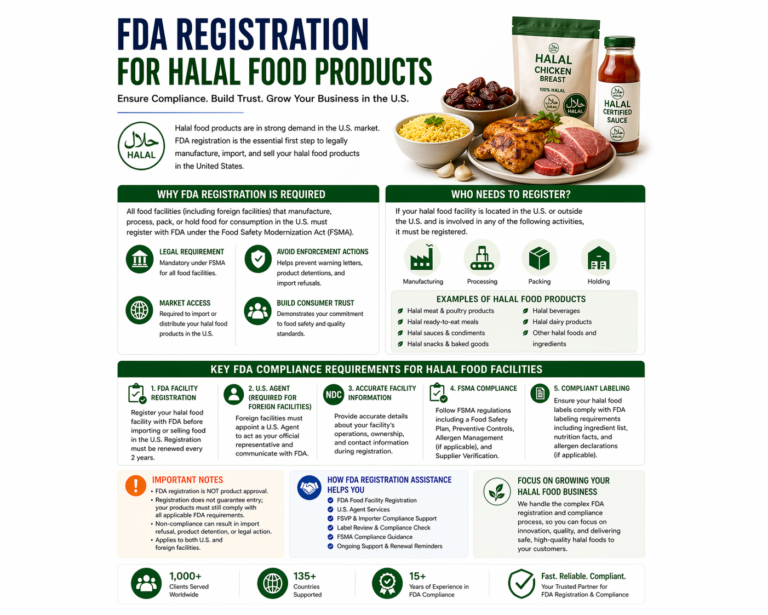
- Facility registration — anyone manufacturing, processing, packing, or holding the food (foreign facilities also need a U.S. Agent)
- Safe manufacturing — under the applicable food-safety/preventive-controls rules
- Compliant labeling — Nutrition Facts, full ingredient list, allergen declarations (label rules)
- A truthful halal claim — if you display "halal" or a certifier's logo, it must be substantiated; an unsubstantiated claim is misbranding
- FSVP for imports — foreign-supplier verification with prior notice per shipment
Halal Meat Is USDA, Not FDA
Which agency governs the halal claim depends on the product:
| Your halal product | Who governs the halal claim |
|---|---|
| Processed foods, snacks, beverages, packaged goods (non-meat) | FDA — claim must be truthful & not misleading (else misbranded) |
| Meat & poultry (beef, chicken, lamb) | USDA-FSIS — pre-approves the label; needs third-party cert + religious-exemption statement |
| Seafood | FDA (+ Seafood HACCP) — claim truthful & not misleading |
| Imported halal food | Foreign facility registers + FSVP; certification doesn't replace FDA |
How Halal Certification Works
Certification runs through a third-party body that audits your ingredients and processes — separate from anything FDA does:
- No haram inputs — verifying no pork derivatives, alcohol, or other forbidden ingredients
- Ingredient sourcing — checking animal-derived and questionable inputs: gelatin, enzymes/rennet, mono- and diglycerides, glycerin, L-cysteine, alcohol-carried flavors
- Slaughter (for meat) — confirming proper Islamic (zabiha) slaughter and halal integrity from slaughter through packaging
- Cross-contamination — segregation from non-halal production
Get the FDA Side of Halal Right
FDA Registration Assistance handles the FDA side and aligns it with your halal certification: facility registration, U.S. Agent, compliant labeling with a truthful halal claim, and FSVP for imports — and we flag when a product is meat/poultry and therefore USDA-FSIS rather than FDA. We don't issue halal certification (that's your third-party body); we make sure the regulatory setup around it is correct.
Contact us at info@fdaregistrationassistance.com or call +1 (928) 275-8333. Food Facility Registration is available starting at $858. Trusted by companies across 135+ countries, with 15+ years of experience.
Frequently Asked Questions
1. Do halal food products require FDA registration?
Yes — halal foods are regulated as food, so a facility that manufactures, processes, packs, or holds them for the U.S. registers with FDA (foreign facilities also need a U.S. Agent), unless the product is meat/poultry under USDA. But note what this means: FDA registration is about facility and food safety. It is not a halal certification, and it doesn't involve FDA judging whether your product is halal. Those are two separate things.
2. Does the FDA certify or regulate halal?
No. The FDA does not define, certify, or regulate "halal." There is no federal legal definition of halal and no federal agency that licenses halal certifiers — largely because of the constitutional separation of church and state. Halal certification comes from independent, third-party Islamic certifying bodies (such as IFANCA, ISWA, or the American Halal Foundation). FDA's only role regarding the word "halal" is the general one it applies to every claim: it must be truthful and not misleading.
3. So what does the FDA actually require for a halal product?
Exactly what it requires for any food: facility registration, safe manufacturing under the applicable food-safety rules, a compliant label (Nutrition Facts, full ingredient list, allergen declarations), and — for imports — FSVP with prior notice. Halal certification doesn't change or reduce any of these. And if you put a halal claim or logo on the label, that claim must be truthful and substantiated; an unsubstantiated or false halal claim makes the product misbranded under the law.
4. Is halal certification enough to sell in the U.S.?
No — and this is the most common misconception. Halal certification verifies religious compliance; it does nothing for FDA compliance. A product can be perfectly halal-certified and still be refused entry or pulled for a labeling violation, an unregistered facility, or a missing FSVP. The two run on independent tracks and both must be satisfied: FDA (safety and labeling) and your third-party halal certification (religious).
5. What if my halal product is meat or poultry?
Then the halal claim is governed by USDA-FSIS, not FDA. Under the meat and poultry inspection laws, FSIS requires labels to be truthful and not misleading, and it must pre-approve labels for religious-exempt products such as halal and kosher before use. A halal meat label needs a statement that the product was prepared under an Islamic (halal) exemption, the religious authority involved, and supporting recognized third-party certification. FSIS doesn't define what is halal — it ensures the claim is accurate and certified.
6. How does halal certification actually work?
Through a third-party certifying body that audits your ingredients and processes: confirming no haram (forbidden) inputs such as pork derivatives or alcohol, verifying animal-derived ingredients, checking against cross-contamination, and — for meat — confirming proper Islamic (zabiha) slaughter and halal integrity from slaughter through packaging. Each certifier has its own standard and mark. This is entirely separate from FDA registration; we help align your FDA compliance with it, but the certification itself is issued by the halal body.
7. Which ingredients most often cause halal problems?
The usual watch-list is animal- or alcohol-derived ingredients: gelatin, enzymes/rennet, mono- and diglycerides and other emulsifiers, glycerin, L-cysteine, shortenings, and flavors carried in alcohol. Any of these can jeopardize halal status depending on their source. Separately, several of these are also allergen or labeling concerns under FDA rules — so ingredient sourcing serves both your halal certification and your FDA labeling accuracy.
8. Are there state halal laws too?
Yes. Even though there's no federal halal definition, several states (including New Jersey, Illinois, Michigan, Texas, New York, and California) have halal-labeling statutes, and general consumer-protection laws apply everywhere. Penalties for misrepresenting a halal claim can be significant, and some states treat it as a criminal matter. The FTC can also act against deceptive halal advertising. So a false halal claim carries federal, state, and civil exposure.
9. Does importing halal food require anything extra?
The import requirements are the standard ones — the foreign facility must register with FDA and keep a U.S. Agent, and the U.S. importer must run FSVP with prior notice for each shipment (for meat/poultry, the USDA import pathway applies instead). Being halal-certified abroad does not substitute for any of this. Many shipments are held not because of halal issues but because the ordinary FDA import steps were skipped.
10. Does FDA approve halal foods?
No. FDA doesn't pre-approve food products at all, and it certainly doesn't approve or endorse halal status. You register your facility, comply with labeling and safety rules, and keep your halal claim truthful; FDA enforces after the fact. One contrast worth knowing: for meat and poultry, USDA-FSIS does pre-approve the label (including the halal claim) before use — so the "no pre-approval" rule is an FDA one, not universal.
11. Can FDA Registration Assistance certify my product as halal?
No — and no consultant can. Halal certification must come from a recognized third-party Islamic certifying body. What we do is handle the FDA side and make sure it lines up cleanly with your halal certification: facility registration, U.S. Agent, compliant labeling (including reviewing your halal claim for truthfulness), and FSVP for imports. We keep the two workstreams aligned so neither one holds up your launch.
12. Do halal supplements follow the same rules?
If a product is a dietary supplement rather than a conventional food, it follows the supplement rules (Supplement Facts labeling and related requirements) — and the same halal logic applies on top: FDA doesn't certify halal, the claim must be truthful, and certification comes from a third-party body. Supplements often use gelatin capsules and animal-derived ingredients, so the halal ingredient review is especially relevant there.
13. What are the most common mistakes with halal products?
Assuming halal certification covers FDA (it doesn't); putting a halal claim on the label without documentation to back it (misbranding risk); missing that meat/poultry halal is USDA-FSIS with pre-approved labels; and overlooking that ingredient sourcing affects both halal status and FDA allergen/ingredient labeling. Treating the two systems as one is the root of most problems.
14. How does FDA Registration Assistance help with halal food products?
We handle the FDA side and align it with your halal certification: facility registration, U.S. Agent, compliant labeling with a truthful halal claim, and FSVP for imports — and we flag when a product is meat/poultry and therefore USDA-FSIS rather than FDA. We don't issue halal certification (that's your third-party body), but we make sure the regulatory setup around it is correct. Registration is available starting at $858, for companies across 135+ countries. Contact info@fdaregistrationassistance.com or +1 (928) 275-8333.