
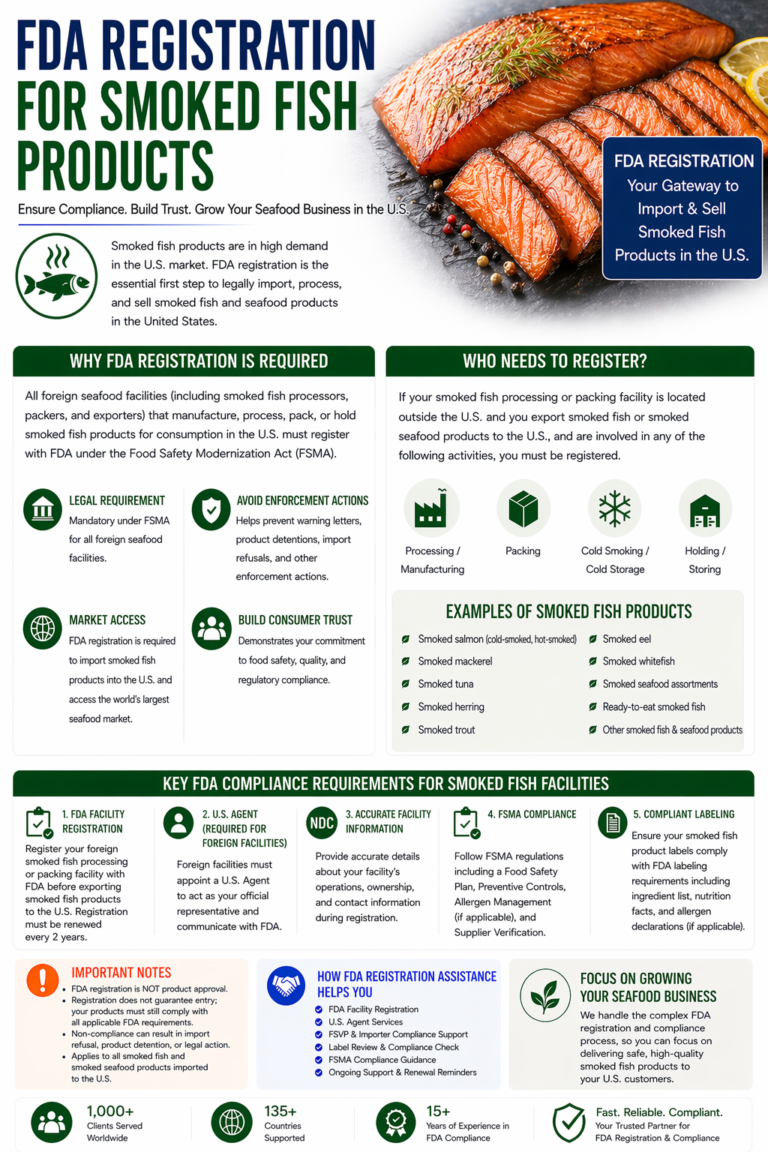
FDA Registration for Smoked Fish Products
The dedicated 123.16 C. botulinum rule, cold-smoked vs hot-smoked and the Listeria hazard, and water-phase salt.
Key Takeaways
- Smoked fish has its own HACCP subpart — 21 CFR 123.16, unique among seafood.
- C. botulinum control for the whole shelf life — the defining §123.16 requirement.
- Cold-smoked = no kill step — Listeria survives; it's the higher-risk, RTE category.
- Hot-smoked = cooked — a kill step, but still C. botulinum control in packaging.
- Water-phase salt ~3.5% + refrigeration — the core C. botulinum hurdles.
- Uneviscerated smoked fish is adulterated — except small fish under 5 inches.
Smoked Fish Has Its Own HACCP Subpart
This is what sets smoked fish apart. Seafood HACCP (21 CFR Part 123) has a whole subpart — Subpart B, including §123.16 — just for smoked and smoke-flavored fishery products. No other seafood category has its own subpart.
Cold-Smoked vs Hot-Smoked
The single most important question for a smoked fish product is whether it's cold-smoked or hot-smoked — it determines the whole hazard picture:
| Cold-smoked (e.g. lox) | Hot-smoked | |
|---|---|---|
| Temperature | ≈ 70–100°F — low | Cooked to ≈ 145°F+ internal |
| Kill step? | No — pathogens can survive | Yes — cooks the fish |
| Main hazards | Listeria and C. botulinum | C. botulinum (esp. in packaging) |
| C. botulinum control | Water-phase salt (~3.5%) + refrigeration + shelf-life limit | Heat, plus refrigeration/salt |
Water-Phase Salt, Refrigeration & the Other Hazards
- Water-phase salt (WPS) — the salt concentration in the water portion of the fish is what inhibits bacteria; a minimum WPS of about 3.4–3.5% is commonly used for cold-smoked products to help prevent C. botulinum
- Refrigeration + shelf-life limits — combined with WPS as hurdles; often freezing; sometimes nitrites
- Reduced-oxygen (vacuum) packaging — favors C. botulinum type E, so it needs the most robust controls
- Uneviscerated smoked fish — FDA considers uneviscerated salt-cured/dried/smoked fish adulterated (life-threatening botulism), except small fish under 5 inches meeting salt/aw/pH limits (see dried seafood)
- Histamine — smoked scombroid species (mackerel, tuna) form heat-stable histamine before smoking; the cold chain is the control (see canned tuna)
Labeling & Imports
- Correct species/market name, ingredient statement (salt, smoke, nitrites), net quantity, fish as a major allergen, and responsible firm
- RTE & storage labeling — refrigeration and use-by/shelf-life, which tie directly to the C. botulinum control
- Frequently detained — Listeria, inadequate C. botulinum control, uneviscerated fish, and histamine drive detention, and firms can land on import alert (DWPE)
- FSVP for imports — verify C. botulinum, Listeria, histamine, and evisceration controls; smoked fish is one of the most scrutinized seafood categories
Get Your Smoked Fish U.S.-Ready
FDA Registration Assistance helps with Seafood HACCP built around the 123.16 C. botulinum requirement (water-phase salt, refrigeration, shelf-life), Listeria controls for cold-smoked RTE products, the cold-smoked vs hot-smoked distinction, and the uneviscerated-fish and histamine questions — plus labeling, registration, U.S. Agent, and FSVP for imports.
Contact us at info@fdaregistrationassistance.com or call +1 (928) 275-8333. Food Facility Registration is available starting at $858. Trusted by companies across 135+ countries, with 15+ years of experience.
Frequently Asked Questions
1. Do smoked fish products need FDA registration?
Yes. Any facility that processes, packs, stores, or holds smoked fish for the U.S. market must be registered with FDA, with a U.S. Agent if foreign and prior notice for each shipment. But registration is the easy part — smoked fish is one of the highest-hazard seafood categories, and it's the only one with its own dedicated subpart in the Seafood HACCP regulation.
2. What is 21 CFR 123.16 and why does it matter?
21 CFR Part 123 has a whole subpart (Subpart B, including §123.16) just for smoked and smoke-flavored fishery products — smoked fish is the only seafood category with its own subpart. It requires processors to include in their HACCP plans how they control the hazard of Clostridium botulinum toxin formation for at least as long as the product's shelf life, under normal and moderate abuse conditions. That C. botulinum control obligation is the defining requirement for smoked fish.
3. What's the difference between cold-smoked and hot-smoked fish?
It's the single most important distinction. Cold-smoked fish (like lox) is smoked at low temperatures (roughly 70–100°F) and is NOT cooked — there's no kill step, so Listeria monocytogenes and other pathogens can survive. Hot-smoked fish is cooked to a lethal internal temperature (around 145°F or higher), which provides a kill step. Cold-smoked, ready-to-eat products are the higher-risk category and need the most careful controls.
4. Why is Listeria such a concern for cold-smoked fish?
Because cold smoking doesn't kill it. Listeria monocytogenes can survive the cold-smoking process and grow at the salt and temperature conditions of the finished product — and since cold-smoked fish is ready-to-eat (no cooking by the consumer), any Listeria present reaches the plate. Cold-smoked salmon and trout have a real listeriosis and recall history. So Listeria control — sanitation, environmental monitoring, formulation, and shelf-life limits — is central for cold-smoked RTE products.
5. How is C. botulinum controlled in smoked fish?
Through a combination of hurdles, because smoked fish is often vacuum/reduced-oxygen packaged and refrigerated — conditions that favor Clostridium botulinum type E (which grows at refrigeration temperatures). The controls include a minimum water-phase salt level (commonly around 3.5%), refrigeration (and often freezing), shelf-life limits, and sometimes nitrites. The HACCP plan has to show the toxin is controlled for the whole shelf life, per 21 CFR 123.16.
6. What is water-phase salt and why does it matter?
Water-phase salt (WPS) is the salt concentration in the water portion of the fish — the measure that actually determines whether salt is inhibiting bacterial growth. For cold-smoked products, a minimum WPS of roughly 3.4–3.5% is commonly used to help prevent C. botulinum growth, combined with refrigeration. It's not the total salt on the label that matters for safety; it's the water-phase salt, which is why HACCP plans specify and verify it.
7. Can I sell uneviscerated smoked fish?
Generally no. FDA considers uneviscerated (not gutted) fish that are salt-cured, dried, or smoked to be adulterated — a life-threatening botulism hazard, because C. botulinum spores concentrate in the gut. The narrow exception is small fish under 5 inches (like anchovies and sprats) processed to reach specific salt, water-activity, or pH limits. Larger uneviscerated smoked fish generally cannot be sold. This is the same rule that applies to dried and salt-cured fish.
8. Is histamine a hazard for smoked fish?
Yes, for scombroid species — smoked mackerel, smoked tuna, and similar fish. Histamine forms from time/temperature abuse before smoking, and it's heat-stable, so smoking doesn't remove it. The control is the cold chain before processing. A smoked scombroid fish in vacuum packaging combines the histamine hazard with the C. botulinum concern, so it needs especially careful handling and a thorough HACCP plan.
9. Does smoked fish need FCE and SID filing?
Usually not — smoked fish is controlled under Seafood HACCP (specifically §123.16) rather than the low-acid canned food rules. FCE registration and a scheduled process (SID) apply to shelf-stable canned/retorted products (Part 113) or acidified products (Part 114); §123.16 specifically excludes products subject to those parts. So a refrigerated smoked fish uses HACCP controls, while a canned smoked fish would be a low-acid canned food matter instead.
10. Do vacuum-packed smoked fish products have extra requirements?
Yes. Vacuum or reduced-oxygen packaging removes oxygen, which suppresses normal spoilage bacteria while favoring Clostridium botulinum type E growth and toxin formation if the product isn't adequately salted, refrigerated, and shelf-life limited. So reduced-oxygen-packaged smoked fish needs particularly robust C. botulinum controls in the HACCP plan — it's one of the highest-risk smoked-fish configurations.
11. What labeling and allergens apply to smoked fish?
The correct species/market name, ingredient statement (including any added salt, smoke, nitrites), net quantity, fish as a major allergen, and the responsible firm. Ready-to-eat smoked fish should be clearly identified, with appropriate storage instructions (refrigeration, use-by/shelf-life). Accurate identity and RTE/storage labeling are common problem areas, and shelf-life dating ties directly to the C. botulinum control.
12. Why is smoked fish detained so often at import?
Because it's high-hazard and ready-to-eat. Listeria in cold-smoked products, inadequate C. botulinum controls, uneviscerated fish, and histamine all lead to detention — and firms with problems can be placed on import alert, subjecting shipments to detention without physical examination (DWPE). Smoked fish is one of the most scrutinized seafood categories at the U.S. border, so thorough HACCP and supplier verification matter.
13. Do imported smoked fish products need FSVP?
Yes. The U.S. importer holds FSVP and must verify the foreign supplier controls the relevant hazards — C. botulinum (water-phase salt, refrigeration, shelf life), Listeria for cold-smoked RTE products, histamine for scombroid species, and evisceration — with records available to FDA, plus prior notice before each shipment. Given how often smoked fish is detained, thorough FSVP is essential.
14. How does FDA Registration Assistance help with smoked fish?
We help with Seafood HACCP built around the 123.16 C. botulinum requirement (water-phase salt, refrigeration, shelf-life), Listeria controls for cold-smoked RTE products, the cold-smoked vs hot-smoked distinction, the uneviscerated-fish and histamine questions, labeling, and facility registration, U.S. Agent, and FSVP for imports. Starting at $858 for registration, for companies across 135+ countries. Contact info@fdaregistrationassistance.com or +1 (928) 275-8333.
