
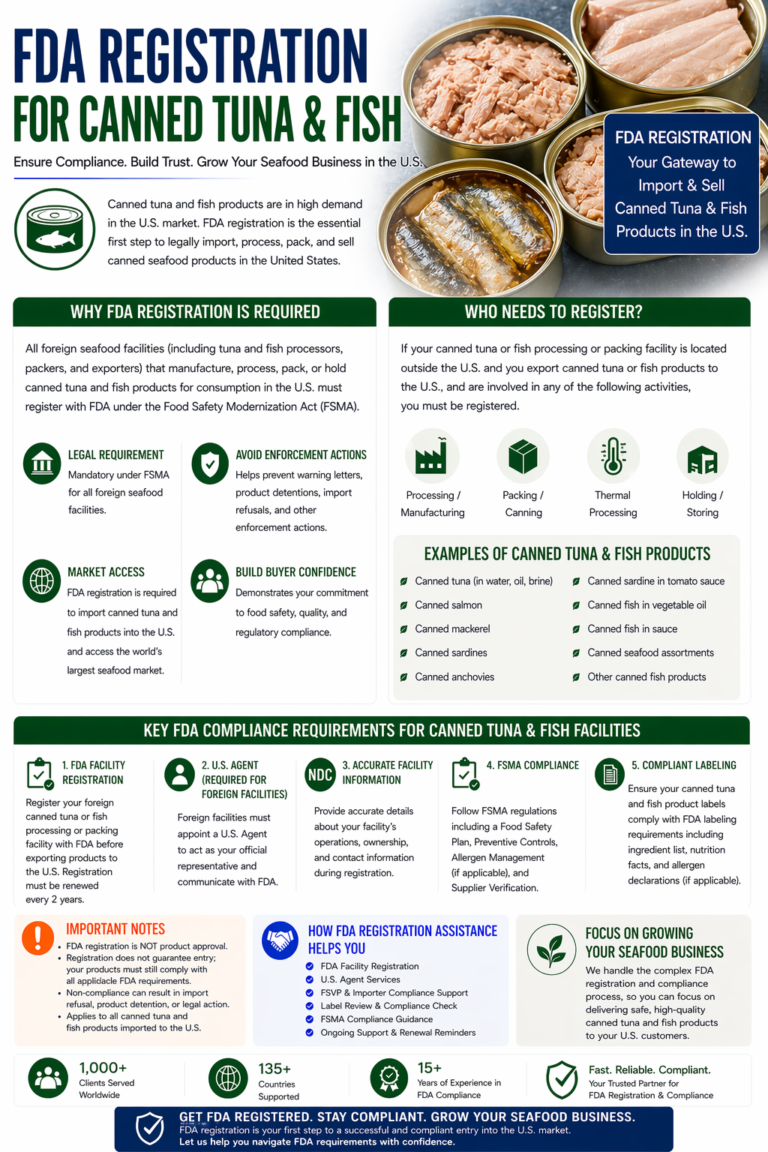
FDA Registration for Canned Tuna & Fish
Three stacked frameworks, the histamine hazard you can't cook out, the standard of identity, and mercury.
Key Takeaways
- Three frameworks stack — Seafood HACCP + LACF (FCE/SID) + standard of identity.
- Seafood HACCP is mandatory — for all fish and fishery products.
- Canned = low-acid canned food — FCE registration + a scheduled process.
- Histamine is the defining hazard — and it's heat-stable, so canning can't remove it.
- Cold chain from catch is the control — you can't "cook out" histamine.
- Mercury is separate — methylmercury action level of 1 ppm; varies by species.
The Three Frameworks That Stack
Canned tuna is unusual in that three separate FDA frameworks all apply to the same can — and missing any one causes serious problems:
| Framework | What it requires | Basis |
|---|---|---|
| Seafood HACCP | A HACCP plan controlling seafood hazards — above all, histamine | 21 CFR 123 |
| Low-acid canned food | FCE registration + a scheduled process (SID) for the thermal process | 21 CFR 113 |
| Standard of identity | Name, species, pack form, and packing medium | 21 CFR 161.190 |
Histamine — the Problem You Can't Cook Out
Tuna is high in the amino acid L-histidine, and when the fish is time/temperature abused after catch, bacteria convert that histidine into histamine (scombrotoxin), the cause of scombroid poisoning. Here's what makes it so serious for canned tuna:
Standard of Identity & Mercury
Labeling & Imports
- Correct standardized name — matching species, pack form, and medium under 161.190
- Full label — ingredient list, Nutrition Facts, net quantity/fill, fish as an allergen, responsible firm
- "Dolphin-safe" — separately regulated (Department of Commerce), not FDA
- FSVP for imports — layers over everything: verify the supplier's Seafood HACCP, FCE/SID, histamine controls, and mercury — one of the more demanding FSVP profiles
Get Your Canned Tuna & Fish U.S.-Ready
FDA Registration Assistance handles the full stack — facility registration and U.S. Agent, FCE and scheduled process (SID) filing with process-authority coordination, guidance on Seafood HACCP and histamine/cold-chain controls, standard-of-identity and labeling review, mercury considerations, and FSVP for imports.
Contact us at info@fdaregistrationassistance.com or call +1 (928) 275-8333. Food Facility Registration is available starting at $858. Trusted by companies across 135+ countries, with 15+ years of experience.
Frequently Asked Questions
1. Do canned tuna and fish products need FDA registration?
Yes — and registration is just the entry point. Any facility that manufactures, processes, packs, or holds canned tuna or fish must be registered with FDA, with a U.S. Agent if foreign and prior notice for each shipment. But canned tuna is one of the most heavily regulated foods, because three separate frameworks stack on top of registration: Seafood HACCP, low-acid canned food process filing, and a standard of identity.
2. What frameworks apply to canned tuna?
Three at once. First, Seafood HACCP (21 CFR Part 123) is mandatory for all fish and fishery products. Second, because canned tuna is a low-acid food in a sealed can that's thermally processed, it's a low-acid canned food (21 CFR Part 113) needing FCE registration and a scheduled process (SID). Third, canned tuna has a standard of identity (21 CFR 161.190) governing its name, pack form, and packing medium. All three apply to the same can.
3. Why does canned tuna need FCE and SID filing?
Because it's a low-acid canned food. Canned tuna is low-acid, sealed in a hermetically sealed container, and made shelf-stable by thermal processing (retort) — which means it must be commercially sterilized to control Clostridium botulinum. So the facility registers as a Food Canning Establishment (FCE) and files a scheduled process (SID) that documents the validated thermal process, established by a process authority. This is on top of the HACCP plan, not instead of it.
4. What is the histamine (scombrotoxin) hazard in tuna?
Histamine is the defining hazard for tuna. Tuna is high in the amino acid L-histidine, and when the fish is time/temperature abused after catch, bacteria convert that histidine into histamine (scombrotoxin), which causes scombroid poisoning. FDA's guidance treats 50 ppm as an indicator of decomposition and 500 ppm as the toxicity action level for canned tuna. Controlling histamine is the central job of a tuna HACCP plan.
5. Can canning or cooking destroy histamine?
No — and this is the critical point. Histamine is heat-stable and survives thermal processing, so retort cooking during canning will not remove it. Once histamine forms, it's there for good. That means the only real control is the cold chain: rapid chilling at catch and tight time/temperature control at every step — harvest vessel, first receiver, processor — before the fish is ever canned. You cannot "cook out" a histamine problem.
6. Are the histamine limits changing?
Possibly. The long-standing FDA levels are 50 ppm (decomposition) and 500 ppm (toxicity) for canned tuna. FDA has proposed, in draft guidance, lowering these to 35 ppm and 200 ppm respectively, to align the U.S. with Codex, the EU, and other countries. As of now this is a proposal, not a finalized change — so the current levels still apply, but processors and importers should watch for finalization and design controls with the tighter limits in mind.
7. What does the canned tuna standard of identity cover?
21 CFR 161.190 defines canned tuna — the eligible tuna species, the pack forms (solid, chunk, flake, and grated), the packing media (such as oil, water, or broth), color designations, and fill of container. So the name and description on the can have real requirements: "solid white albacore in water," for example, has to genuinely be that pack form, species, and medium. Using a pack-form or species term that doesn't match is a labeling violation.
8. Is mercury a concern for canned tuna?
Yes. Tuna contains methylmercury, and FDA has an action level of 1 ppm for methylmercury in fish. Levels vary by species and size — albacore ("white") and bigeye tuna generally run higher than skipjack ("light") tuna — which is also why FDA and EPA issue consumption advice for tuna, especially for young children and people who are pregnant. Mercury is a separate contaminant issue from histamine, and both should be addressed.
9. Does Seafood HACCP replace FCE/SID, or vice versa?
Neither — they work together. Seafood HACCP covers the full range of seafood hazards (histamine, environmental contaminants, etc.) across the process, while the FCE/SID (LACF) requirements specifically govern the thermal process that makes the can commercially sterile and shelf-stable. A canned tuna processor needs both a compliant HACCP plan and proper FCE registration with a filed scheduled process. Missing either one is a serious problem.
10. Do imported canned tuna products need FSVP?
Yes — and most canned tuna is imported. The U.S. importer holds FSVP and must verify the foreign supplier meets U.S. standards, with prior notice before each shipment. For canned tuna, FSVP essentially layers over everything else: the importer should verify the supplier's Seafood HACCP, FCE/SID filings, histamine controls, and mercury, plus correct labeling. It's one of the more demanding FSVP profiles because so many requirements converge.
11. What labeling do canned tuna products need?
The label must use the correct standardized name (matching the species, pack form, and medium under 21 CFR 161.190), an ingredient list, a Nutrition Facts panel, net quantity, fish as an allergen, and the responsible firm. "Dolphin-safe" claims are separately regulated (by the Department of Commerce). Accurate identity and net weight/fill are common problem areas, since they tie directly to the standard of identity.
12. Does registration mean FDA approved my canned tuna?
No. FDA doesn't pre-approve food or facilities — registration, FCE, SID, and HACCP are compliance obligations, not an approval. They put your facility and validated process on record; they don't certify the product. Canned tuna can be registered and still be adulterated (histamine, mercury, or an underprocessed can) or misbranded (wrong pack-form or species name). FDA enforces at import and in the marketplace, and canned tuna is a high-scrutiny category.
13. What are the most common compliance mistakes for canned tuna?
Missing or incorrect FCE/SID filings; weak histamine controls (or assuming canning solves histamine, which it doesn't); no compliant Seafood HACCP plan; pack-form or species labeling that doesn't match the standard of identity; overlooking mercury; and incomplete FSVP for imports. The histamine/cold-chain issue and the FCE/SID stacking are the two that most often cause serious problems.
14. How does FDA Registration Assistance help with canned tuna and fish?
We handle the full stack: facility registration and U.S. Agent, FCE registration and scheduled process (SID) filing with process-authority coordination, guidance on Seafood HACCP and histamine/cold-chain controls, standard-of-identity and labeling review, mercury considerations, and FSVP for imports. Starting at $858 for registration, for companies across 135+ countries. Contact info@fdaregistrationassistance.com or +1 (928) 275-8333.
