FDA Process Filing Requirements for Shelf-Stable Foods
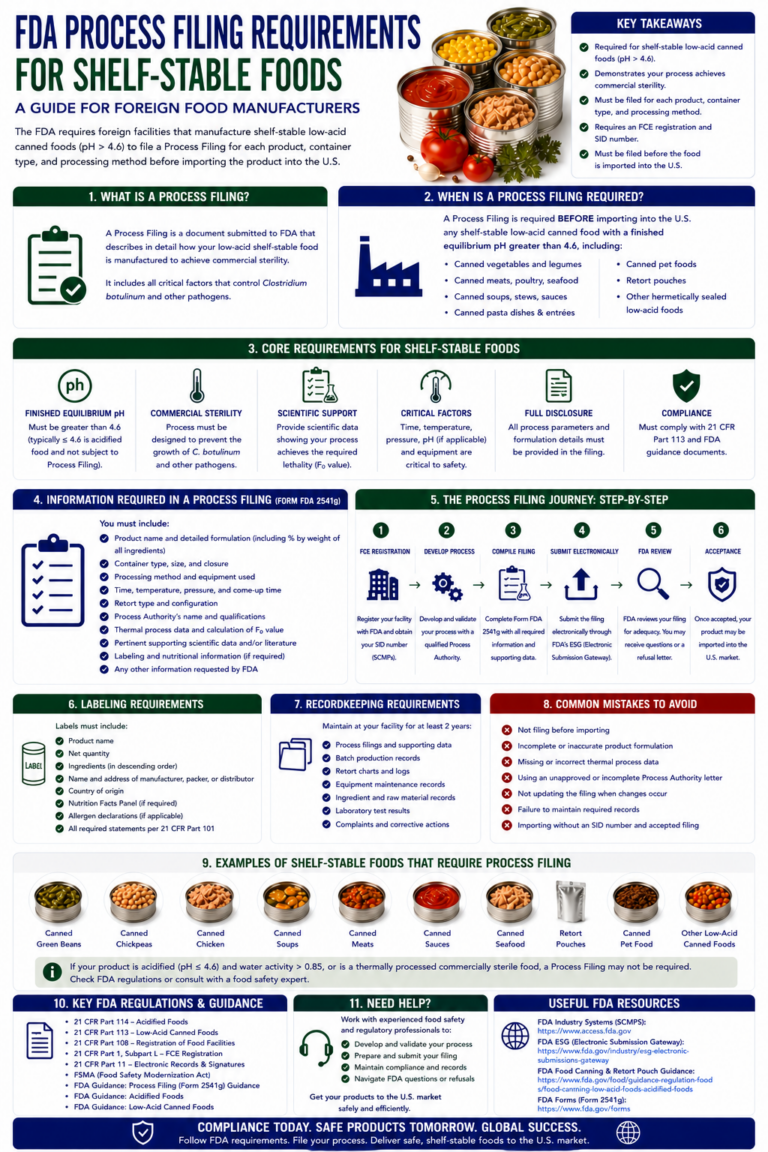
A map of which shelf-stable foods trigger process filing — and which don't.
Key Takeaways
- Shelf-stable ≠ automatically needs filing — the control method decides.
- Heat control (LACF) → filing — Part 113, pH above 4.6.
- Acid control (acidified) → filing — Part 114, pH 4.6 or below.
- Natural acidity, drying, low water activity → generally not — under the LACF/acidified rules.
- "No process filing" ≠ "no requirements" — other food-safety rules can still apply.
- Two numbers frame it all — pH 4.6 and water activity 0.85.
It's the Control Method, Not the Shelf
The word "shelf-stable" describes a result — a product that's safe at room temperature — not a regulatory category. What determines whether you need process filing is how your product reaches that stability and controls the risk of Clostridium botulinum:
Heat → Low-acid canned (LACF)
A low-acid product (finished pH above 4.6) made safe by thermal sterilization. Regulated under Part 113 — requires FCE + SID.
Acid → Acidified
A low-acid base brought to pH 4.6 or below with added acid. Regulated under Part 114 — requires FCE + SID.
If your product's safety rests on either of these, process filing applies. If it rests on something else — natural acidity, low moisture, formulation — you're generally outside this requirement, though not necessarily outside all requirements.
Which Shelf-Stable Foods Need Process Filing
By how the product achieves stability:
| Stability method | Typical products | Process filing? |
|---|---|---|
| Thermal sterilization (LACF) | Canned vegetables, meats, seafood, soups, meals | Yes · Part 113 |
| Acidification (added acid) | Pickles, hot sauces, salsas, relishes | Yes · Part 114 |
| Natural acidity (no added acid) | Many fruit products, some juices | Generally no |
| Low water activity / drying | Dried fruit, many snacks, grains, powders | Generally no* |
| Formulation / water-activity control | Some intermediate-moisture foods | Depends |
| Requires refrigeration | — | Not shelf-stable |
Two Numbers Frame the Whole Question
The low-acid and acidified rules are built around two measurable thresholds on the finished product:
- pH 4.6 — Clostridium botulinum can't grow at or below this. Above it, a food needs another control (heat); at or below it, acidity does the work.
- Water activity 0.85 — below this, there isn't enough available water to support the same growth, which is why low-moisture foods generally sit outside the low-acid box.
A low-acid canned food is above 4.6 pH and above 0.85 water activity, made safe by heat. An acidified food is brought to 4.6 or below with added acid. Move outside those conditions — naturally acidic, or low water activity — and you're generally outside the filing requirement. That's why the determination rests on your actual finished-product data.
Don't Guess the Classification
A process authority evaluates your finished pH, water activity, and process, and confirms which category — if any — applies. That determination is the foundation everything else rests on.
Find Out If Your Product Needs Filing
FDA Registration Assistance starts by confirming whether your shelf-stable product actually needs process filing — based on its pH, water activity, and control method — then, if it does, handles Food Facility Registration and U.S. Agent, FCE and the correct scheduled process (SID), and process-authority coordination.
Contact us at info@fdaregistrationassistance.com or call +1 (928) 275-8333. Food Facility Registration is available starting at $858. Trusted by companies across 135+ countries, with 15+ years of experience.
Frequently Asked Questions
1. Do all shelf-stable foods require FDA process filing?
No. Process filing — FCE registration and a scheduled process (SID) — is required specifically for low-acid canned foods and acidified foods, not for every shelf-stable product. What triggers filing is how the food controls safety: heat for low-acid canned foods, added acid for acidified foods. Shelf-stable foods kept safe by natural acidity, low water activity, or formulation generally fall outside that mandatory path.
2. What actually triggers process filing?
The safety-control mechanism, not shelf-stability itself. A low-acid product (finished pH above 4.6) made safe by thermal sterilization is a low-acid canned food under Part 113 and needs filing. A low-acid product brought to pH 4.6 or below with added acid is an acidified food under Part 114 and needs filing. Being shelf-stable is a result; the control method is what decides the requirement.
3. Does a dried or low-moisture shelf-stable food need process filing?
Generally not under the low-acid or acidified rules. A food kept safe by low water activity — below the threshold that defines low-acid canned foods — typically falls outside that FCE/SID path. That said, other food-safety requirements can still apply (for example, validated controls for certain products), so "no process filing" isn't the same as "no requirements." A process authority can confirm.
4. Does a naturally acidic shelf-stable food need filing?
Generally no. A food that's naturally at pH 4.6 or below with no acid added is an acid food, not an acidified food, and typically doesn't require FCE or SID. The distinction is whether acid was added to a low-acid base — if it wasn't, the acidified rules generally don't apply. It's a common source of over- or under-filing.
5. What about foods controlled by formulation or water activity?
This is the gray area. Some products are kept safe by a combination of formulation and water activity rather than heat or added acid, and a scheduled process form exists for water-activity or formulation control. Whether one applies depends on the specific product, which is exactly the kind of borderline case a process authority should evaluate rather than guessing.
6. What are the two thresholds that define the filing requirement?
A finished equilibrium pH of 4.6 and a water activity of 0.85. Low-acid canned foods are above 4.6 pH and above 0.85 water activity, made safe by heat. Acidified foods are brought to 4.6 or below with added acid. Foods below the water-activity threshold, or naturally acidic, generally sit outside the low-acid/acidified box — so those two numbers frame the whole question.
7. If filing is required, what does it involve?
Food Facility Registration, an FCE (Form 2541, one per plant), a scheduled process (SID) per product validated by a process authority, a U.S. Agent for foreign facilities, a compliant label matching the filed process, FSVP held by the U.S. importer, and prior notice before arrival. Classification decides whether this applies; if it does, this is the package.
8. Why does shelf-stable packaging get so much scrutiny?
Because a sealed, room-temperature product that isn't properly processed can support Clostridium botulinum, which is why low-acid canned and acidified foods carry validated-process requirements. The scrutiny isn't about the packaging itself but about ensuring the process reliably controls that risk — which is what the scheduled process and process-authority validation confirm.
9. Do imported shelf-stable foods that need filing also need FSVP?
Yes. For imported low-acid canned or acidified foods, the U.S. importer holds FSVP and uses the supplier's FCE, SID, and process documentation as verification evidence. The foreign manufacturer files the FCE and SID; the importer verifies and maintains FSVP records. Both sit on top of the process filing.
10. How do I know for sure whether my product needs filing?
By determining your finished equilibrium pH and water activity and how the product achieves safety, then confirming the classification with a process authority. Because the boundary between categories — and the gray areas like formulation control — is technical, the classification call is best made on the actual product data rather than assumed from the product type.
11. Can I complete filings after shipping if it turns out I needed them?
In most cases, no. If a product required an FCE and scheduled process and they weren't in place, the shipment can be detained or refused, and the filings can't be back-dated. That's why confirming whether filing applies — before you ship, and ideally before you print packaging — matters so much for shelf-stable products.
12. Does process filing mean FDA approved my shelf-stable food?
No. FCE registration and the scheduled process filing are compliance steps, not an FDA approval or endorsement. FDA doesn't pre-approve foods; the filings put your facility and validated process on record. The product still has to meet all applicable requirements, including labeling, at import.
13. How long does process filing take for a shelf-stable food?
There's no single fixed number — it depends on the product and how ready your information is. The FCE and SID submissions are relatively quick; the process-authority validation behind each scheduled process is usually the longest part. Starting the validation early, once classification is confirmed, is the practical approach.
14. How does FDA Registration Assistance help with shelf-stable process filing?
We start by confirming whether your shelf-stable product actually needs process filing, based on its pH, water activity, and control method — then, if it does, handle Food Facility Registration and U.S. Agent, FCE and the correct scheduled process (SID), and process-authority coordination. Starting at $858 for registration, for companies across 135+ countries. Contact info@fdaregistrationassistance.com or +1 (928) 275-8333.