
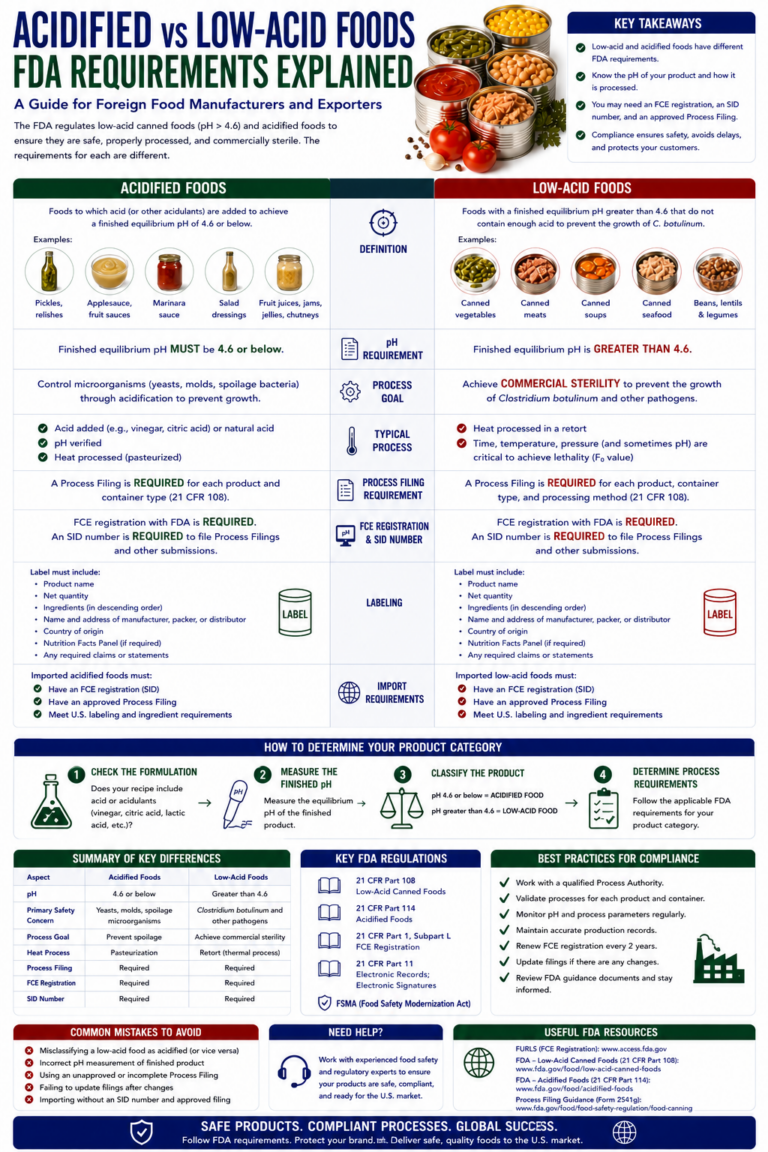
Acidified vs Low-Acid Foods: Export Requirements
The two categories side by side — and the third one people miss.
Key Takeaways
- Low-acid = heat is the control — pH above 4.6, Part 113.
- Acidified = acid is the control — low-acid base + acid to pH ≤ 4.6, Part 114.
- Naturally acidic ≠ acidified — low pH with no added acid needs no FCE/SID.
- Both need FCE + SID — same FCE form, different scheduled process form.
- Classification is by finished equilibrium pH — confirmed by a process authority.
- Misclassification is the top cause of holds — get it right before you file.
Low-Acid vs Acidified, Compared
The two regulated canned categories, line by line:
| Low-acid canned (LACF) | Acidified | |
|---|---|---|
| Finished pH | Above 4.6 | 4.6 or below (with added acid) |
| Water activity | Above 0.85 | Above 0.85 |
| Safety control | Thermal sterilization (heat) | Acidification (acid) |
| Base product | Low-acid | Low-acid, then acid added |
| CFR part | Part 113 | Part 114 |
| FCE form | 2541 | 2541 |
| Scheduled process form | 2541d retorted · 2541g aseptic | 2541e acidified method |
| Process authority validates | The thermal process | The acidification & pH control |
| Typical products | Canned vegetables, meats, seafood, soups, meals | Pickles, hot sauces, salsas, relishes |
Naturally Acidic Is Not Acidified
This is the mix-up that catches people out. A low pH alone doesn't make a food "acidified." The word means something specific:
The trap is reading "pH ≤ 4.6 = acidified." It isn't — what matters is whether acid was added to a low-acid base. If you're not sure which bucket a borderline product lands in, that's exactly the call a process authority makes. See do acidified foods require process filing for the boundary in detail.
What Both Categories Require
Once your product is a LACF or an acidified food, the compliance package is the same shape — only the process form and the validation focus differ:
- Food Facility Registration — active and accurate
- An FCE — Form 2541, one per physical plant
- A scheduled process (SID) — per product, on the form for your category
- Process-authority validation — of the heat process or the acidification
- A U.S. Agent — for foreign facilities
- A compliant label — matching your formulation and filed process
- FSVP & prior notice — importer holds FSVP; prior notice before arrival
Classifying Accurately
Classification uses the finished equilibrium pH — the stable pH of the whole product after it settles, not the pH of one ingredient. A few things that trip businesses up:
Because the call is technical and the consequences are real, a process authority should confirm classification before you file.
Confirm Your Classification, Then Comply
FDA Registration Assistance evaluates your formulation and finished pH to confirm whether your product is low-acid or acidified, then handles what follows: Food Facility Registration and U.S. Agent, FCE and the correct scheduled process (SID), and process-authority coordination for validation.
Contact us at info@fdaregistrationassistance.com or call +1 (928) 275-8333. Food Facility Registration is available starting at $858. Trusted by companies across 135+ countries, with 15+ years of experience.
Frequently Asked Questions
1. What is the main difference between acidified and low-acid foods?
The safety control. A low-acid canned food has a finished pH above 4.6 and relies on thermal sterilization for safety, under 21 CFR Part 113. An acidified food starts low-acid and has acid added to bring it to pH 4.6 or below, relying on that acidity, under Part 114. Same idea — shelf-stable canned food — but a different mechanism, a different rulebook, and a different scheduled process form.
2. Do both categories require FCE and SID filings?
Yes. Both low-acid canned foods and acidified foods require FCE registration (Form 2541, one per plant) and a scheduled process (SID) filed per product, validated by a process authority. The FCE form is the same; the scheduled process form differs by category — the low-acid forms for LACF, the acidified-method form for acidified.
3. Which scheduled process form applies to each?
Low-acid canned foods use the low-acid forms — Form 2541d for retorted products and 2541g for aseptically processed ones. Acidified foods use Form 2541e, the acidified-method form. There's also 2541f for products controlled by water activity or formulation. You file the form that matches how your product achieves safety, for each product and container.
4. Is a naturally acidic food the same as an acidified food?
No — and this is a common and costly mix-up. An acidified food is a low-acid product with acid added to reach pH 4.6 or below. A naturally acidic food is already at pH 4.6 or below on its own, with no acid added — like many fruit products. Naturally acidic foods are acid foods, not acidified foods, and generally don't require FCE or SID. Low pH alone doesn't make a food acidified.
5. Why is pH the deciding factor?
Because pH determines whether Clostridium botulinum can grow. Above pH 4.6, a low-acid food needs heat to be safe; at or below 4.6, acidity controls the risk. The classification uses the finished equilibrium pH — the stable pH of the whole product after it settles — so accurate pH testing on the finished product is essential.
6. Can a product be both acidified and low-acid?
No. A product is classified by its finished equilibrium pH into one category. What can happen is that a low-acid product is deliberately acidified to become an acidified food — but once finished, it's one or the other, not both. The starting point being low-acid is exactly why acidified foods get their own rules.
7. Do I need a process authority for both categories?
Yes. A process authority validates the process for both — the thermal process for a low-acid canned food, the acidification and pH control for an acidified food — and provides the documentation your scheduled process depends on. FDA doesn't "approve" the process; the process authority establishes and validates it. It's typically the longest-lead step for either category.
8. What happens if my product is misclassified?
Misclassification leads to the wrong filings — or missing ones — which can hold, delay, or cause refusal of a shipment. Treating a low-acid food as acidified, or a naturally acidic food as acidified, sends you down the wrong compliance path from the start. It's the leading cause of avoidable problems in this area, which is why classification is confirmed by a process authority.
9. Do imported products meet the same rules?
Yes. Imported low-acid and acidified foods meet the same FDA requirements as domestic ones — there's no separate, lighter standard for imports. Foreign facilities additionally need a U.S. Agent, and the U.S. importer holds FSVP. The classification and the FCE/SID requirements apply regardless of where the product is made.
10. What else is required beyond classification?
For either category: active Food Facility Registration, an FCE, a scheduled process (SID) per product validated by a process authority, a U.S. Agent for foreign facilities, a compliant label that matches the filed process, FSVP held by the U.S. importer, and prior notice before arrival. Classification decides which rules and forms apply; these requirements sit on top for both.
11. Do both categories require FSVP?
Yes. For both low-acid and acidified imported foods, the U.S. importer — the owner or consignee at entry — holds FSVP. The foreign manufacturer supports it by supplying registration, FCE, SID, and process documentation, but the FSVP obligation itself sits with the importer for either category.
12. Can I fix a classification issue after shipping?
In most cases, no. Classification, FCE, SID, and labeling have to be right before export, and they can't be back-dated to rescue a shipment already in transit or at the port. Getting the classification right up front — before you file or print packaging — is the whole point, because it drives everything downstream.
13. Does registration or filing mean FDA approved my product?
No. FCE registration and the scheduled process filing are compliance steps, not an FDA approval or endorsement, for either category. FDA doesn't pre-approve foods or labels; the filings put your facility and validated process on record. The product still has to meet all applicable requirements at import.
14. How does FDA Registration Assistance help with classification and compliance?
We evaluate your formulation and finished pH to confirm classification, then handle the compliance that follows: Food Facility Registration and U.S. Agent, FCE and the correct scheduled process (SID) for your category, and process-authority coordination for validation. Starting at $858 for registration, for companies across 135+ countries. Contact info@fdaregistrationassistance.com or +1 (928) 275-8333.