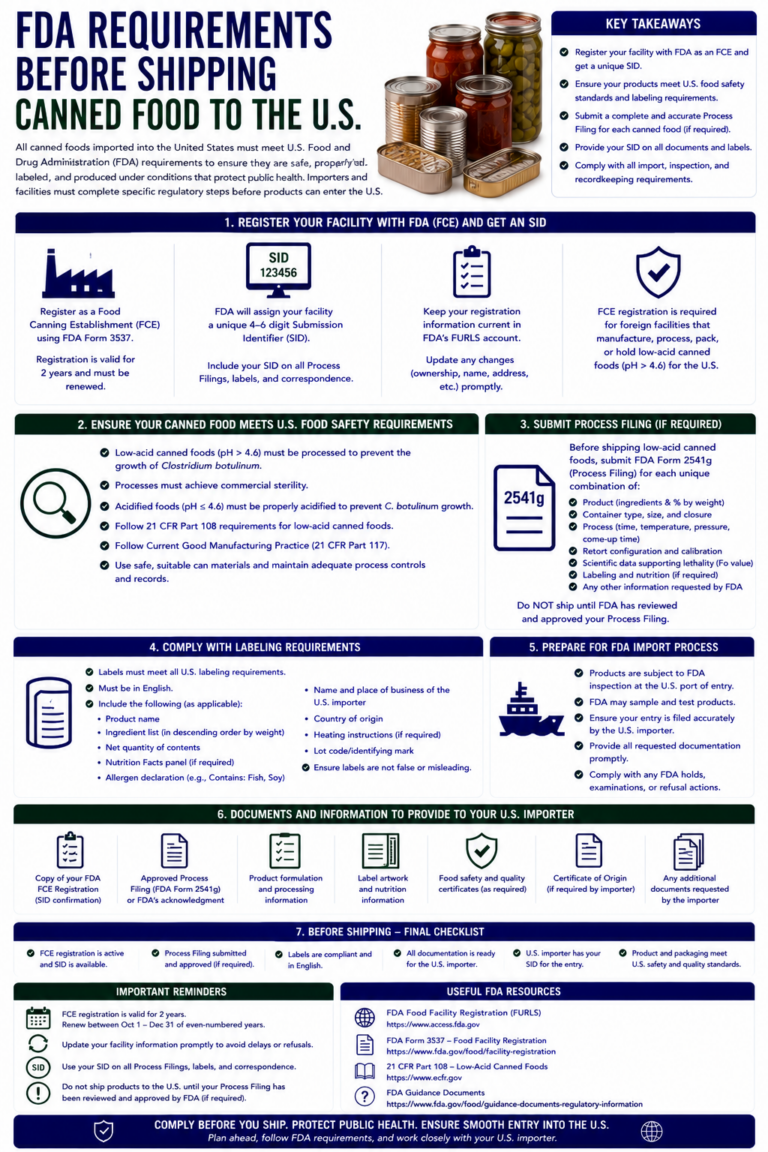
FDA Requirements Before Shipping Canned Food to the U.S.
Trusted by 1,000+ companies across 135+ countries, with 15+ years of FDA regulatory experience. Below: the full checklist at a glance, the one-time setup, the per-shipment steps, and what you can't fix after shipping.
The Pre-Shipment Checklist
Every requirement, when it's due, and who owns it. Low-acid and acidified canned foods need all of it; simpler shelf-stable products may not need FCE/SID, but still need the rest.
| Requirement | When | Who |
|---|---|---|
| Food facility registration (+ DUNS) | Before first shipment; renew every 2 years | Foreign facility |
| U.S. Agent | Before first shipment | Foreign facility |
| FCE registration | Before any process filing | Foreign facility |
| Process authority validation | Before SID filing | Facility + process authority |
| SID process filing | Before first shipment | Foreign facility |
| FDA-compliant labeling | Before shipping | Facility / brand |
| FSVP | Maintained; confirmed per shipment | U.S. importer |
| Prior Notice | Before each shipment arrives | Importer / broker |
One-Time Setup — Before Your First Shipment
Per-Shipment — Before Each One Arrives
Prior Notice
Filed before each shipment arrives at the U.S. port — usually by the importer or broker. Errors can mean immediate refusal.
FSVP Confirmation
Your importer's FSVP must be in place; you confirm it and provide the supporting documentation.
Matching Documents
Invoice, bill of lading, packing list, and specifications consistent with your filings and labels.
Current Registrations
Confirm facility registration is active and process filings still match the product you're shipping.
What You Can't Fix After Shipping
Get Ship-Ready Before Your Canned Food Leaves
Send us your products, formulation, processing method, and container sizes. We'll confirm classification, complete facility registration and U.S. Agent service, handle FCE and SID filings, coordinate a process authority, support FSVP, and review your labels — so everything is in place before you ship. Email info@fdaregistrationassistance.com or call +1 (928) 275-8333.
Frequently Asked Questions — Before Shipping Canned Food to the U.S.
What FDA requirements must be completed before shipping canned food to the U.S.?
Before shipping you generally need food facility registration (with a U.S. Agent and DUNS), and for low-acid or acidified foods, FCE registration and a SID process filing validated by a process authority, plus compliant labeling. Per shipment, FSVP must be confirmed and Prior Notice filed.
Why must FDA compliance be done before shipping, not after?
The FDA verifies compliance when your shipment arrives. Several requirements — especially process filings and Prior Notice — can't be created retroactively for goods already in transit, so a gap means a hold or refusal.
Can I fix FDA issues after my shipment has left?
Usually not in time. Process filings can't be backdated, Prior Notice must precede arrival, and labels must already match the filed process — corrections typically mean delay, detention, or refusal.
Do all canned foods need FCE and SID before shipping?
Not all, but most shelf-stable canned foods do, because they're low-acid or acidified — see which foods require FCE/SID. If your product is low-acid or acidified and shelf-stable, FCE registration and a SID filing are required before shipping.
What's the very first step?
Product classification — is it a low-acid canned food, an acidified food, or neither? That determines whether FCE/SID and a process authority are needed, and which process-filing form applies.
Do foreign canned food facilities need to register?
Yes. Every facility that manufactures, processes, packs, or holds food for the U.S. must register (renewing biennially), and foreign facilities must designate a U.S. Agent.
What is FCE registration and when is it due?
FCE (Food Canning Establishment) registration, on Form FDA 2541, must be completed before you can submit any process (SID) filing — so it's an early, one-time setup step.
What is a SID and when must it be filed?
A SID is the Submission Identifier for your scheduled-process filing. It must be on file before you ship the product, for each product, method, and container size.
Do I need a process authority before shipping?
Yes. A process authority validates the scheduled process behind your SID filing. Without that validation, your filing isn't complete and your shipment is at risk of being held.
When does labeling need to be finalized?
Before shipping. Your label must already be FDA-compliant and match the filed process and formulation — see fixing a food label before import. A mismatch is a common cause of holds.
Who handles FSVP, and when?
The U.S. importer maintains the Foreign Supplier Verification Program and must have it in place. You confirm it's assigned and supply supporting documentation for each shipment.
When is Prior Notice submitted?
Before each shipment arrives at the U.S. port — it's a per-shipment step, usually handled by the importer or customs broker, and errors can cause immediate refusal.
Is a DUNS Number needed before shipping?
Yes. The DUNS Number is the required Unique Facility Identifier for food facility registration, so it must be obtained as part of your setup, before you register and ship.
Does FDA registration mean my canned food is approved?
No. The FDA does not approve foods. Registration and process filing are mandatory requirements, but they are separate from any notion of FDA “approval.”
How far ahead should I start?
Start the one-time setup — classification, registration, FCE, process authority, SID, and labeling — well before your first shipment. Some steps, like process-authority validation, take time to complete properly.
What documents should match before shipping?
Your label, SID filing, and formulation must align, and shipping documents (invoice, bill of lading, packing list, specifications) should be consistent with them. Mismatches trigger questions at entry.
What are the most common reasons canned food shipments are refused?
Missing FCE or SID, a misclassified product, no process-authority validation, a label that doesn't match the filing, unconfirmed FSVP, and Prior Notice errors — nearly all preventable before shipping.
Does each product and can size need its own SID?
Generally yes. Because processing depends on the product and the container size, each typically needs its own scheduled-process filing on file before shipping.
How long does it take to get ship-ready?
Food facility registration is often a few business days, but FCE/SID and process-authority validation can take longer depending on your product range — so plan the setup with margin before your ship date.
Do I need to renew anything?
Food facility registration renews biennially — every two years — and process filings must be updated whenever a product, process, or container changes. Keep both current to stay ship-ready.
What if my product is refrigerated, not shelf-stable?
Refrigerated and frozen foods are generally outside the low-acid canned food rules, so they may not need FCE/SID — but they still need facility registration, labeling, FSVP, and Prior Notice.
Can you confirm whether my canned food needs process filing?
Yes. We review the formulation, pH, water activity, and packaging — or coordinate a process authority — to confirm classification before you commit to a ship date.
Can one firm handle the whole pre-shipment process?
Yes. We complete facility registration and U.S. Agent service, FCE and SID filings, coordinate a process authority, support FSVP, and review labeling so everything is ready before you ship.
What should I send you to get started?
Your products, their formulation and processing method, container sizes, facility details, and intended U.S. importer. From there we map the pre-shipment checklist and begin the filings.
How do I make sure I'm ready before shipping?
Work through the one-time setup and per-shipment steps in order, well before your ship date. Contact our team and we'll confirm your classification, complete the filings, and get you ship-ready. Email info@fdaregistrationassistance.com or call +1 (928) 275-8333.