
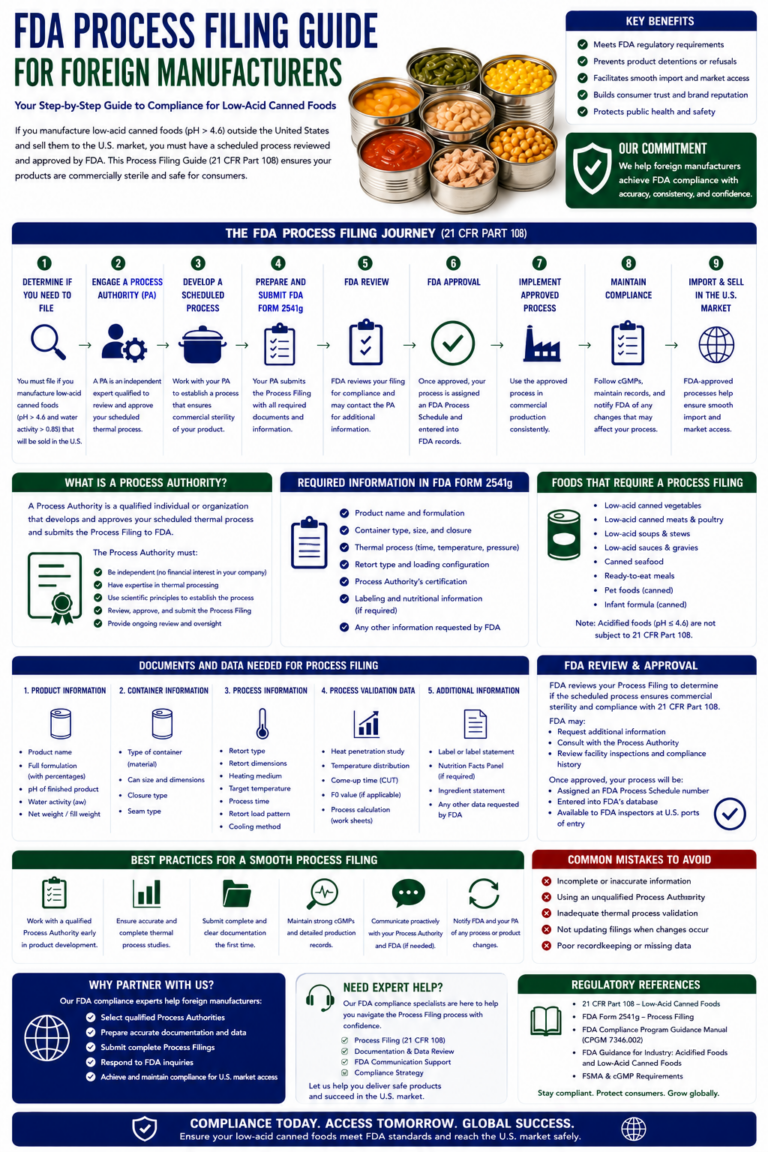
FDA Process Filing Guide for Foreign Manufacturers
Trusted by 1,000+ companies across 135+ countries, with 15+ years of FDA regulatory experience. Below: the four process-filing methods, the step-by-step workflow, and what foreign manufacturers need alongside it.
What Process Filing Is — and Who Must Do It
A scheduled process is the validated combination of controls — time, temperature, pressure, acidity, or water activity — that makes a shelf-stable food safe in its container. Process filing is submitting that scheduled process to the FDA, where it receives a Submission Identifier (SID). It's required for any commercial processor of low-acid or acidified shelf-stable foods — foreign manufacturers included.
The Four Process-Filing Methods
The FDA uses a different process-filing form for each safety method. A process authority confirms which one fits your product.
| Form | Method | Use it for |
|---|---|---|
| FDA 2541d | Low-Acid Retorted | Heat-processed low-acid canned foods — vegetables, meats, seafood, soups |
| FDA 2541e | Acidified | Acidified foods — pickles, salsas, acidified peppers |
| FDA 2541f | Water Activity / Formulation | Low-acid foods made safe by water activity or formulation rather than heat |
| FDA 2541g | Low-Acid Aseptic | Aseptically processed and packaged low-acid foods |
All four sit on top of FCE registration (Form FDA 2541), which must be completed first.
Process Filing Step by Step
What You Need Alongside Process Filing
Process filing doesn't stand alone. As a foreign manufacturer, four more pieces have to be in place for your food to clear U.S. entry.
Facility Registration
Food facility registration under 21 CFR Part 1 Subpart H, renewed biennially — the baseline for all food exporters.
U.S. Agent
Required for every foreign facility (21 CFR 1.227) as the FDA's U.S. point of contact.
FSVP (Importer)
Your U.S. importer verifies your facility and keeps records — you supply the documentation that supports it.
Prior Notice
Filed before every shipment arrives in the U.S., in addition to your process filings.
File Your Scheduled Processes the Right Way
Send us your products, processing methods, and container sizes. We'll classify each product, coordinate a process authority, complete FCE registration and the SID filings on the correct forms, and handle your U.S. Agent and import coordination — so your shelf-stable foods clear the FDA. Email info@fdaregistrationassistance.com or call +1 (928) 275-8333.
Frequently Asked Questions — FDA Process Filing for Foreign Manufacturers
What is FDA process filing?
Process filing is submitting your scheduled process to the FDA for a low-acid or acidified food — documenting exactly how each product and container is processed to be safe and shelf-stable. Each filing receives a Submission Identifier (SID).
Who must do process filing?
Any commercial processor of low-acid canned foods or acidified foods packaged in hermetically sealed, shelf-stable containers — including foreign manufacturers exporting those foods to the U.S.
Do foreign manufacturers really need to file with the FDA?
Yes. A foreign facility making low-acid or acidified shelf-stable foods for the U.S. market must complete FCE registration and process (SID) filings, just like a domestic one — and also appoint a U.S. Agent.
What's the difference between FCE registration and process filing?
FCE registration (Form FDA 2541) registers your establishment; process filing (Forms 2541d/e/f/g) documents the scheduled process for each product. You need the FCE number first — see what foods require FCE/SID filing.
What is a SID?
A Submission Identifier — the number assigned to each scheduled-process filing for a specific product, method, and container size. See our SID number explainer.
Which process-filing form do I use?
It depends on the method: Form 2541d for retorted low-acid foods, 2541e for acidified foods, 2541f for water-activity or formulation control, and 2541g for low-acid aseptic systems.
What is a scheduled process?
The specific, validated combination of time, temperature, pressure, acidity, water activity, or other controls that makes a given product safe in its container. A process authority establishes it.
What is a process authority?
A qualified person or organization with the expertise to establish and validate the scheduled process. Their determination is the basis for your SID filing, and the FDA expects one to be involved.
Do I need a U.S. Agent as a foreign manufacturer?
Yes. Every foreign facility that registers with the FDA must designate a U.S. Agent under 21 CFR 1.227 as its U.S. contact. This is separate from process filing but required alongside it.
Is process filing the same as FDA approval?
No. The FDA does not approve the food. Process filing is a mandatory submission documenting your validated process, but it is separate from any notion of FDA approval.
How many process filings do I need?
Generally one per product, processing method, and container size. A manufacturer with several products or can sizes needs multiple SID filings.
Does container size matter?
Yes. Because thermal processing depends on container geometry, each container size usually requires its own scheduled process and filing.
What records must I keep?
Your scheduled-process documentation, process-authority determinations, production and processing records, and your filings — all available to the FDA on request.
Do supervisors need training?
Yes. Supervisors of low-acid and acidified processing generally must complete Better Process Control School as part of the 21 CFR Part 113 and Part 114 requirements.
What happens if I skip process filing?
Your shelf-stable low-acid or acidified shipments can be detained or refused at the port. Missing or incorrect process filings are among the most common causes of holds.
Can I file a process without an FCE number?
No. FCE registration (Form FDA 2541) must be completed first — the FCE number is required on every process filing, so the establishment is always registered before any scheduled process is submitted.
What's the difference between low-acid and acidified for filing?
Low-acid foods (pH above 4.6) rely on thermal processing and file on Form 2541d (or 2541f/2541g by method). Acidified foods (acid added to pH 4.6 or below) file on Form 2541e.
Does FSVP apply too?
FSVP is the U.S. importer's responsibility, separate from your process filing — see FSVP. As the foreign manufacturer, you'll often need to provide documentation supporting it.
Is Prior Notice required for these foods?
Yes. Every food shipment to the U.S. requires FDA Prior Notice before it arrives at the port of entry, in addition to your process filings — it is a separate, per-shipment submission.
How long does process filing take?
It depends on how many products, methods, and container sizes you have, and on obtaining the process authority's determinations. We prioritize urgent situations such as a scheduled inspection or a held shipment.
Do filings expire?
They don't expire on a fixed schedule, but they must be updated whenever you change the product, process, or container. Food facility registration separately renews biennially.
Can you act as our process filer and U.S. Agent?
Yes. We complete FCE registration and SID filings, coordinate a process authority, and can serve as your U.S. Agent and support FSVP — one coordinated process from a single firm.
What foods does this apply to?
Canned vegetables, meats, seafood, soups, beans, coconut milk, and other low-acid canned foods, plus acidified foods like pickles and salsas — see, for example, exporting canned vegetables.
What if my product is near pH 4.6?
That is exactly when a process authority's evaluation matters — products near the line may be acidified foods, and the classification determines which form and controls apply.
How do I get started with process filing?
Send us your products, processing methods, and container sizes. Contact our team and we'll classify each product, coordinate a process authority, complete FCE registration and the SID filings, and handle the U.S. Agent and import pieces. Email info@fdaregistrationassistance.com or call +1 (928) 275-8333.