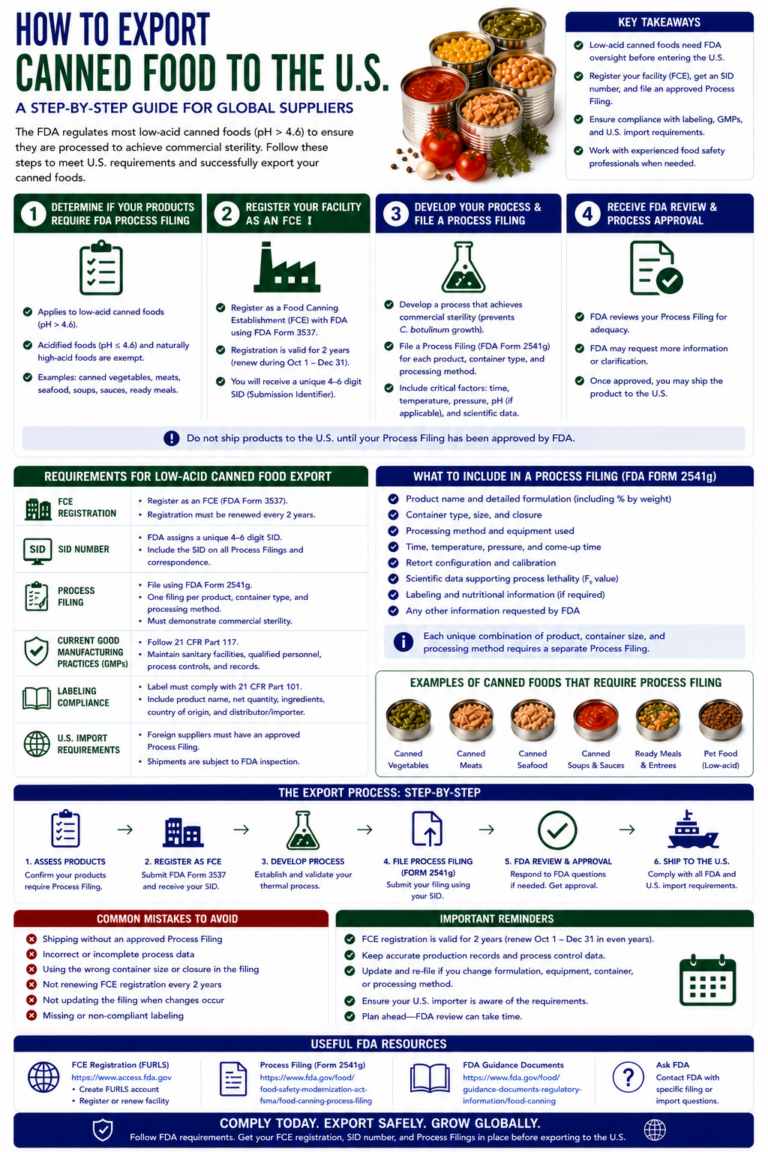
How to Export Canned Food to the U.S.
Your roadmap for the whole path — and the deep guide for each phase.
Key Takeaways
- Classification comes first — LACF or acidified decides your whole path.
- FCE + SID apply to LACF and acidified — not naturally acidic foods.
- The manufacturer files — not the importer, who relies on the filings.
- A process authority validates the process — usually the long pole.
- Foreign facilities need a U.S. Agent — appointed in your registration.
- Everything before you ship — filings can't be fixed at the port.
The Five Phases, End to End
Here's the whole journey at a glance — each phase links to its detailed guide:
Classify your product
Determine whether your canned food is low-acid (LACF), acidified, or naturally acidic — this decides whether the FCE/SID path applies and which forms you'll use. A process authority should confirm it.
Which type is mine? ↓Register & file
Complete Food Facility Registration, obtain your FCE, and file a scheduled process (SID) for each product. Foreign manufacturers file these — not the importer — and appoint a U.S. Agent.
Register a canning facility →Validate the process
A process authority establishes and validates the scheduled process behind each SID — the heat process for LACF, the pH control for acidified. This is usually the longest-lead step, so start it early.
How process filing works →Make the label compliant
Your label has to meet FDA requirements and match your formulation and the process on file. A label that doesn't align with your SID can hold a shipment on its own.
Labeling for export →Complete the import chain & ship
Your U.S. importer holds FSVP; prior notice is filed before arrival, usually by the broker. With filings, validation, label, and import chain in place, you're ready to ship.
Prepare the shipment →Which Type of Canned Food Do You Have?
This is the decision everything else hangs on. The two regulated categories follow different rules and different forms — pick yours to go deep:
Low-acid canned (LACF)
- Finished pH above 4.6
- Canned vegetables, meats, seafood, meals
- Thermal process under Part 113
Acidified
- Low-acid base + added acid → pH ≤ 4.6
- Pickles, hot sauces, salsas, relishes
- Acidification under Part 114
Guides for Each Part of the Path
FCE & SID for foreign manufacturers
Who files, and which form applies.
Filing responsibility →The importer's side
What your U.S. buyer verifies.
Importer & FSVP →Pre-export checklist
Confirm everything before you ship.
Run the checklist →First-time exporter
The risks and timeline up front.
First-timer guide →If the filing is wrong
What goes wrong, and how to fix it.
Filing errors →U.S. Agent
Required for every foreign facility.
U.S. Agent →The Mistakes That Cause Holds
Export Your Canned Food Compliantly
FDA Registration Assistance handles the full canned-food path: confirming classification, Food Facility Registration and U.S. Agent, FCE and scheduled process (SID) filing, process-authority coordination, and label review — so your product is compliant before it ships.
Contact us at info@fdaregistrationassistance.com or call +1 (928) 275-8333. Food Facility Registration is available starting at $858. Trusted by companies across 135+ countries, with 15+ years of experience.
Frequently Asked Questions
1. What does it take to export canned food to the U.S.?
Five phases: classify your product as low-acid canned (LACF) or acidified, register your facility and obtain an FCE, file a scheduled process (SID) for each product validated by a process authority, make your label compliant, and complete the import chain — FSVP held by your U.S. importer and prior notice before arrival. Foreign facilities also need a U.S. Agent. Classification comes first because it determines everything after it.
2. Do all canned foods need FCE and SID filings?
No — only low-acid canned foods (finished pH above 4.6) and acidified foods (low-acid base brought to pH 4.6 or below with added acid) require FCE registration and scheduled process filings. A naturally acidic canned food generally doesn't. That's why classification is the first phase: it decides whether the FCE/SID path applies to you at all.
3. How do I know if my product is low-acid or acidified?
A low-acid canned food has a natural finished pH above 4.6 — canned vegetables, meats, seafood, prepared meals — and relies on heat for safety. An acidified food starts low-acid and has acid added to reach pH 4.6 or below — pickles, hot sauces, salsas — relying on acidity. A process authority should confirm the classification, since it drives which rules and forms apply.
4. What is an FCE and why do I need one?
FCE stands for Food Canning Establishment. It registers a physical plant that produces low-acid or acidified canned foods, and it's required before you can file a scheduled process. There's one FCE per plant, and it has to be in place before any SID can be filed against it.
5. Who files the FCE and SID?
The manufacturer, or an authorized FDA agent acting for it — not the U.S. importer, distributor, or broker. The importer relies on your FCE and SID for their own FSVP, but the filings themselves are the manufacturer's responsibility. This trips up exporters who assume their buyer handles it.
6. Do foreign facilities need a U.S. Agent?
Yes. Every foreign facility that registers with FDA must designate a U.S. Agent as FDA's U.S.-based point of contact. The agent role is a contact function, distinct from the party that files your FCE and SID, though one provider often handles both. It's designated as part of your Food Facility Registration.
7. What role does a process authority play?
A process authority validates your process — determining the safe parameters and providing the documentation your scheduled process depends on. FDA doesn't "approve" your process; the process authority establishes and validates it, and that validation is what a SID rests on. It's typically the longest-lead part of the whole path.
8. Does the label matter as much as the filings?
Yes. Your label has to meet FDA requirements and match your formulation and the process on file. A label that's inconsistent with your SID can hold a shipment even when the FCE and SID are valid, so labeling isn't a formality tacked on at the end — it's part of the compliance package.
9. Who holds FSVP — me or my importer?
Your U.S. importer — the owner or consignee at entry — holds FSVP, not you as the foreign exporter. You support it by supplying your registration, FCE, SID, and process documentation. The obligation itself sits with the importer bringing the product into the U.S.
10. What is prior notice?
Prior notice is an FDA submission that has to be filed before an imported food shipment arrives, identifying the product, shipper, and importer. It's usually filed by the customs broker or importer through the customs system, and missing it can lead to refusal at the port.
11. Can I fix compliance problems after shipping?
In most cases, no. FCE, SID, prior notice, and labeling have to be right before export, and they can't be back-dated to rescue a shipment already in transit or at the port. That's why planning the whole path before you ship is the single most important thing you can do.
12. How long does the whole process take?
There's no single fixed number — it depends on your product, your facility, and how ready your information is. Food Facility Registration and the FCE and SID submissions are relatively quick; the process-authority validation behind each scheduled process is usually the long pole. The practical advice is to start validation early rather than treat it as a final step.
13. Does registration or filing mean FDA approved my canned food?
No. Registration and the FCE/SID filings are compliance steps, not an FDA approval or endorsement. FDA doesn't pre-approve foods or labels; the filings put your facility and validated process on record. Your product still has to meet all applicable requirements at import.
14. How does FDA Registration Assistance help canned food exporters?
We handle the full canned-food path: confirming classification, Food Facility Registration and U.S. Agent, FCE and scheduled process (SID) filing, process-authority coordination, and label review — so your product is compliant before it ships. Starting at $858 for registration, for companies across 135+ countries. Contact info@fdaregistrationassistance.com or +1 (928) 275-8333.